
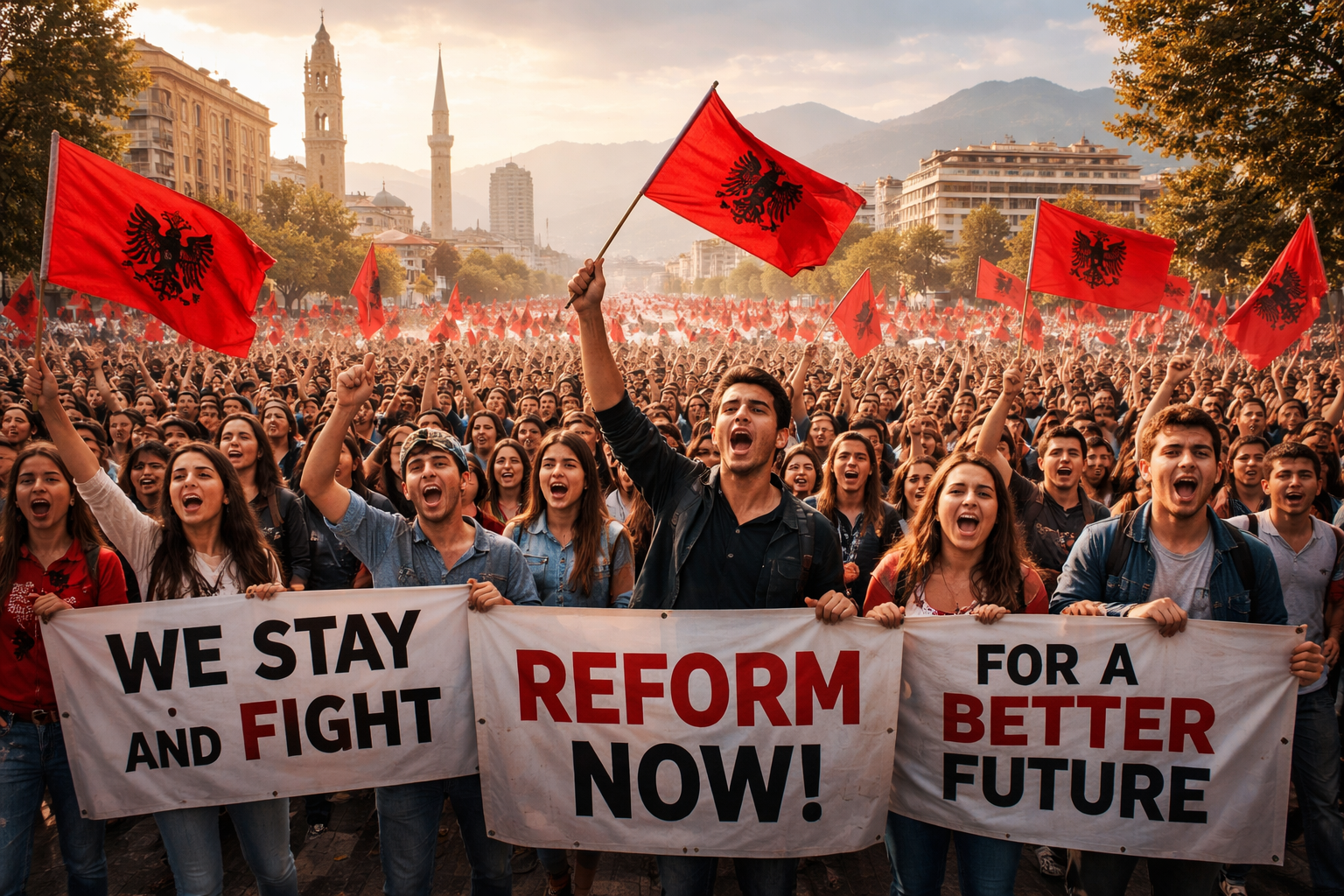
In a powerful symbolic act in mid-October, Albanian students in the capital city of Tirana set a suitcase ablaze and threw it into the courtyard of the Education Ministry. The gesture represented a dramatic break from a decades-long pattern where young Albanians, frustrated by political and economic conditions, opted to emigrate in search of better lives. According to the 2023 census, Albania’s population has contracted by nearly 15%—about 420,000 people—primarily due to emigration.
However, a growing youth movement known as the “Flamingo Revolution,” which began with protests in May against a controversial luxury resort linked to American figures Ivanka Trump and Jared Kushner, has evolved into a broader challenge against government corruption, the ruling Socialist Party, and the country’s entrenched political elite. Thousands have marched nearly every evening for months, demanding Prime Minister Edi Rama’s resignation, transitional governance, electoral reforms, and fresh elections, reflecting widespread disillusionment with Albania’s political system.
Escalating Protests and Government Response
Though largely peaceful for four months, tensions spiked on October 13 during a student demonstration that escalated into clashes with police. Security forces responded with tear gas, water cannons, and rubber bullets, resulting in hundreds of arrests and numerous injuries amid property damage. The protests maintain diverse political support and reject external influence claims made by the Prime Minister, emphasizing domestic grievances such as corruption, high living costs, and poor wages as core issues.
Political Context and Electoral Challenges
Albania’s political landscape has been dominated by two figures for more than two decades: Prime Minister Rama, leader of the Socialist Party since 2005, and Sali Berisha, longtime chairman of the Democratic Party. Since reforms implemented in 2008, party leaders significantly control parliamentary representation, weakening direct ties between lawmakers and citizens, and creating barriers for new political parties. Allegations of electoral fraud and unequal campaigning conditions cloud elections, with turnout under 45% in 2025 despite acknowledgments from the OSCE that the vote was professionally managed.
Economic Pressures and Youth Determined to Stay
The protesters voice frustrations with a system favoring politically connected businesses through public contracts and concessions, often neglecting broader societal needs like healthcare and education. With half of employees earning below roughly €620 per month after taxes, Albanians face economic hardships intensified by rising food prices and sharply increasing real estate and rent costs in the capital. For many young Albanians, protesting in the streets represents a deliberate political choice to forego the long-held path of emigration—where Albanian nationals in Germany more than doubled between 2018 and 2024—asserting their desire to remain and change the country from within.
EU Ambitions and the Road Ahead
Despite political turmoil, public support for European Union integration remains strong. Prime Minister Rama warns that his resignation could imperil Albania’s EU accession prospects targeted for 2030, but protesters view his administration as a significant barrier to this goal. While the situation echoes recent student-led movements in Serbia that unseated long-standing rulers, Albania’s future depends on whether the energized youth can translate street activism into sustained political engagement and voting power. The act of burning suitcases symbolizes a new chapter where Albania’s youth reclaim their voice and refuse to continue the cycle of migration driven by systemic failure.