

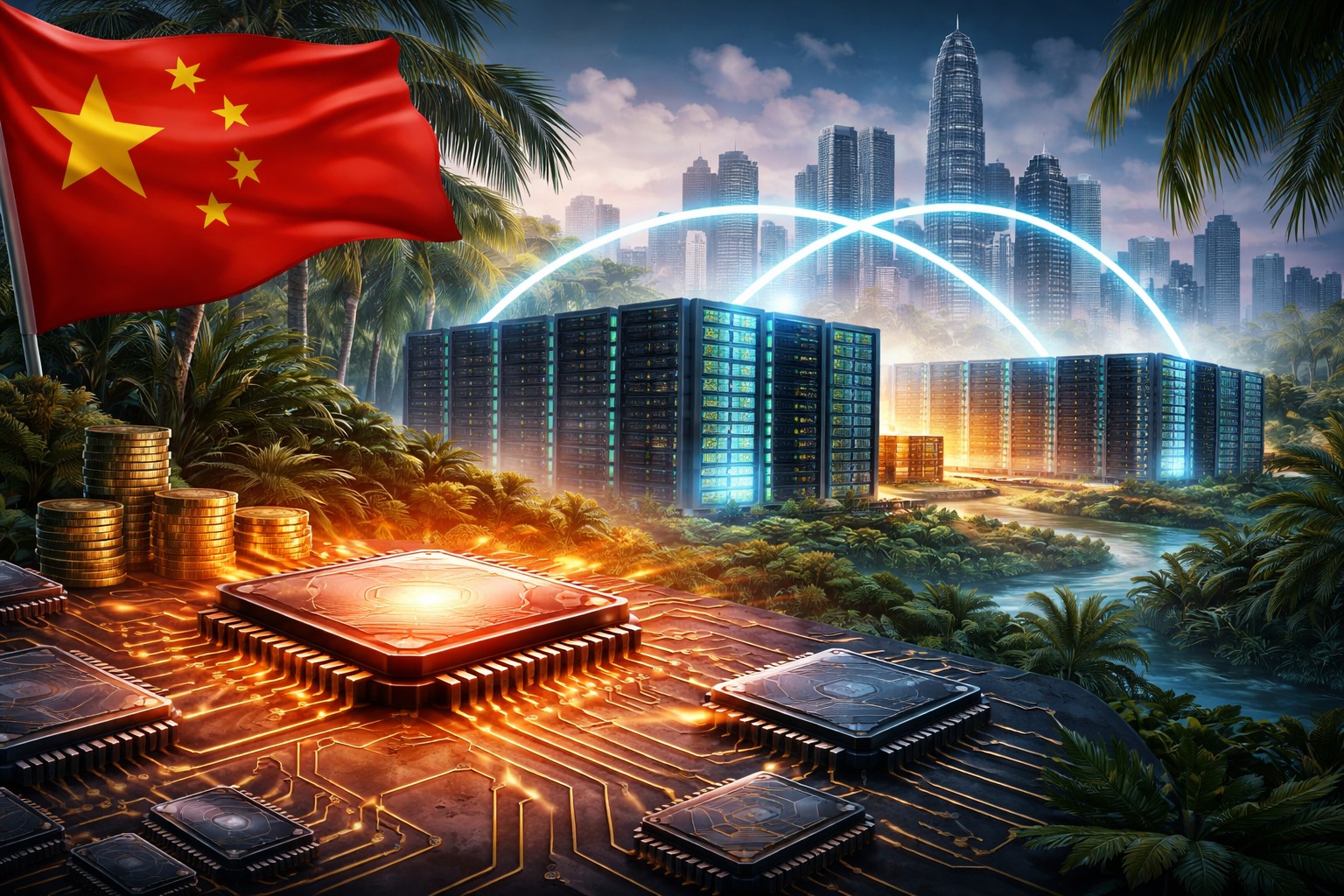
A growing number of Chinese companies are leveraging data centers in Southeast Asia, particularly Malaysia, to circumvent US restrictions on advanced semiconductor exports. This strategy enables them to remotely access powerful computing resources despite strict controls on high-performance chips and chip manufacturing technologies.
Since early 2025, Malaysia has seen investments exceeding €510 billion ($559 billion) in its digital infrastructure, driven by an expanding network of at least 125 data centers nationwide. The state of Johor alone hosts 16 of 27 new data centers, reflecting the country’s ambition to become a leading hub for computing power in the region.
US Tech Giants and Chinese Firms Invest Heavily in Malaysia
Major American tech companies including Amazon, Google, Microsoft, and Oracle have collectively invested billions of dollars in establishing data centers along the strategic Strait of Malacca, with Google’s parent company announcing an additional $15 billion investment recently. Concurrently, Chinese technology giants like Alibaba Cloud operate multiple centers in Malaysia, expanding their footprint with six data centers spread across Johor and the Kuala Lumpur region.
This infrastructure boom supports local employment, with Malaysian officials expecting up to 90% of new positions to be filled by residents. Besides competitive electricity rates favoring energy-intensive computing, Malaysia’s location provides strong connectivity through subsea international cables, making it an optimal setting for data centers serving global operations.
Remote Access to US Chips Enables Chinese AI Development
Chinese firms face export bans on cutting-edge US chips—such as Nvidia GPUs—and advanced manufacturing equipment from ASML in the Netherlands, complicating their development of advanced computing capabilities. To work around these restrictions, some companies legally rent time and capacity at overseas data centers, primarily in Southeast Asia, giving them indirect access to US technology.
Research by the Institute for Progress (IFP) indicates that already by late 2025, roughly 24% of Chinese computing power was sourced through remote overseas data center access, with about 75% of those centers in Southeast Asia. This proportion is projected to increase to 31% by 2027. However, precise quantification is difficult due to confidentiality by cloud providers and customer nondisclosure.
Regulatory Responses and Ongoing Challenges
In response to these dynamics, the US government has introduced tighter export controls and remote access rules targeted at data centers providing substantial computing resources to Chinese entities or other sanctioned countries. These measures include new licensing requirements for advanced semiconductors destined for several Southeast Asian countries, including Malaysia, Thailand, Singapore, and Indonesia, aimed at closing loopholes undermining US national security policies.
The US Department of Commerce’s Bureau of Industry and Security tightened regulations concurrently with international diplomatic engagements, signaling heightened vigilance over semiconductor technology flows. Malaysia has also taken steps to prevent illegal chip resale and transshipment by imposing licensing on sensitive exports, following US warnings about tariff threats.
Attempts to secure large-scale computing contracts, such as Tencent’s multi-billion-dollar agreement with Oracle, have stalled amid reported governmental pressures from both Beijing and Washington, reflecting the complex geopolitical tensions influencing the tech sector.
Implications for the Global Technology Landscape
The expansion of Southeast Asian data centers as hubs for Chinese computing needs illustrates the growing contest over advanced technology resources in the US-China rivalry. The ability of Chinese firms to remotely tap into US-origin chips complicates enforcement of export restrictions and intensifies the strategic competition for technological supremacy, particularly in artificial intelligence development.
Malaysia’s ambitions to become a creative AI economy and a major digital power player intersect with these geopolitical dynamics, underscoring the region’s increasing importance as a digital backbone for both Western and Chinese technology companies.