

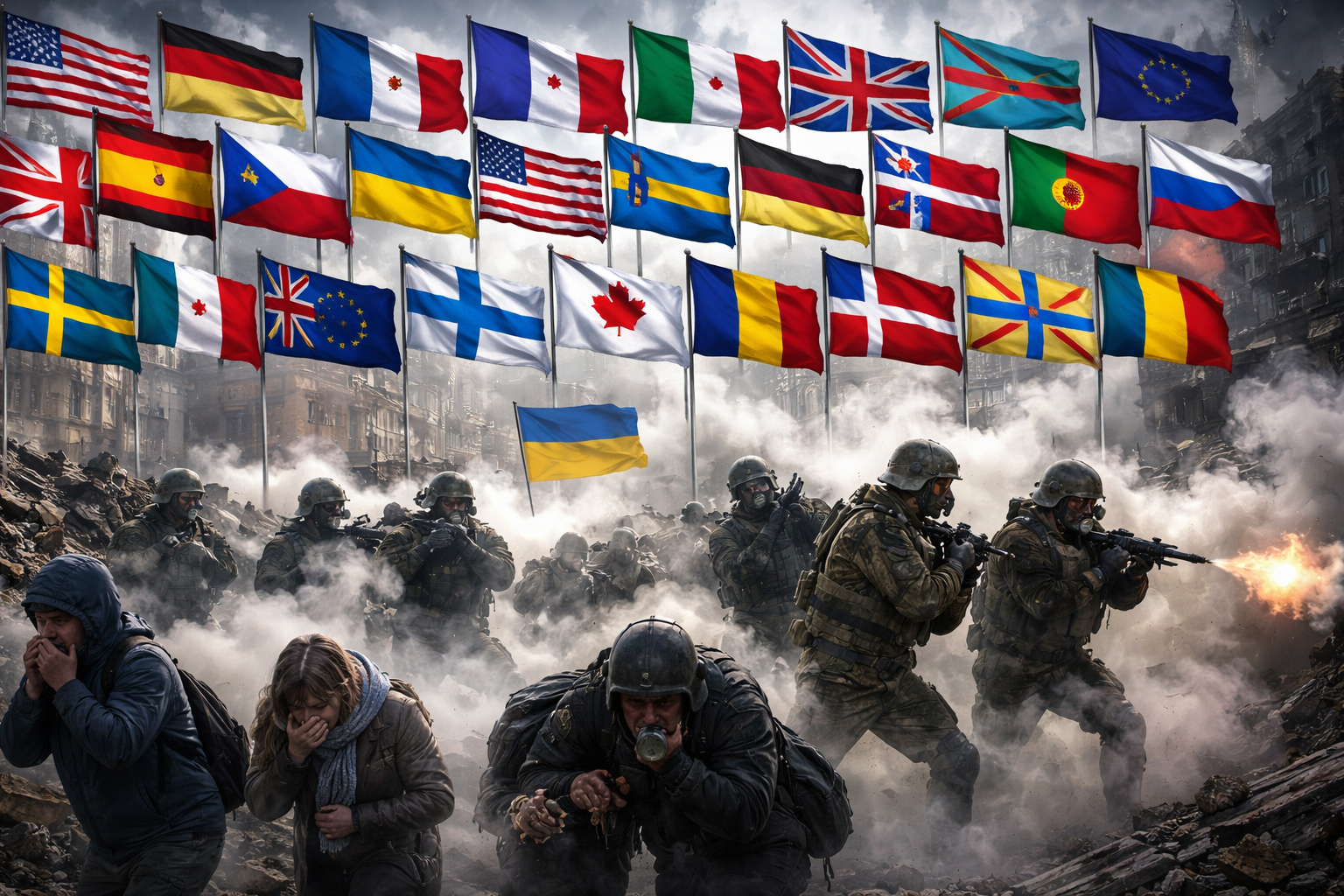
Officials from 34 countries and the European Union have jointly called on Russia to stop deploying riot-control gases, including teargas, in the ongoing conflict in Ukraine. This appeal follows confirmation by the Organisation for the Prohibition of Chemical Weapons (OPCW) that samples collected from a trench hit by a Russian grenade contained traces of riot-control chemicals.
The joint statement came as the OPCW convened in The Hague, amid Ukraine’s report distributed to 193 countries detailing more than 14,000 documented instances since 2022 of Russian munitions containing riot-control agents and toxic substances on the frontline. Laboratories accredited by the OPCW verified the presence of the chemical CS, a common form of tear gas, in samples from the site.
International Response and Claims
The use of riot-control agents like CS in warfare is prohibited under international law. Representatives from Britain, France, Germany, Japan, New Zealand, and the EU urged the immediate cessation of such chemical weapons in Ukraine. Western intelligence sources had previously reported that Russian forces used riot-control agents to force Ukrainian troops out of trenches, making them vulnerable to attack. Russia has denied these allegations and accused Ukraine of employing illegal munitions instead.
Recent Developments on the Battlefield
In related conflict updates, a drone attack on a car park in the Russian-occupied part of Ukraine’s Zaporizhzhia region reportedly killed at least five people and injured three. In Russian territory, debris from downed drones caused a fire in an industrial zone in the Bashkortostan region.
Russian forces conducted a significant overnight strike targeting military-industrial sites in Kyiv, including a shopping center and other buildings, injuring three individuals. Ukrainian officials reported a successful strike on the Savasleyka airbase in Russia’s Nizhny Novgorod region, damaging five military aircraft used in attacks against Ukraine.
Political Reactions and Security Measures
German Chancellor Friedrich Merz criticized Russia’s escalating threats to European security during a Bundestag address, emphasizing the necessity of maintaining defense spending and financial support to Ukraine despite opposition. Meanwhile, U.S. envoy Jared Kushner warned of potential escalation due to miscalculations in what he referred to as a proxy war supported by European aid to Ukraine.
Poland announced plans to establish a no-fly zone near its border with Ukraine following several unauthorized airspace incursions attributed to Russia, a measure intended to enable rapid identification and neutralization of Russian military aircraft threats.
Winter Preparations and Humanitarian Efforts
Russian authorities highlighted preparations to counter Ukrainian drone attacks on critical infrastructure during the winter, particularly in border areas. On the humanitarian front, nine more Ukrainian children have been reunited with their families amid the conflict, totaling 43 reunifications driven by an initiative involving former U.S. first lady Melania Trump, the White House, and Russian cooperation. Ukrainian authorities have yet to comment on the program.