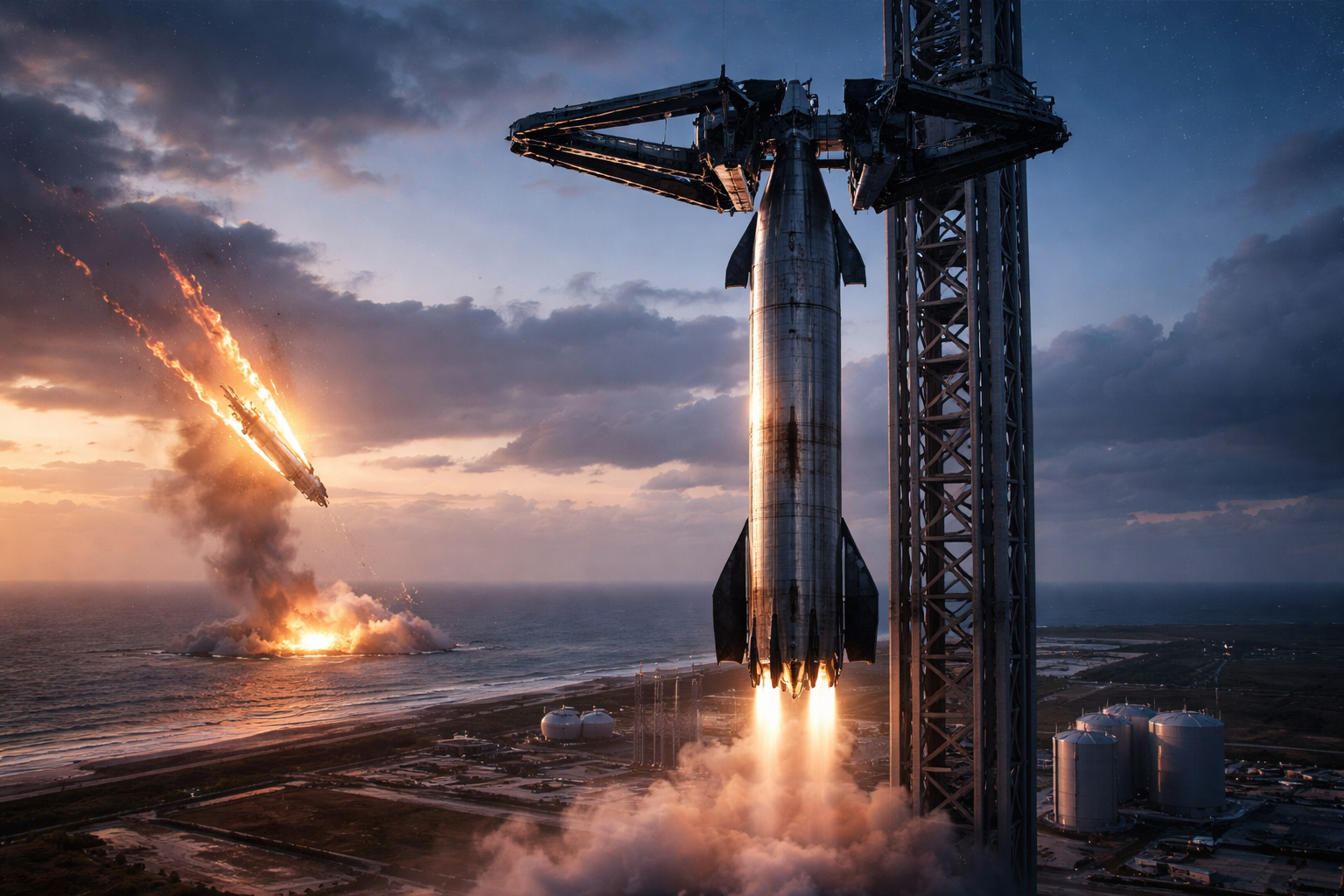
SpaceX achieved a significant milestone by successfully capturing its Starship spacecraft as it returned from its longest orbital flight to date. The spacecraft made a controlled descent, slipping between the mechanical chopstick arms above Launch Pad 2 in Texas, completing over 14 orbits of Earth and deploying 26 Starlink satellites during more than 22 hours in space.
This marks the 15th test flight of Starship, one of the world’s largest and most powerful rocket systems, and represents a major step toward SpaceX’s goal of developing a fully reusable spaceship. However, the mission faced a setback when the Super Heavy booster stage was lost after an aborted recovery attempt led to its self-destruction over the Gulf of Mexico shortly after launch.
NASA has expressed enthusiasm regarding this development, as it plans to use Starship for lunar missions and establishing a permanent base on the moon. Administrator Jared Isaacman described the spacecraft’s return as almost magical, highlighting its importance for Artemis astronauts slated to land on the moon later this decade.
Starship’s Orbital Flight and Recovery
Starship orbited Earth 14 times, successfully deploying a batch of Starlink satellites integral to SpaceX’s satellite internet business. The spacecraft returned to its launch tower by descending precisely between two robotic arms designed to catch and secure the vehicle, a first critical recovery for the system’s centerpiece vessel in the company’s decade-long reusable rocket development.
Booster Stage Failure
The booster, known as Super Heavy, experienced engine shutdown earlier than planned during descent. According to SpaceX’s Kate Tice, the booster’s guidance system detected incorrect positioning and triggered the self-destruct protocol as a safety measure. Investigations into the precise cause remain ongoing.
Implications for SpaceX and NASA
This successful recovery of Starship’s upper stage advances SpaceX’s plans for human spaceflight beyond Earth orbit, including missions to the Moon and Mars envisioned by Elon Musk. NASA’s ongoing collaboration with SpaceX involves substantial funding for Starship’s role in future Artemis moon landings and lunar infrastructure development.