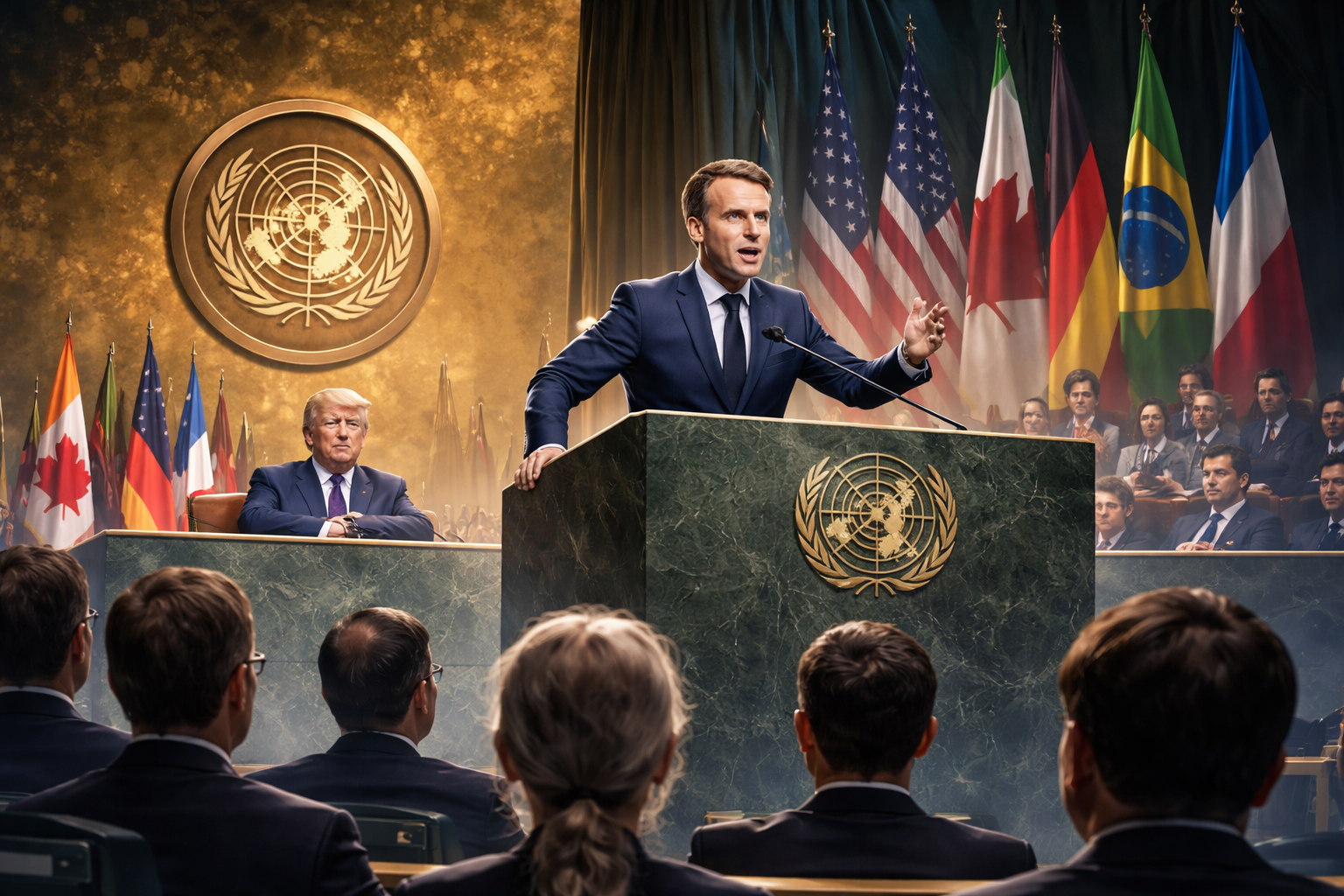
At the United Nations General Assembly’s opening, a clear divide emerged between Donald Trump’s confrontational vision and Emmanuel Macron’s defense of a rules-based international system. Trump’s speech echoed past rhetoric, marked by military threats and unilateral assertions of U.S. dominance, including disturbing remarks about potentially “annihilating the Islamic Republic” in ongoing conflict.
Macron’s address, delivered hours later, presented an alternative vision emphasizing international law and cooperation. He criticized acts of barbarism and rejected the notion that might makes right, implicitly questioning the unilateral and aggressive posture championed by Trump. Macron underscored the West’s historic double standards in respecting sovereignty, highlighting the imbalance between European respect and disregard elsewhere.
Emergence of Middle Powers Defending International Norms
Macron has long been a rare voice among Western leaders advocating for European strategic autonomy and a strengthened multilateral order. Despite domestic challenges and geopolitical shifts—including Brexit and leadership changes in European allies—he maintained this line of defense throughout his tenure.
This final UN speech, preceding his scheduled departure from office, catalyzed other so-called middle powers to publicly support the principles Macron enshrined. Leaders from Australia and Spain, among others, echoed his concerns about protecting the UN mission from domination by great powers alone and resisting political actors intent on regressing to a more lawless past.
New Alliances and Initiatives Reflecting a Values-Based Approach
In the aftermath of the speech, middle powers have begun to form new alliances driven by shared values rather than traditional geopolitical ties. Discussions within the EU and between Canada have explored “associate memberships” to strengthen cooperation. The UK has also helped establish a coalition to impose sanctions targeting Israel’s occupation of the West Bank.
Remarkably, Finland and Norway launched an international initiative at the UN to oversee AI model safety, directly challenging Trump’s dismissive stance on AI risks. Twenty-seven leaders, including Macron, joined this effort, signaling a collective commitment to global governance on emerging technologies.
Challenges Ahead for Middle Powers
This growing movement, described as “values-based realism,” acknowledges that the new global order is fragmenting into overlapping coalitions of like-minded states. Middle powers now face the delicate balance of when to confront and when to engage cautiously, a strategic calculus made more complex by Trump’s influence and the question of Russia’s role in forums like the G20.
Macron’s final UN speech may have planted a lasting seed—encouraging smaller and medium-sized nations to assert themselves as guardians of international law and multilateralism amid disruptive global tides.