

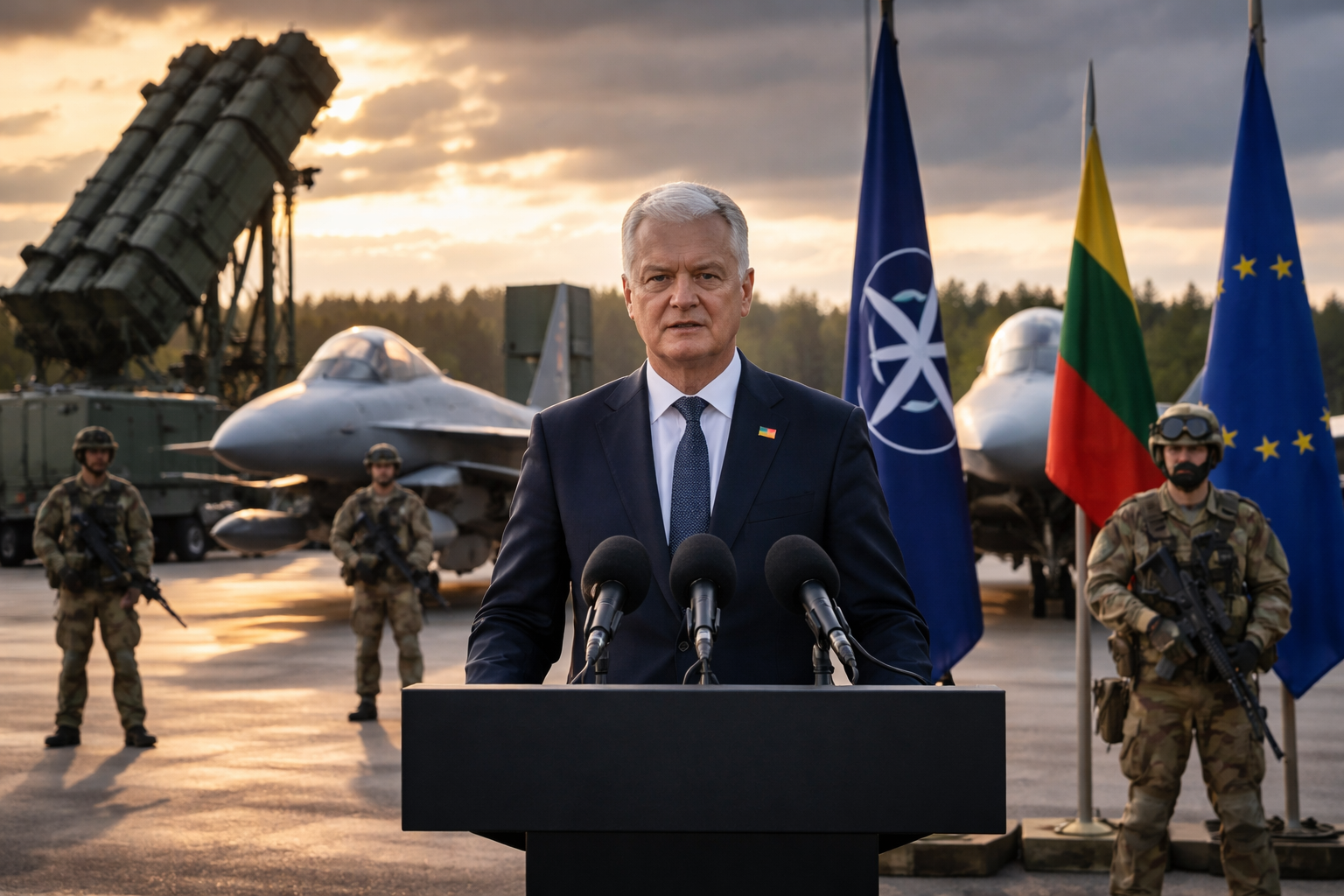
The Lithuanian prime minister has stressed the importance of strengthening NATO’s air defense systems, emphasizing that Lithuania’s airspace is crucial for the alliance’s overall security. Positioned on NATO’s eastern border adjacent to Belarus and Russia’s Kaliningrad region, Lithuania faces increased security challenges following Russia’s large-scale invasion of Ukraine in early 2022.
Mindaugas Sinkevicius, serving as Lithuania’s prime minister and leader of the Social Democratic Party, expressed concern over the growing insecurity across Europe, fueled by incidents involving drones, weaponized migration, and unauthorized aerial balloons entering Lithuanian territory from Belarus. While he acknowledged NATO’s collective defense principle, he highlighted that individual member states must also bolster their own deterrence capabilities.
Priority on Air Defense and Regional Cooperation
Sinkevicius identified air defense as Lithuania’s most urgent security priority, asserting that protecting Lithuanian skies equates to protecting NATO airspace. He noted that drone-related incidents have affected not only Lithuania but other European countries as well, underscoring the transnational nature of the threat.
To confront these challenges, Lithuania seeks deeper solidarity and support from its NATO allies but insists on contributing actively rather than relying solely on partnerships. Cooperation within the Nordic-Baltic Eight (NB8), a regional framework linking Northern European and Baltic countries, was also highlighted as a key element for enhancing defense efforts.
Balancing Defense and Social Cohesion
The prime minister challenged the notion that military advances must trade off between traditional equipment like tanks and newer technologies such as drones, advocating for the integration of both. However, he emphasized that military hardware alone cannot guarantee security without a societal sense of safety and connection to the state.
Drawing a link between national security and social policy, Sinkevicius argued that supporting vulnerable populations, including the unemployed and ill, is essential for maintaining societal resilience. This approach reflects a shift in the political landscape, where center-left parties, traditionally focused on social issues, now prioritize defense amid heightened geopolitical tensions.
Continued Support for Ukraine
Demonstrating Lithuania’s commitment to regional stability, Sinkevicius recently visited Kyiv and Lutsk to meet with Ukrainian leaders. Lithuania has pledged to allocate at least 0.25% of its GDP annually to aid Ukraine, with recent support estimated at around 0.3% of the GDP. Despite signs of war fatigue in Europe, he called for sustained Western support, particularly from countries like Germany, cautioning that weakened backing on the Western front could jeopardize efforts to resist Russian advances on the Eastern front.