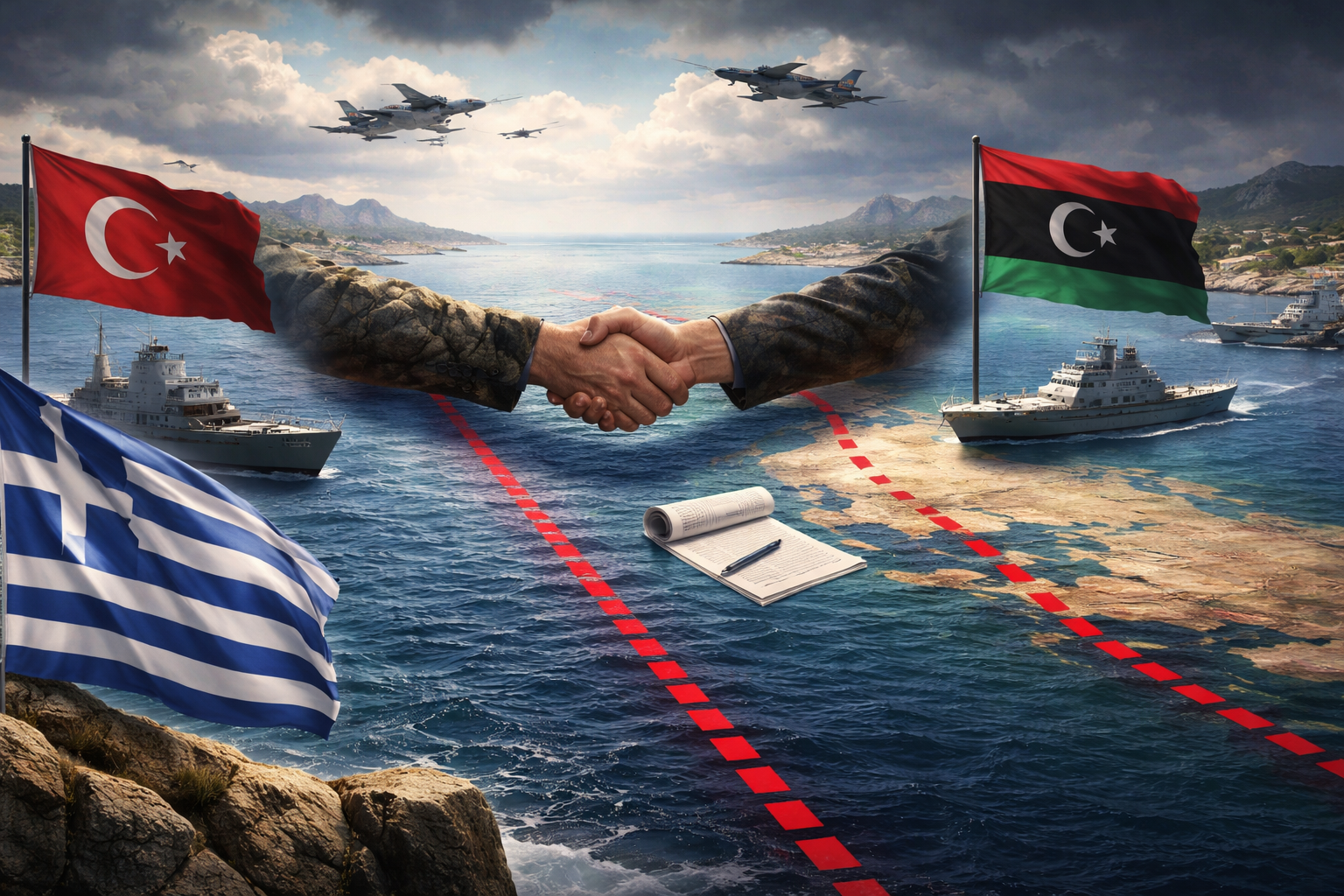
Greece has strongly rejected a newly approved maritime agreement between Turkey and Libya that establishes a direct economic corridor in the eastern Mediterranean. The deal, unanimously endorsed by Libya’s eastern parliament on Tuesday, shifts the regional dynamic by extending Turkey’s maritime claims southward toward Libya’s northern coast, bypassing key Greek islands.
The Turkish-Libyan accord, originally negotiated in 2019 with Libya’s UN-recognized western government, aims to secure energy rights to large oil and gas deposits estimated to be worth several hundred billion US dollars. Despite initial opposition from Libya’s eastern authorities, the parliament’s recent backing signals a political realignment and potential expansion of Turkey’s role in Mediterranean geopolitics.
Greece and the European Union Condemn the Agreement
The Greek government insists it holds an exclusive economic zone surrounding the islands of Crete, Karpathos, and Rhodes under international maritime law, specifically referencing the United Nations Convention on the Law of the Sea (UNCLOS). It issued a statement affirming rejection of the maritime deal and highlighted European Union support, noting the agreement violates the sovereign rights of third countries and contradicts established maritime law.
Kaja Kallas, the EU high representative for foreign affairs and security policy, echoed this position on social media, emphasizing that the deal infringes upon the rights of third states in the region.
Dispute Over Maritime Boundaries and Legal Frameworks
The core of the contention lies in conflicting interpretations of maritime boundaries. Greece bases its claims on Article 121 of the UNCLOS, which grants islands the right to their own economic zones if they support an economic life. Turkey, which has not ratified UNCLOS, argues that granting full maritime zones to small Greek islands would severely restrict its access to open sea routes and demands that geographical realities be factored into boundary delimitation. This disagreement has prevented resolution through UN arbitration or international adjudication.
Turkey’s Growing Influence in Libya and Eastern Mediterranean Tensions
Turkey’s engagement in Libya has evolved since 2019. Initially supporting the western government militarily in Libya’s civil conflict, Turkey now has fostered ties with eastern Libyan factions, including General Khalifa Hifter’s camp. The new maritime agreement could enhance Hifter’s influence and secure eastern Libya’s stake in resource development plans.
Beyond energy cooperation, Turkish companies have obtained extensive reconstruction contracts in Libya, while Turkish state oil entities collaborate with Libyan counterparts on exploration. Turkey’s expanding military and economic presence challenges other regional players such as Egypt and Russia.
This deal also threatens the EastMed pipeline project, intended to channel natural gas from Israel and Cyprus to Europe via Greece. The Turkish-Libyan corridor crosses the pipeline’s proposed route, and Turkey insists projects in the disputed maritime areas require its approval, adding complexity to regional energy security prospects.
The new alignment suggests an emerging division in the eastern Mediterranean, possibly pitting a Turkey-Libya axis against an EU-backed coalition of Greece, Cyprus, Egypt, and Israel, heightening prospects for further disputes over maritime boundaries and resource exploitation.