

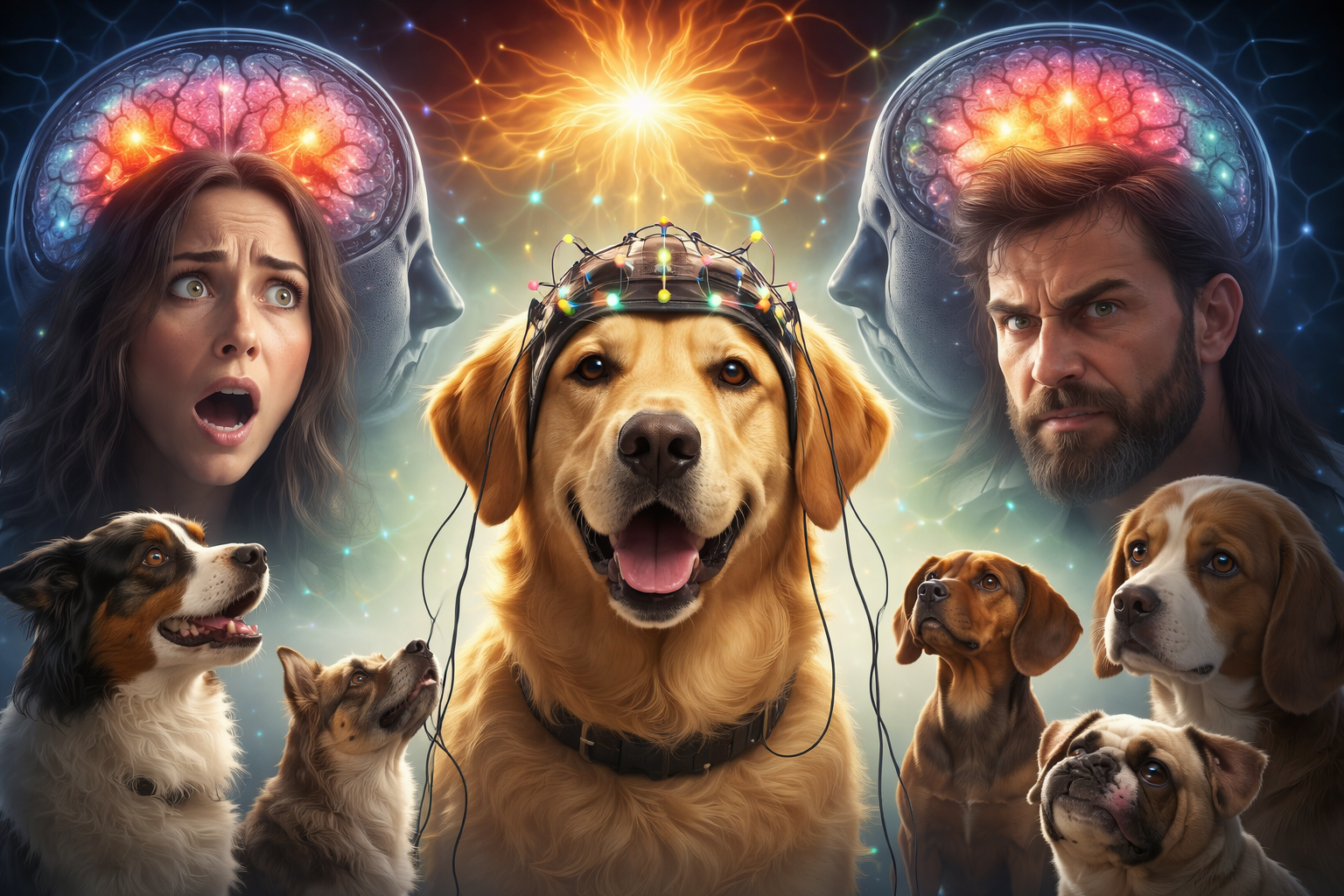
New research shows dog brains can differentiate fearful, angry, and sad human facial expressions, expanding understanding of canine social perception
Dogs have long been known for their ability to connect emotionally with humans and respond to our expressions. Now, new brain imaging research provides clear evidence that dogs not only recognize happy faces but can also distinguish between different types of negative human emotions such as fear, anger, and sadness.
This discovery sheds light on the sophisticated social awareness dogs have developed through domestication. Understanding these subtle emotional cues helps explain how dogs read and react to human behavior in everyday interactions.
The findings come from a study where researchers used MRI scans to track brain activity in dogs presented with various human facial expressions, revealing distinct neural responses linked to specific emotions, as reported by the University of Vienna research team.
Dog brain activity reveals complex emotional processing
According to Dr. Laura Cuaya, co-author of the study, earlier behavioral research showed dogs could distinguish some facial expressions, but those studies generally focused on one positive and one negative expression at a time. This new study goes further by demonstrating dogs’ brains differentiate between several negative emotions, such as fear and anger or sadness.
The research involved training pet dogs to remain still inside an MRI scanner while viewing images of unfamiliar humans displaying happy, neutral, fearful, angry, or sad faces. The brain scans showed increased activity in areas associated with visual, social, and reward processing, especially in response to happy faces, suggesting dogs perceive happiness as positive and rewarding.
Machine learning decodes dogs’ perception of human emotions
The team applied machine learning to analyze brain activity patterns in the dogs, confirming the dogs could clearly distinguish happy faces from negative ones. However, initial analyses found difficulty telling some negative faces apart. When observing the whole brain, dogs could differentiate between fearful and sad faces, as well as fearful and angry faces, though they struggled to distinguish angry from sad faces.
Researcher Dr. Raúl Hernández explained these results might indicate that different negative facial expressions signal distinct types of threats to dogs, triggering varied brain responses. The study also suggests dogs might rely on additional cues like human body language to interpret emotions fully.
Implications for human-dog relationships and training
Dr. Cuaya highlighted practical implications for dog training, noting that expressing happiness could enhance dogs’ learning experiences by engaging their brain’s reward pathways. This aligns with the idea that dogs are attuned to positive social signals and the emotional states of their human companions.
Not involved in the study, Professor Bridget Waller from Nottingham Trent University described the research as fascinating, noting it illustrates how dogs have evolved to understand human social behavior. She commented, “Smiling is the most commonly used human facial expression, vital to our social interactions, and so it makes sense that dogs have developed a particular ability to distinguish this from other facial movements.” Waller also pointed out that less frequent negative expressions are harder for dogs to differentiate, which aligns logically with their social exposure.
Study limitations and future directions
The researchers acknowledge limitations such as the small sample size, the predominance of border collies in the group, and that all dogs were healthy without behavioral problems. Future studies could explore a wider variety of breeds and incorporate additional types of emotional cues to deepen understanding of canine emotional perception.
This research offers compelling evidence that dogs’ brains process human emotional expressions with remarkable nuance and complexity, illuminating the depth of the bond between humans and their canine companions.