
For decades, global health efforts to control malaria have concentrated largely on West and Central Africa, where the disease causes the most illness and death. These regions have typically experienced stable conditions ideal for the malaria parasite Plasmodium falciparum to thrive, transmitted by Anopheles mosquitoes. According to data for the WHO African Region, about 95% of global malaria cases and deaths occur here, with Nigeria, the Democratic Republic of Congo, and Niger bearing the heaviest burden. Children under five account for roughly 76% of these deaths.
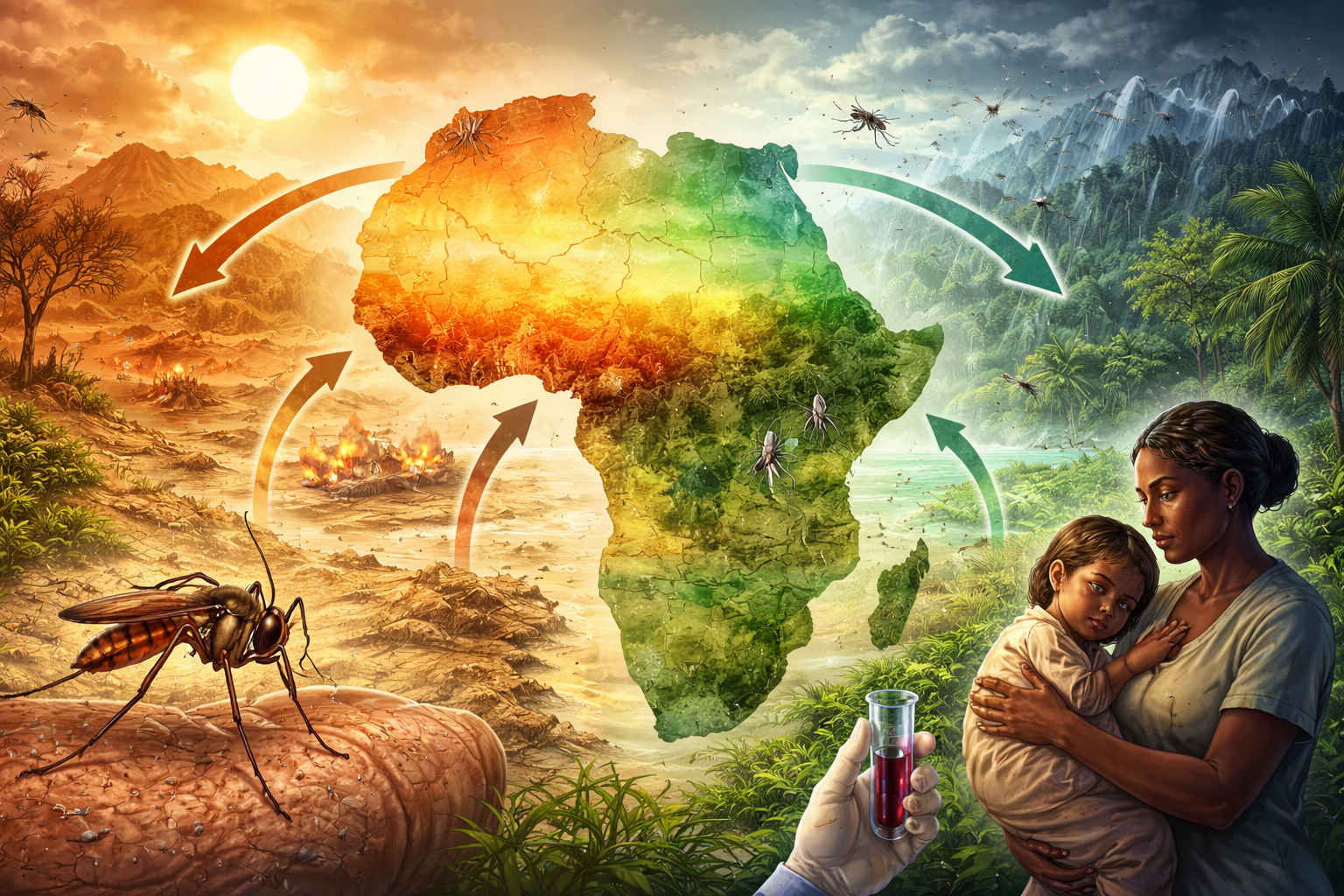
However, climate change is reshaping this landscape. A study published in Nature reveals that rising temperatures are making southern Africa and high-elevation areas of East Africa more hospitable to malaria transmission, while some parts of West Africa may become too hot for optimal parasite development. These shifts threaten to undermine decades of progress in regions that historically experienced lower malaria risk.
Temperature’s Role in Malaria Transmission
Malaria transmission is highly temperature-dependent. The parasite requires a certain temperature range to complete its life cycle inside mosquitoes. Transmission peaks near 25°C (77°F) and drops significantly when temperatures fall below 16°C (61°F) or exceed 34°C (93°F). Traditionally, West and Central Africa’s tropical climates have supported sustained transmission, while cooler areas in southern and eastern Africa have been less affected.
New Risks and Regional Differences
The changing climate is creating a complex pattern of malaria risk across the continent. According to experts like Olugbenga Mokuolu, a professor of pediatrics in Nigeria, while West African countries may see reduced transmission due to higher heat, this is not necessarily positive for overall child health. The increasing temperatures pose broader health dangers, and malaria remains primarily driven by factors like funding, drug and insecticide resistance, and healthcare capacity.
Meanwhile, East and southern Africa, traditionally less affected by malaria, now face a rising threat. This shift demands proactive adaptation from governments and health systems to prepare for more aggressive malaria control programs in these emerging risk areas.
Challenges for African Health Systems
Olumide Idowu, founder of the International Climate Change Development Initiative, highlights that although many African nations have climate adaptation plans, implementation lags behind the pace of environmental change. Africa’s minimal greenhouse gas emissions contrast sharply with its high vulnerability to climate impacts, which threaten economies, infrastructure, and fragile health systems.
Experts warn that without urgent investment, reinforcement of institutional capacity, and integrating health into climate resilience strategies, many countries will be unprepared for shifting malaria patterns. Sustaining malaria prevention in West and Central Africa remains critical, as ongoing challenges like resistance and funding gaps could negate any gains linked to temperature changes.
Global Health Context
In response to the persistent threat, global health organizations recommend expanding the use of the RTS,S/AS01 malaria vaccine among children in moderate to high transmission areas. This vaccine has shown a 13.2% reduction in all-cause mortality among children in pilot programs in Ghana, Kenya, and Malawi. However, recent funding cuts pose risks to malaria control efforts, with many malaria-endemic countries reporting service disruptions.
As climate change continues to alter the distribution and intensity of malaria, sustained international and local efforts will be essential to adapt strategies and protect vulnerable populations across Africa.