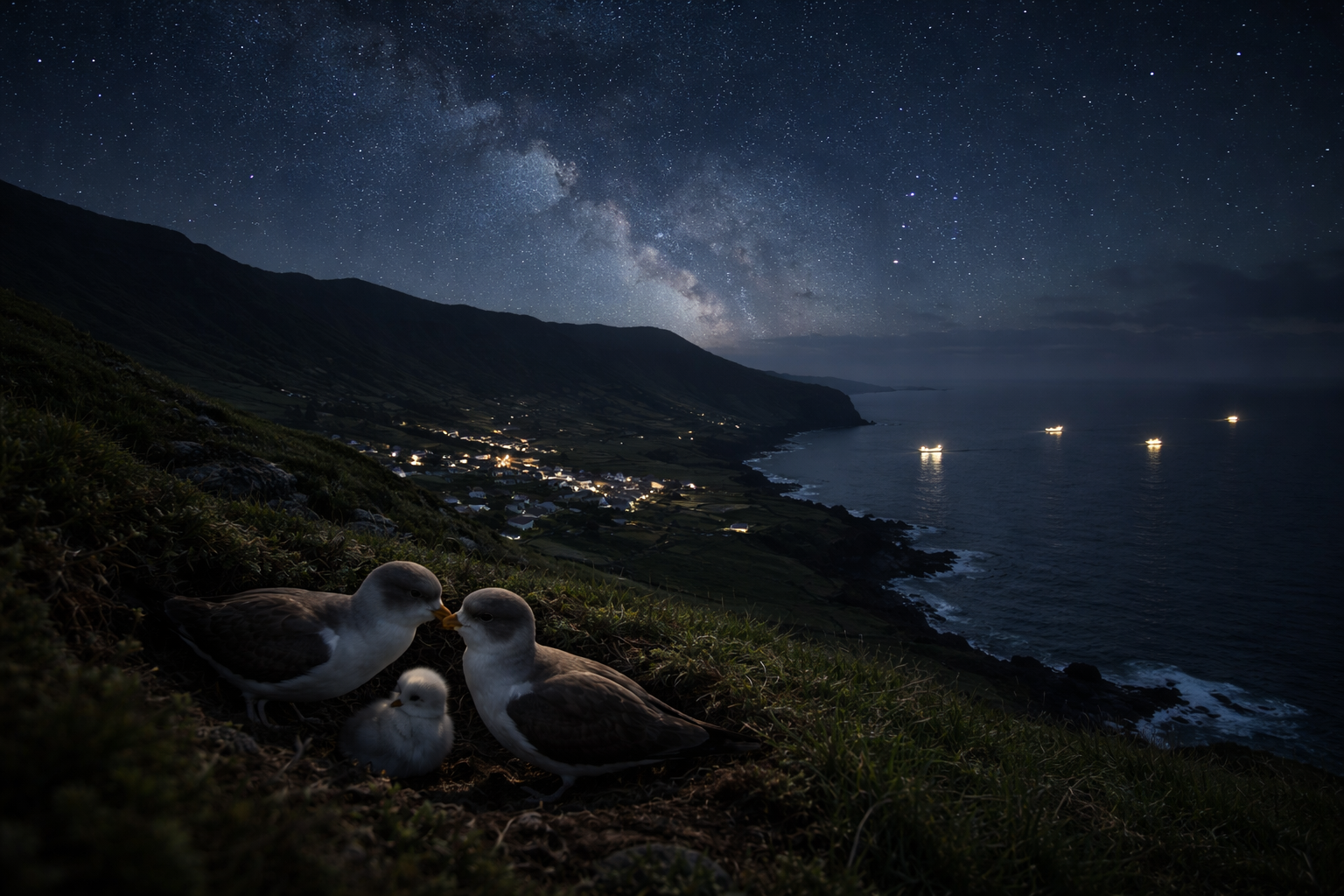
Corvo, the smallest and northernmost island of Portugal’s Azores, has adopted a unique conservation effort since 2019: turning off all artificial public lighting for five nights every fall. This blackout aims to protect the Cory’s shearwater, a seabird native to the Atlantic Ocean, by reducing mortality among its fledglings, who are disoriented by urban lights as they leave their nests to reach the ocean.
The problem was first noticed in 1991, when residents observed alarming numbers of young shearwaters dying. These birds rely on starlight to navigate during their initial flight to the ocean after spending about three months in their nests. Artificial lighting in the village of Vila do Corvo confuses the juveniles, causing them to collide with structures and streets, often leading to fatal injuries.
Community and Government Initiatives
Local volunteers began nighttime rescues of stranded birds, walking through the darkened village to collect them. This grassroots effort inspired broader action, leading to the Azorean government’s 1995 launch of the “SOS Cagarro” campaign, which expanded protections to all nine islands in the archipelago. The Portuguese Society for the Study of Birds (SPEA) also joined the initiative, helping strengthen the program’s reach and effectiveness.
Ongoing Impact and Conservation Significance
Today, Corvo remains the only island that enforces a total blackout of public lighting for the benefit of wildlife. When the lights go out, the sky reveals a clear view of stars, allowing the young shearwaters to navigate safely towards the ocean. Villagers then rescue any fallen birds, keeping them overnight in cardboard boxes before releasing them from cliffs near the sea, improving their survival chances.
Since 2015, over 30,000 Cory’s shearwater fledglings have been rescued across the Azores, with some 6,000 saved on Corvo alone. This coordinated effort exemplifies how reducing light pollution can restore ecological balance and demonstrate the potential for human coexistence with natural rhythms.
A Model for Global Reflection
The lights-out initiative on Corvo highlights the importance of community involvement and education in wildlife conservation. It shows that simple, local actions can have significant impacts on preserving biodiversity and mitigating unintended harms caused by artificial lighting.