

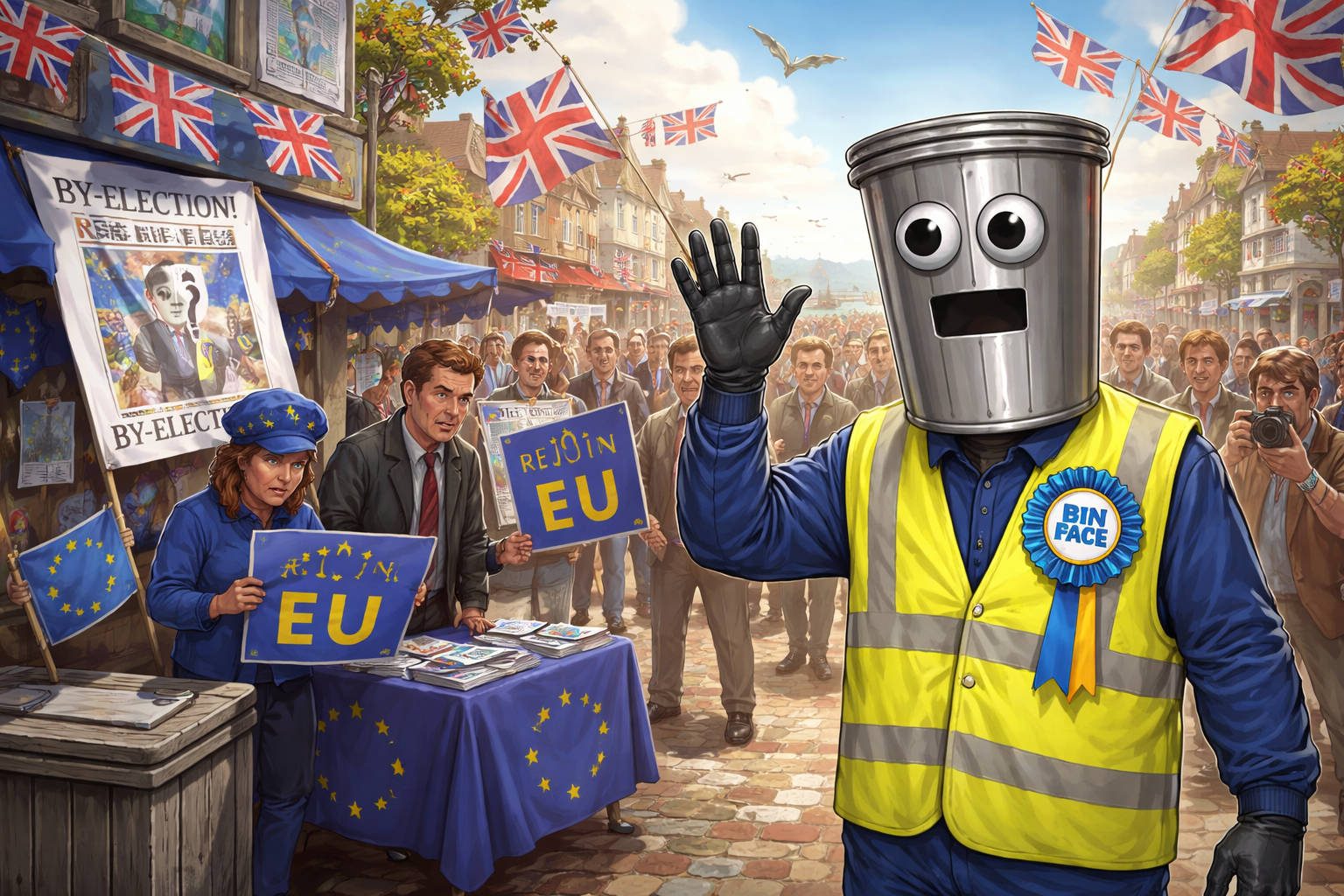
Examining the UK pro-Europeans’ strategy as a satirical bin candidate overshadows a serious pro-EU campaign in the Clacton by-election, revealing deep divisions and challenges
The upcoming Clacton by-election has sparked an unusual political spectacle. Amid Nigel Farage’s anticipated victory in his former safe seat, a satirical candidate known as Count Binface has gained widespread media attention, overshadowing a more earnest pro-European contender. This unusual dynamic exposes the difficulties within the UK’s pro-European camp in making their case publicly.
Voters in Clacton are confronted with a choice not just between candidates, but between different forms of opposition to Farage and Brexit. While many outside Essex back the humor of Binface, within the constituency a significant number appear uncomfortable with reducing democratic engagement to satire.
According to reports by journalist Simon Nixon, this divide points to much more than just a quirky campaign. It suggests broader questions about the strength and visibility of the pro-European movement in the UK today.
Source: Reporting by Simon Nixon.
Farage vs. The Bin: A Media-Driven Contest?
Media and political commentators have largely framed the by-election as a showdown between Nigel Farage and Count Binface, whose campaign is rooted in political satire. This is amplified by notable figures like Alastair Campbell and Rory Stewart, who granted Binface high-profile media attention including a BBC Radio 4 podcast. While this has created a spectacle, it may not reflect the true sentiments of many local voters.
The emphasis on a joke candidate risks trivializing the democratic process in Clacton, reducing serious political discourse to entertainment. An Ipsos poll cited in the analysis reveals that only 25% of UK voters nationally view joke candidates positively, and this drops to 13% among Conservative voters, which is significant given Clacton’s historical Tory backing.
A Serious Alternative: John Stevens and the Rejoin EU Campaign
Contrasting the Binface campaign is John Stevens of the Rejoin EU party, a former Conservative MEP and dedicated pro-European. Stevens is running a grounded and organized campaign, actively engaging communities across Clacton and nearby areas such as Frinton-on-Sea. His team’s door-to-door leaflet campaigning reflects a serious effort to mobilize voters who oppose Farage and Brexit but are hesitant to support a satirical candidate.
Stevens’s presence challenges the assumption that all opposition to Farage must be channeled through protest or humor. Instead, he offers a legitimate voice to those uneasy with Brexit’s aftermath and looking for policy-driven change, despite uncertainties about the cost or logistics of rejoining the EU.
Pro-Europeans’ Internal Divisions and the Hidden Message
Ironically, Stevens’ earnest campaign faces criticism from fellow pro-Europeans who fear vote splitting could hand victory more easily to Farage. Many prominent pro-Europeans publicly ignore or privately admonish Stevens for running independently rather than throwing unified support behind Binface’s media-friendly protest.
This division underscores a deeper hesitation within the UK’s pro-European cause to openly present a clear, confident argument for reversing Brexit. Politicians like Andy Burnham offer vague or noncommittal EU policies, while Liberal Democrats propose compromises that struggle to satisfy the more dedicated pro-EU voters.
When a serious pro-European campaign risks being sidelined behind a satirical facade, it raises questions about how effectively the movement can influence public opinion or shift political discourse, especially in Brexit heartlands like Clacton.
The Stakes for Clacton and Beyond
With prominent Reform UK placards already displayed in Clacton, Nigel Farage’s win appears inevitable. Yet a strong showing by Rejoin EU, even in defeat, would send a clearer, more constructive signal to Westminster than a joke candidacy. It would demonstrate that opposition to Brexit and Farage exists on serious political grounds, not mere satire.
Without this, the protest vote risk becoming a fleeting media moment, quickly forgotten after the election, leaving the broader issues unresolved. As Nixon concludes, the political joke might only last 24 hours, but the consequences of marginalizing genuine political debate linger far longer.
Ultimately, the Clacton by-election reveals a telling truth about the UK’s pro-European movement – a cause that struggles to make its voice heard when it hides behind humor instead of embracing bold, serious advocacy.