
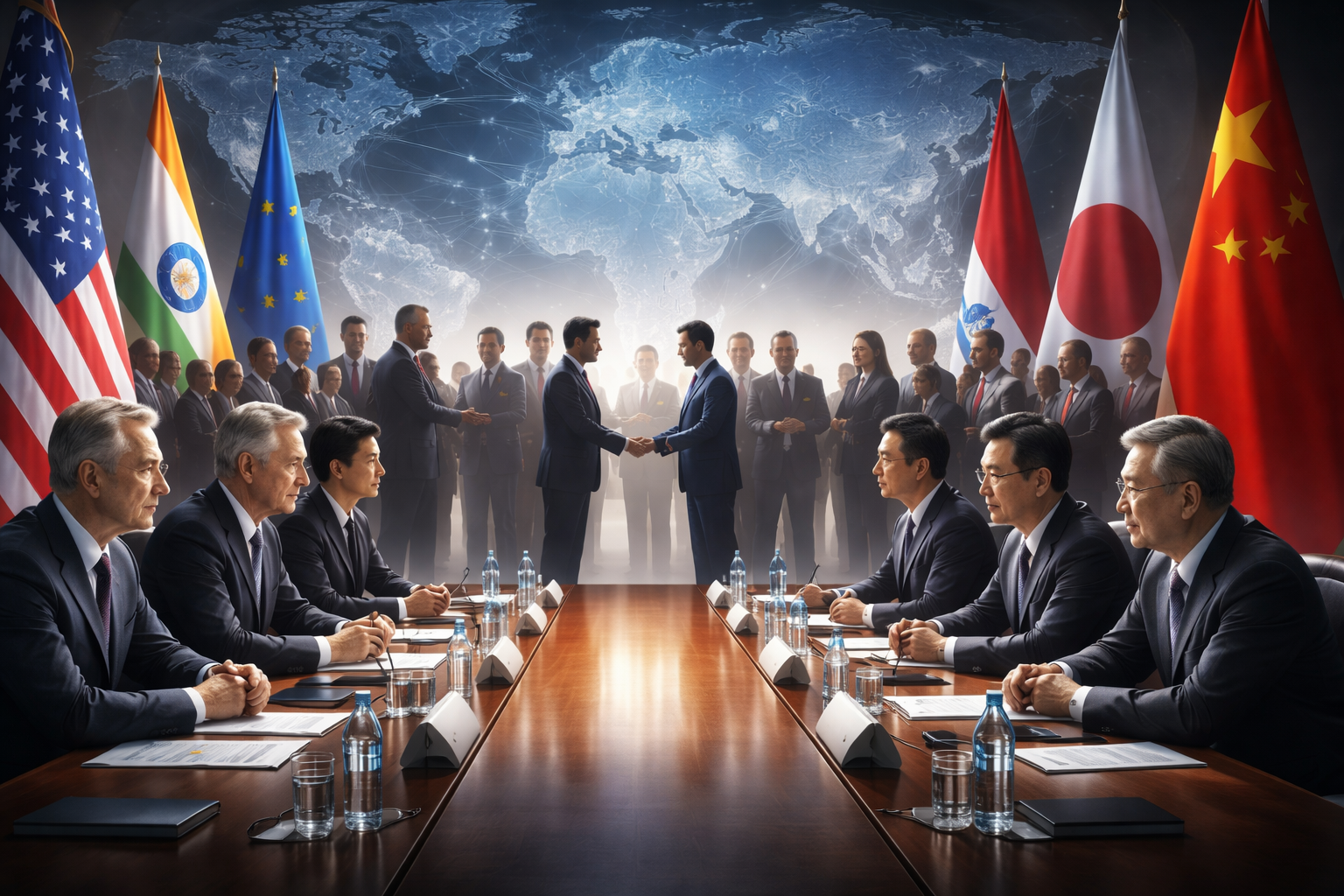
The renewed economic dialogue between the US and China in Washington underscores a strategic stalemate, as both powers seek to hold each other in check while middle powers jostle to redefine their positions on the global stage. Discussions around trade, technology, and artificial intelligence (AI) highlight the persistent tensions between the two giants, with wider implications for allies and economic partners.
Last week’s meeting between German and Chinese business leaders in Düsseldorf centered on trade and investment, but the broader US-China rivalry loomed large. Experts observe that neither side currently seeks a breakthrough but rather more time to manage their adversarial coexistence.
US-China Trade and AI Tensions
As Chinese leader Xi Jinping visited Washington to meet US President Donald Trump, hopes for easing the trade war have been met with cautious expectations following a fruitless summit in Beijing months earlier. China and the US continue to impose reciprocal restrictions: the US blocks exports of high-performance chips to China, while China controls exports of rare earth elements vital to semiconductor production.
Artificial intelligence adds complexity to this rivalry. The US Treasury Secretary has indicated discussions about creating mechanisms to share information on AI-related security incidents, reflecting concern over unregulated development. While Xi advocates for international AI cooperation, Trump views AI regulation as a possible threat to American technological leadership.
European and Middle Power Responses
European leaders see China and the US as challenging partners amid accelerating technological competition. European Commission President Ursula von der Leyen referred to a “second China shock,” characterized by China’s rapid advancements in battery technology and green energy, which contribute to deindustrialization in Europe’s traditional industrial regions. Brussels pushes for a swift transition to electric mobility but also considers tariffs on Chinese electric vehicles due to concerns over government subsidies and lower prices, a move opposed by German automakers wary of retaliation.
Meanwhile, Canada represents a model for middle powers seeking to balance relations with both great powers. Canadian Prime Minister Mark Carney has openly advocated for stronger collaboration among middle powers, warning that negotiating bilaterally with the US weakens sovereignty and leads to unfavorable outcomes. Canada recently reduced import tariffs on Chinese electric cars and established a “new-era strategic partnership” with China, even as it hedges against instability caused by US tariff threats and contested alliances.
Variable Alliances and Strategic Implications
China’s outreach to US allies, including attendance at summits in India and Central Asia, illustrates a diplomatic effort to engage with so-called fragile allies amid great power rivalry. Canada’s approach, described as “variable geometry,” reflects a strategy of forging different alliances tailored to specific issues based on shared interests and values rather than rigid blocs.
As the US-China dialogue unfolds, the actions of middle powers like the EU and Canada will shape emerging global economic and security dynamics. Their ability to navigate these tensions will influence whether they can maintain autonomy or remain subject to the strategic competition between the foremost global powers.