
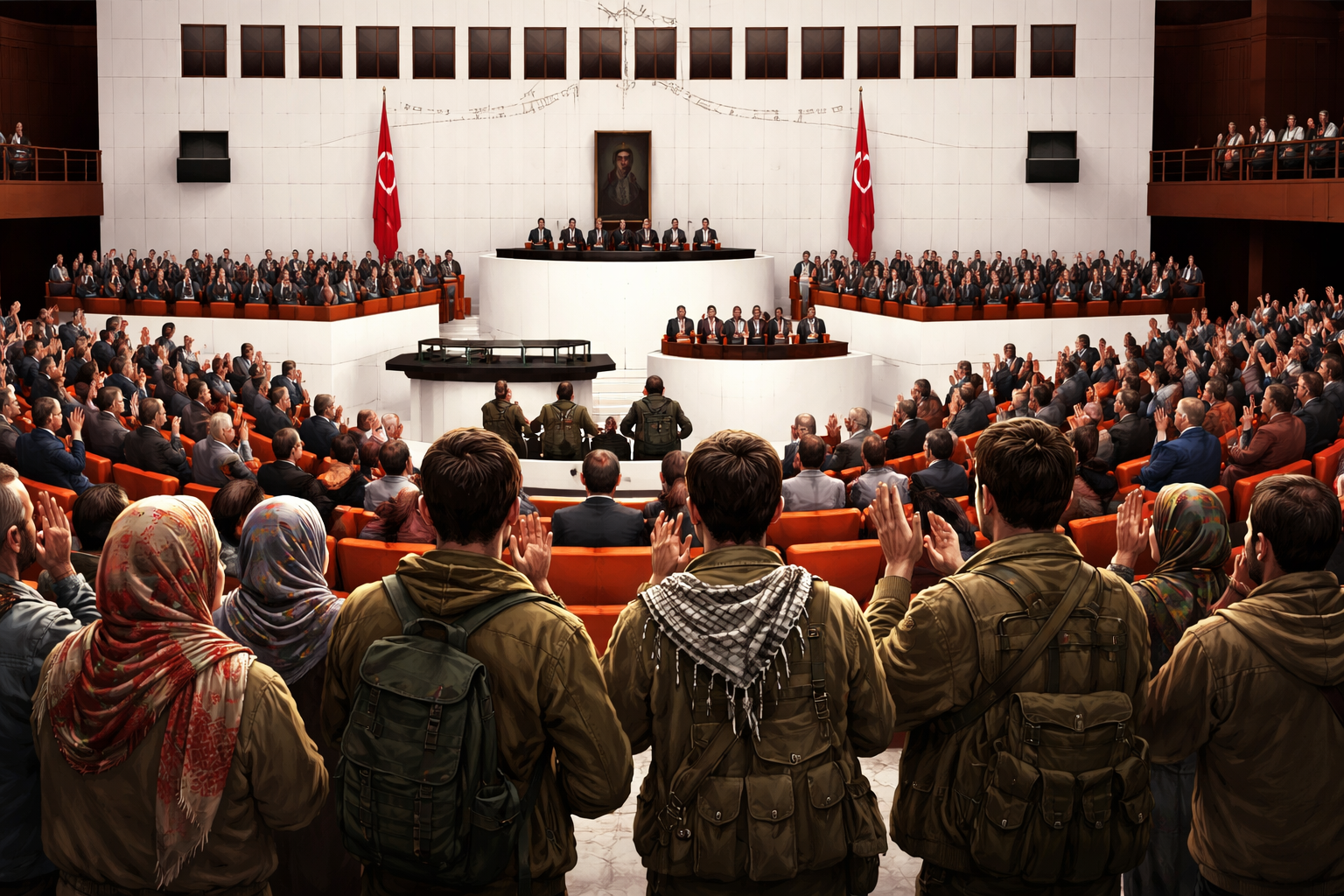
Turkey’s parliament approved a bill on Monday offering conditional pardons and legal protections to thousands linked to the Kurdistan Workers’ Party (PKK). The vote was 468 to 88 with six abstentions after about 12 hours of debate. The measure was supported by the ruling AK Party, its nationalist allies, and the pro-Kurdish DEM party.
The new law provides detailed steps for the PKK’s disarmament and dissolution, along with the reintegration of some former members into civilian life. However, the government emphasized that the legislation does not amount to a general amnesty.
Key Provisions of the Law
The law suspends some prison sentences and allows for the postponement of investigations and trials for five to ten years depending on the offense. If no terrorism-related crimes are committed during that period, cases could be dropped and sentences considered served. Initially, approximately 3,500 detainees linked to the PKK could be freed.
Exclusions apply to individuals convicted of intentional killings and some serving life sentences. The law will only take effect once the National Security Council confirms the PKK has fully disarmed and dissolved. Eligible individuals will then have six months to apply, while official committees will monitor the implementation.
Exclusion of PKK Founder Abdullah Ocalan
The law does not cover Abdullah Ocalan, the imprisoned PKK founder held since 1999. Officials stated his case is outside the scope of the legislation but noted he could still contribute to the peace process. Ocalan called for the PKK to disarm and dissolve in February 2025, a move followed by the group’s announcement of its dissolution two months later, including a symbolic weapons burning in northern Iraq.
Political Debate and Regional Implications
The PKK described the legislation as a starting point but pointed out shortcomings, demanding Ocalan’s release and guarantees that former fighters could engage in politics without prosecution. Some opposition lawmakers criticized the government for making concessions and questioned the unconditional disarmament claim.
The conflict with the PKK, designated a terrorist group by Turkey, the U.S., and the EU, has persisted since 1984, causing over 40,000 deaths and significant regional damage. This new initiative could influence broader regional relations, especially involving Kurdish groups in Iraq and Syria.