Topline
August begins with a comet getting close to the sun, but for most skywatchers it will be about spotting early members of the Perseid meteor shower, due to peak overnight on Aug. 12/13 just hours after a total solar eclipse. Add a waning crescent moon and the possibility of a nova explosion, and Aug. 3-9 is a great week for skywatching.
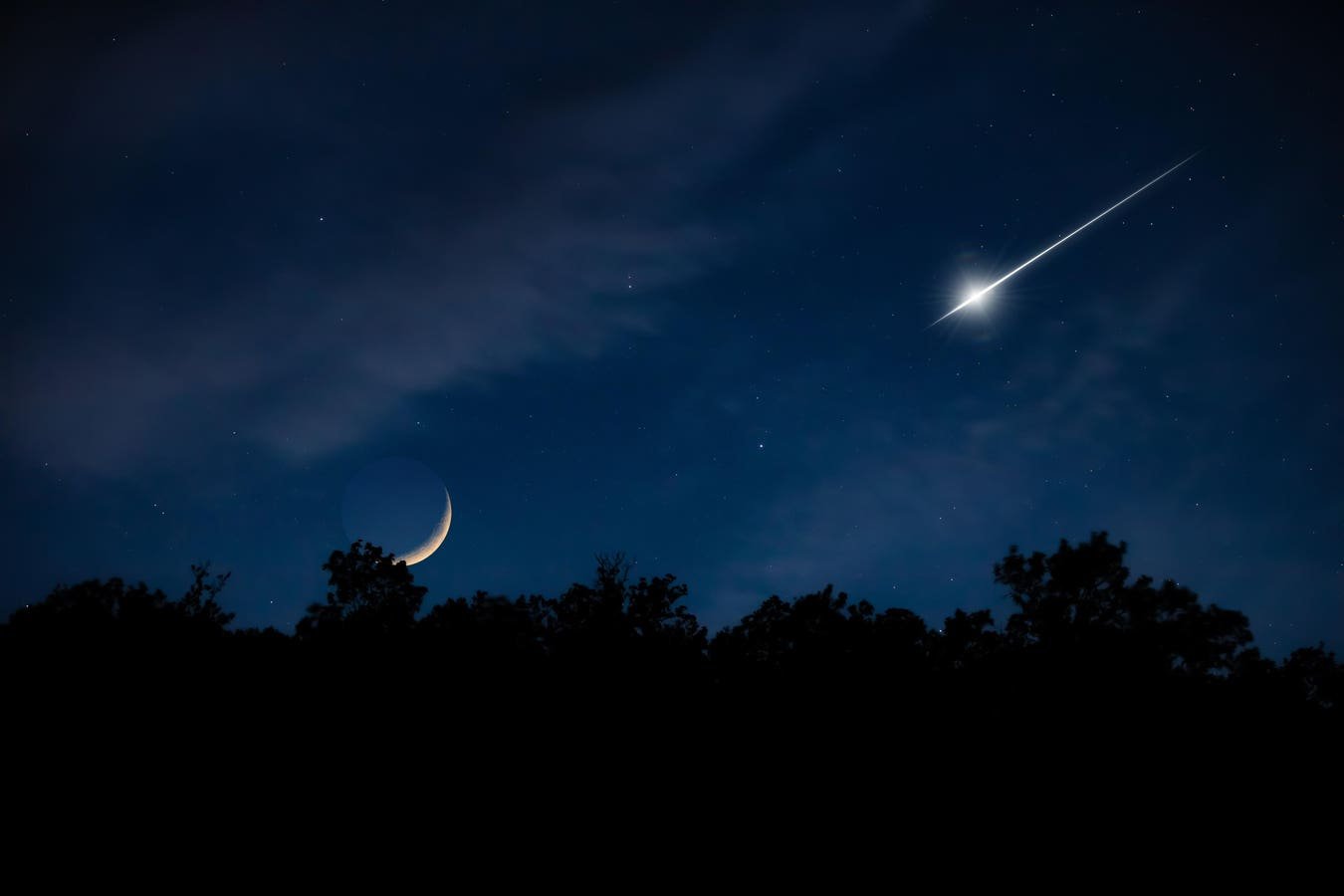
Although the Perseid meteor shower peaks next week, activity is already underway.
getty
Timeline
The waning gibbous moon rises late in the evening in the east, close to Saturn.
A last-quarter moon means the beginning of about 10 nights of moon-free skies until about midnight — this is the period of the month to look for early Perseid meteors.
A 35%-lit waning crescent moon will hang very close to the Pleiades, the two rising together just after midnight and visible for the rest of the night until dawn.
A 15%-lit waning crescent moon rises in the early morning hours alongside Mars.
In the early hours of Aug. 7, a waning crescent moon will be very close to the sparkling Pleiades open cluster.
Stellarium
THE PERSEIDS HAVE BEGUN
Although the Perseid meteor shower peaks later in the month, activity is already underway. This is one of the most reliable annual showers, caused by Earth passing through a stream of debris left by comet 109P/Swift–Tuttle.
These particles — often no larger than grains of sand — strike Earth’s atmosphere at speeds of around 37 miles (59 km) per second, according to the American Meteor Society, producing streaks of light . The Perseids are particularly fast and often leave persistent glowing trails. However, you may only see a few meteors per hour. Face northeast after dark and allow your eyes to adapt. The radiant — the point from which meteors appear to originate — is in the constellation Perseus, but meteors can appear anywhere in the sky.
Finding Comet 10P/Tempel 2
Comet 10P/Tempel 2 — about the same size as Halley’s Comet — reached perihelion (its closest point to the sun) on Aug. 2, and makes its closest approach to Earth on Aug. 3. According to NASA, Tempel 2 won’t become a bright naked-eye object, but it is within reach of binoculars or a small telescope — though the view is better the closer you are to the equator. Here’s everything you need to know about Comet 10P/Tempel 2.
In the early hours of Aug. 9, a waning crescent moon will be very close to Mars.
Stellarium
VENUS DOMINATES THE EVENING SKY
While attention this week is on meteors and the moon, a longer-term story is unfolding in the western sky. Venus is now climbing higher after sunset and is on the verge of becoming the defining object of the evening sky. On Aug. 12, Venus will appear about half-lit — a phase similar to a quarter moon — marking the point (called dichotomy) at which it begins to transition into a crescent. From then on, as it moves closer to Earth in its orbit, its apparent size will increase while its illuminated portion shrinks. It causes Venus to grow dramatically brighter — helped by the fact that the planet is always cloudy, so reflects a lot of light. Over the following weeks, it will transform into a striking crescent and continue brightening, ultimately reaching peak brilliance on Sept. 18. At that point, it will outshine every object in the night sky except the moon.
The coming solar eclipse
Also on Aug. 12, a total solar eclipse will sweep across parts of Greenland, Iceland and Spain. Outside that narrow path, observers across much of Europe, North America and North Africa will see a partial eclipse. A solar eclipse occurs when the moon passes directly between Earth and the sun, casting a shadow onto Earth’s surface. Totality reveals the solar corona — the sun’s outer atmosphere — normally hidden by its glare. This eclipse is particularly notable for its low solar altitude in Spain, where totality occurs close to sunset. That geometry offers the rare possibility of watching an eclipsed sun descend toward the horizon.
Look centre-left for bright star Deneb, the top of the “Northern Cross” — also known as the constellation Cygnus. The Milky Way flows through it.
getty
Constellation Of The Week: Cygnus
This is an ideal week to look for the Milky Way after dark. But do you know where it is? High overhead after dark, Cygnus is one of the most useful constellations in the entire sky because it does something few others can: it shows you the location of the Milky Way and its structure. Its brightest stars form a large cross, often called the Northern Cross, with Deneb marking the top and colorful double-star Albireo the base. When you trace Cygnus from top to bottom, you are effectively slicing through the disk of our galaxy. Start with Deneb, one of the most luminous stars known, then follow the line downward through the cross. This becomes your reference for the Milky Way itself. Once you can see Cygnus clearly, the rest of the summer sky begins to organize around it.
The times and dates given apply to mid-northern latitudes. For the most accurate location-specific information, consult online planetariums like Stellarium.