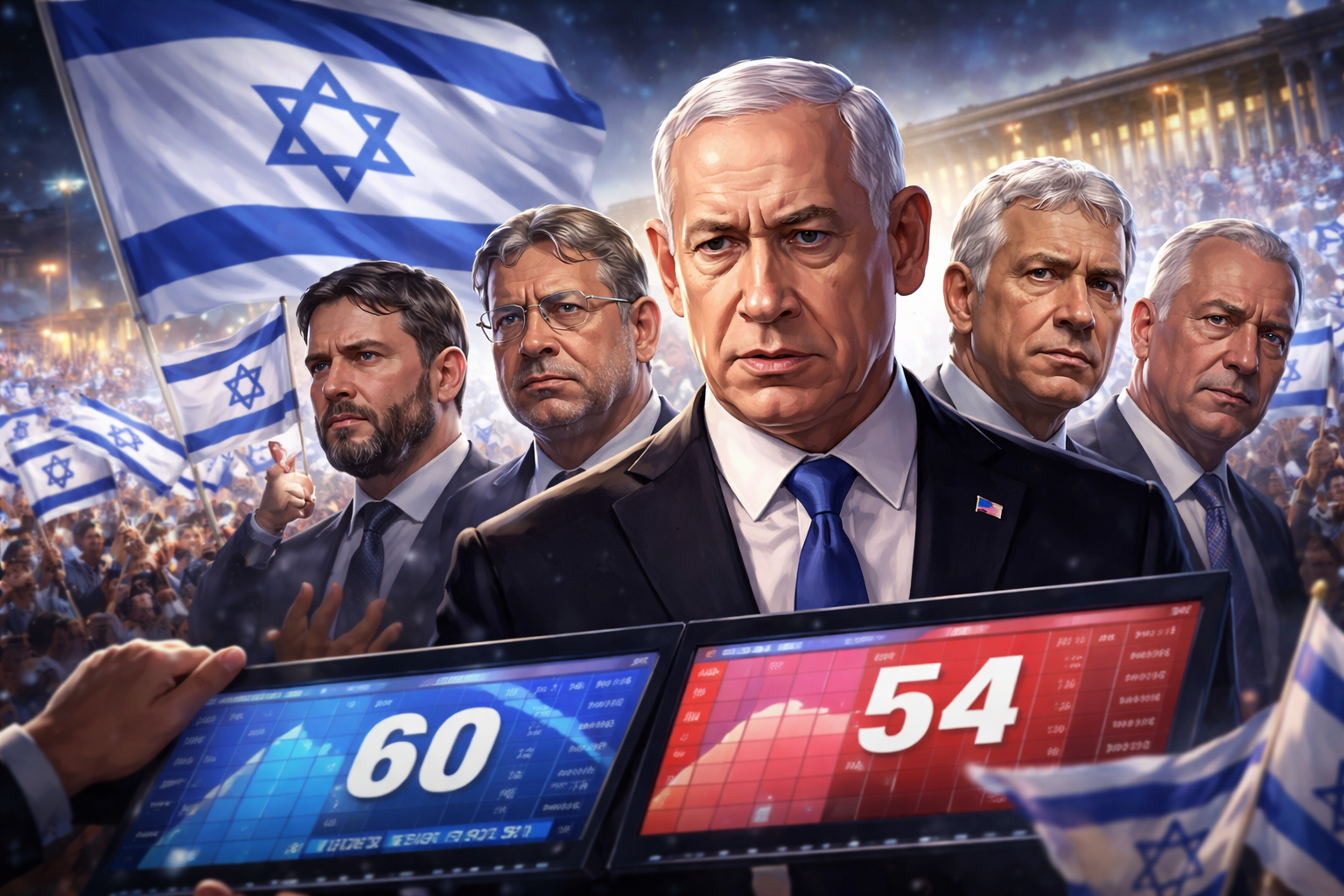
In Israel’s recent parliamentary election, the bloc led by Benjamin Netanyahu holds a slim lead with 53 seats, while the opposition bloc headed by Gadi Eisenkot stands at 48 seats as nearly 90% of the votes have been tallied. Neither side has reached the 61-seat threshold needed to form a stable government in the 120-seat Knesset, according to information released by election officials and reported by multiple sources.
The high voter turnout, the highest in decades, has complicated the post-election landscape, with significant numbers of absentee and special ballots yet to be fully counted. These ballots, which include votes from soldiers, diplomats abroad, and prisoners, could influence final seat distribution, adding uncertainty to the outcome.
Experts and analysts anticipate prolonged coalition negotiations, as no single bloc appears poised to secure an outright majority. The role of Arab parties, which have increased their representation to 17 seats collectively, may be pivotal in shaping the next government, despite traditional resistance from right-wing factions to cooperate with them.
Major Party Standings and Voting Dynamics
Prime Minister Benjamin Netanyahu’s Likud party currently leads with a projected 27 seats, while the opposing Yashar party under Gadi Eisenkot is projected at 21 seats. The Arab-led coalition, including the Joint List and the United Arab List (Ra’am), secured a combined 17 seats, reflecting an increased political influence in this election cycle.
Partial results issued over the last day reveal little movement in seat counts, with the Netanyahu bloc hovering around 53-54 seats and the anti-Netanyahu coalition around 48-49. Absentee ballots, which amount to between 430,000 and 480,000 votes, remain under processing and are expected to be decisive in the final distribution of parliamentary seats.
Calls for Cooperation and Post-Election Statements
Opposition leader Gadi Eisenkot urged Netanyahu to step down following election results, emphasizing the public’s desire for change and warning against another election. Eisenkot pledged to pursue the formation of a “Zionist conscription government” to unify leadership and encompass all sectors of Israeli society.
By contrast, Netanyahu called for a “strong right-wing government,” rejecting cooperation with Arab parties despite their electoral gains. He also highlighted the security cooperation opportunity with U.S. President Donald Trump to counter the perceived Iranian threat.
International Concerns and Domestic Reactions
The United Nations High Commissioner for Human Rights, Volker Türk, called on the incoming government to uphold international law and criticized recent Israeli military operations in the West Bank city of Hebron as disproportionate and involving collective punishment, raising serious concerns about ethnic cleansing.
Domestically, the election’s results have spurred debate about Jewish-Arab partnerships, with some opposition figures openly supporting coalition talks with Arab parties, while influential right-wing factions denounce such cooperation as treasonous.