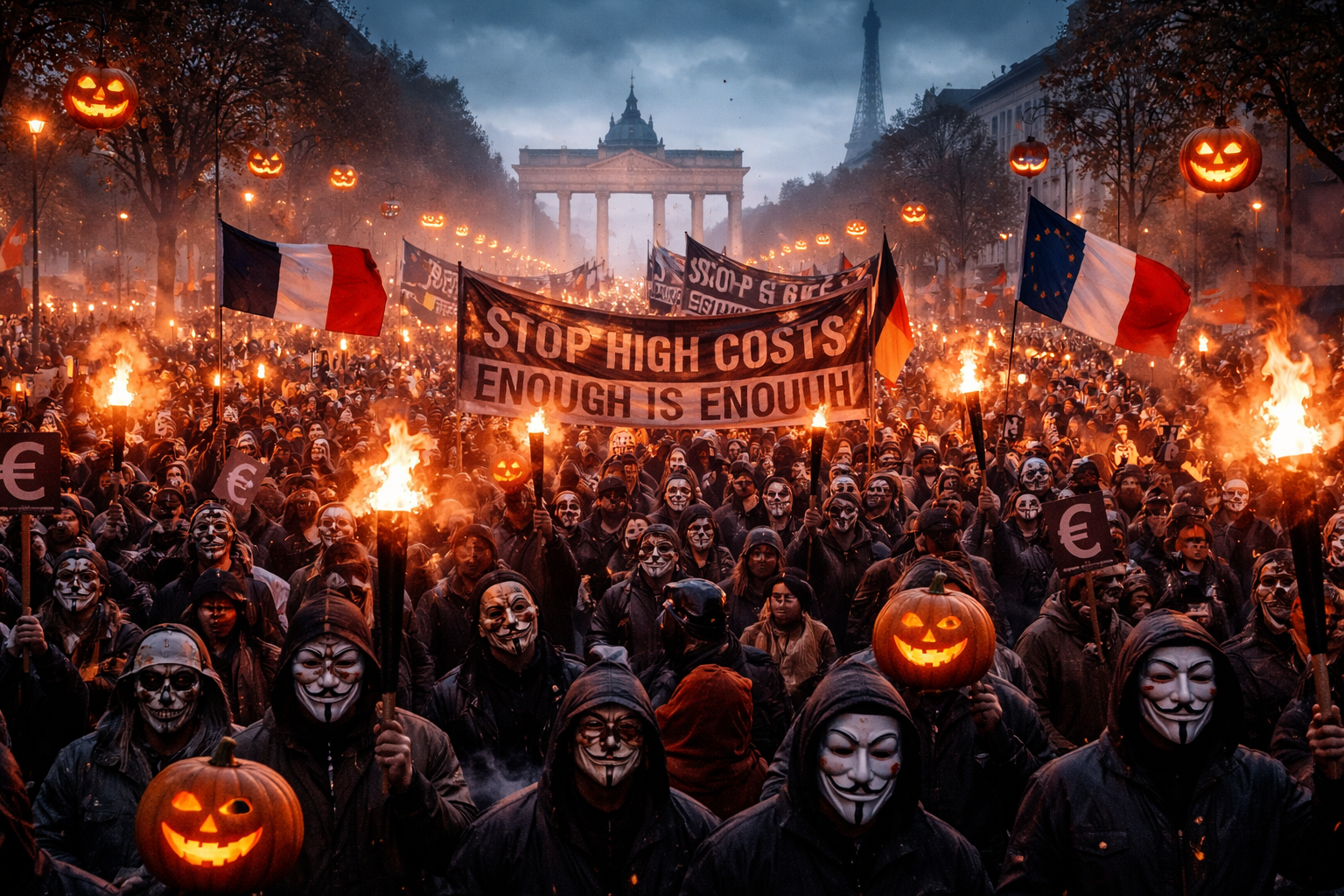
Protests fueled by rising living costs and demands for improved public services are set to escalate in Europe this weekend, with Germany joining the wave of demonstrations and France preparing for renewed unrest on Halloween.
A coalition of German youth groups under the banner “Gen Z regelt” has organized peaceful protests across more than 30 cities, voicing demands for increased funding in education, climate protection, and housing, and opposing any reinstatement of mandatory military service. Authorities in Germany are mobilizing police forces, including an extra 1,500 officers in Berlin, to maintain order while acknowledging no specific threats of coordinated violence or looting have been identified.
Protests in Germany Focus on Education and Housing
About 10,000 protesters—largely students and their families—are expected to gather at Berlin’s Brandenburg Gate. Additional rallies are planned in major cities such as Cologne, Munich, Frankfurt, and Hamburg. Organizers emphasize that their demonstrations will be strictly peaceful, cautioning participants against violence to ensure their goals are achieved constructively.
Political figures have voiced differing perspectives on the demonstrations. Alexander Throm of the conservative Christian Democratic Union stressed the importance of preventing violent outbreaks like those seen in France, while Felix Banaszak of the opposition Green party warned that preemptively criminalizing youth protests could inadvertently push participants toward radicalization.
Heightened Security Measures in France Ahead of Halloween Protests
In France, where recent student and labor protests have sparked occasional violence, the interior minister announced a significant security deployment of 70,000 police and gendarmes, including elite units, for Halloween. Authorities are preparing to respond firmly to any excesses, particularly those stemming from calls by radical groups on social media advocating violent gatherings after official demonstrations end.
To limit disruptions, many peaceful protests have been prohibited in city centers, including two planned marches in Paris by unions and the “yellow vest” movement. Instead, a single march has been authorized outside the city center. Officials rejected appeals to overturn the bans, highlighting concerns over preceding episodes of violence and looting that accompanied earlier protests, despite a strong police presence.
Ongoing Discontent Over Public Services and Living Costs
Both countries see protests driven by dissatisfaction with the cost of living, declining public services, and educational challenges. In France, unions and students have called for a nationwide strike on November 5. Though the French government has introduced measures to address student demands, such as improving university admissions systems and providing renovation loans for schools, student leaders have deemed these efforts insufficient.
The federal pupils’ conference in Germany distanced itself from the weekend’s demonstrations due to unclear organizational structures and unpredictability, instead planning its own protest later in November focused on declining school performance.