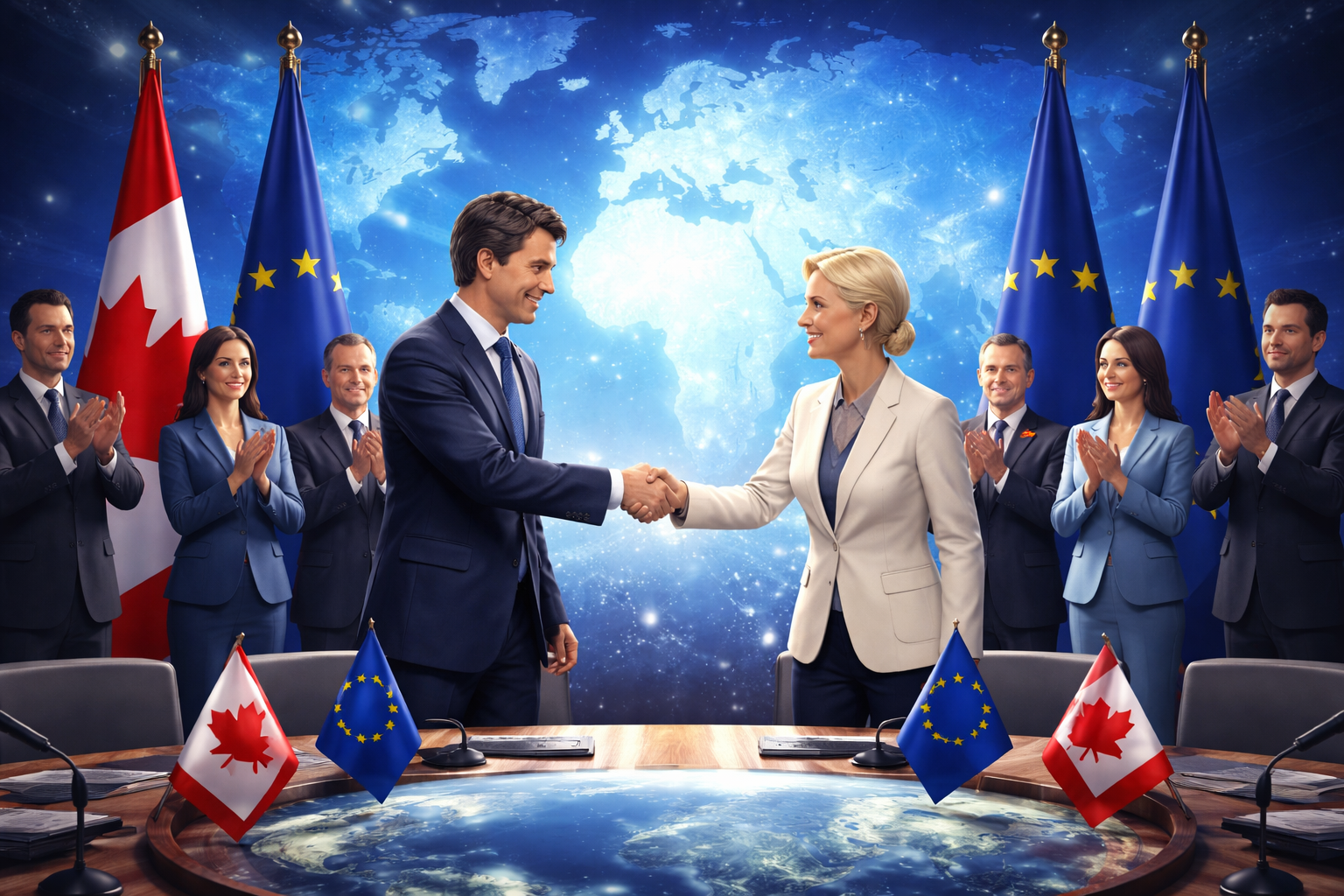
Canada and the European Union announced the creation of the Alliance for the Future at a summit in Montreal, a strategic partnership open to like-minded nations seeking stability in an uncertain global environment. The alliance is designed as a “protective canopy” to support citizens and counter challenges such as climate change, democratic erosion, and trade weaponization.
Officials representing Canada and the 27-member EU bloc emphasized the unprecedented opportunity this partnership presents for enhancing security, economic integration, and cooperation. Canadian leader Mark Carney and European Commission president Ursula von der Leyen expressed confidence in the alliance’s potential to forge a more stable international order while welcoming additional countries to join.
Financial and Technological Support
During the summit, Canada committed to contributing to a €90 billion loan package supporting Ukraine amidst ongoing conflicts. Discussions also laid the groundwork for a more integrated market between Canada and the EU, promising tens of billions of dollars in trade, reduced travel restrictions, and expanded educational exchanges.
Significant emphasis was placed on reducing dependence on American defense and technology firms. Notably, a planned merger between Canada’s Cohere Inc. and Germany’s Aleph Alpha GmbH aims to create a jointly headquartered AI company in Toronto and Berlin, backed by Canadian government investment of up to C$1.6 billion. This move reflects concerns over external control of critical technology and sovereignty in key sectors.
Deepening Cooperation Amid Political Sensitivities
The alliance also includes Canada’s entry into Europe’s supercomputing network, allowing access to advanced computing for AI model training. However, political tensions surfaced, especially in Quebec, where separatist leaders expressed dissatisfaction with their exclusion from the summit’s public proceedings.
Despite these regional dynamics, European Council president António Costa described Canada as the “most European” of non-European countries, underscoring shared values and ambitions. The summit also introduced the concept of Canada becoming an associate member of the EU—an unprecedented status intended to strengthen ties without implying opposition to other nations. The precise nature of this status will be clarified at a 2027 summit.
Addressing Economic Pressures and Supply Security
Leaders highlighted how economic pressures inflicted by trade weaponization affect everyday families, raising costs for essentials and manufactured goods. Von der Leyen and Carney underscored the alliance’s goal to increase competition, diversify supply chains, and enhance resilience collectively against geopolitical shocks.
Through this partnership, both sides seek to create economic and technological buffers to maintain democratic norms and ensure reliable access to energy, critical minerals, and semiconductors.