

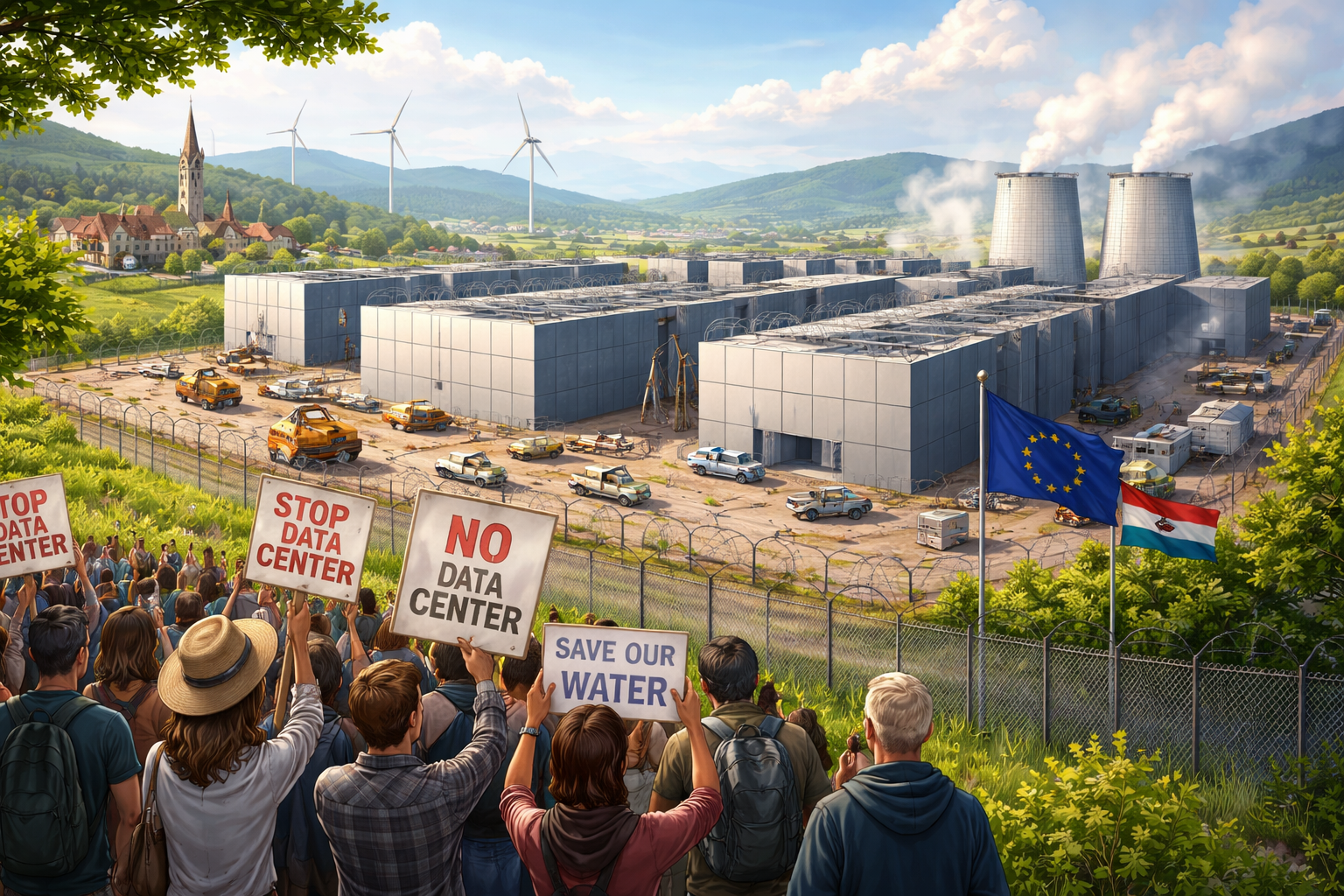
Efforts by European governments and companies to enhance digital sovereignty by locating data centers on the continent have met significant local opposition due to environmental and resource concerns.
Data centers, essential for processing and storing vast amounts of digital information, are increasingly seen as vital infrastructure. However, their construction and operation raise issues relating to high electricity and water consumption, particularly in light of Europe’s record-breaking summer heat and ongoing climate concerns.
Environmental Impact and Resource Use
According to the German Ministry for Economic Affairs, data centers consume between 0.4 and 4.4 liters of water per kilowatt-hour of electricity to cool their systems, with water either evaporating or returning warmer to storage. With summer water use restrictions implemented in several European regions affecting residents, agriculture, and even nuclear power plants, the substantial water use associated with data centers is a growing concern.
Electricity demand is also rising steeply. Finland’s grid operator, Fingrid, projected a nearly 40% increase in electrical consumption if all planned data center projects with approved connections proceed. This surge pressures local energy grids already strained by climate and infrastructure challenges.
New Regulations and Efficiency Initiatives
In response, the European Commission has introduced a transparency scheme requiring data centers exceeding 500 kW capacity to receive an efficiency grading. This grading evaluates not only energy and water consumption but also contributions such as recycling waste heat.
The commission’s executive vice-president for clean transition emphasized that expanding data center capacity must not proportionally increase stress on energy and water resources.
Community Resistance and Changing Location Trends
Traditionally clustered near major urban hubs like Frankfurt, London, Amsterdam, Paris, and Dublin, new data centers are increasingly sited in smaller cities and rural areas due to urban power constraints. Places like Groningen, Barcelona, and Brussels are seeing new developments, sparking protests among residents and environmentalists.
Recent demonstrations in Linz, Austria, and a successful campaign in the Irish village of Killala led by author Sally Rooney highlight growing local backlash. In central France, elected officials resigned in protest over plans for a large Google data center expected to consume electricity comparable to a nuclear power plant.
Technological Innovations and Community Benefits
Some operators point to advances that reduce environmental impact, such as a Marseille facility employing a cooling system that uses 30% less power and no water. Scandinavian data centers repurpose server-generated heat to warm local buildings through district heating networks.
A German survey found that about three-quarters of respondents would accept nearby data centers if waste heat were reused locally. Operators also propose integrating backup power batteries with local grids to enhance energy stability and help manage peak demand.
Despite tensions, supporters argue that expanding data centers in Europe not only contributes to digital sovereignty but also strengthens the continent’s broader energy independence.