

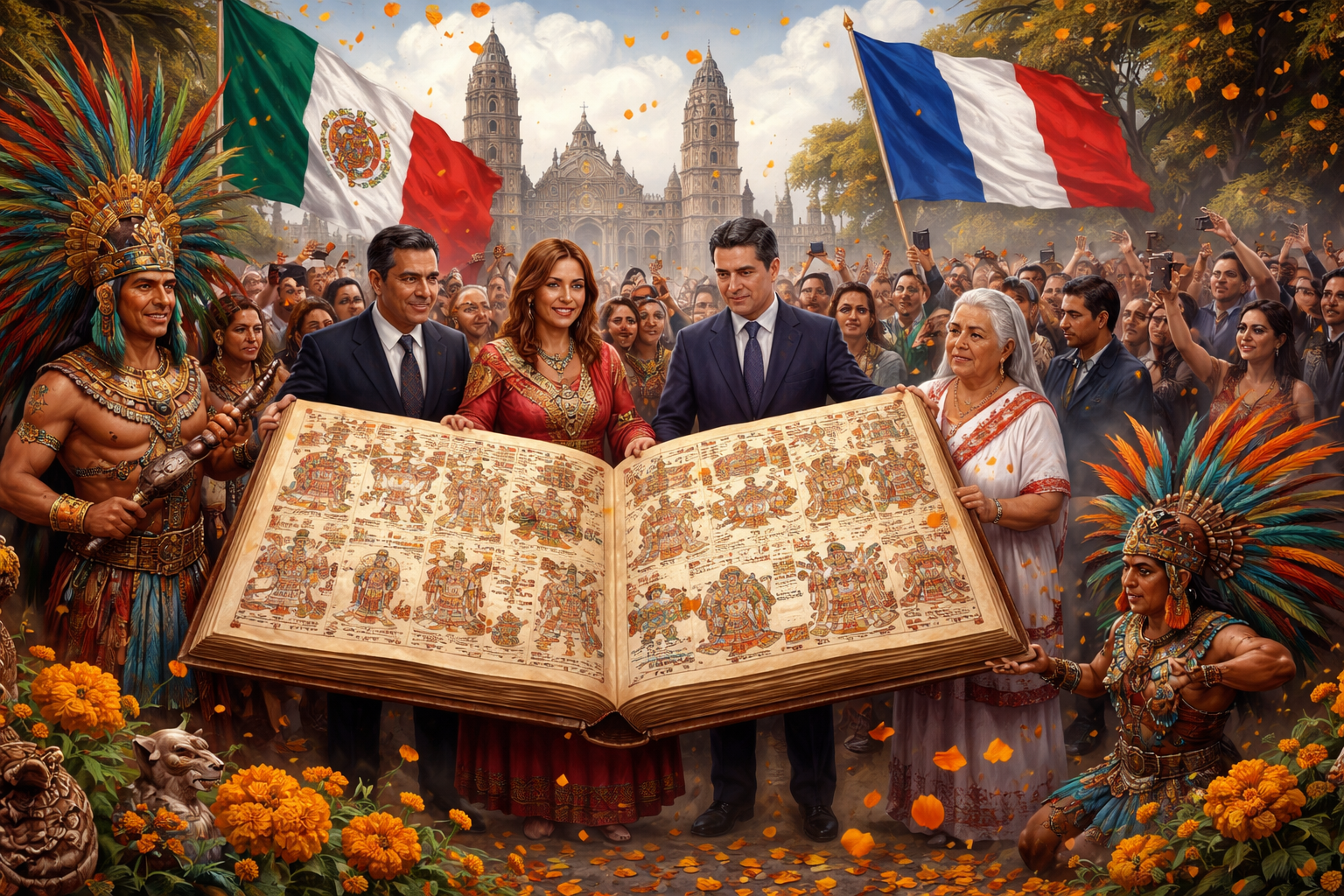
The Azcatitlan Codex, a rare 16th-century manuscript featuring vibrant pictograms that detail the history of the Aztec civilization, has returned to Mexico for the first time since 1840. The codex was brought on loan from the Bibliothèque Nationale in France, where it has been kept since 1898, and went on public display in Mexico City this past Thursday.
This important visual record chronicles significant events from the founding of the Aztec capital, Tenochtitlan, through its fall following the arrival of Spanish conquistadors. The codex’s vivid illustrations depict Aztec rulers, warriors adorned with feathered headdresses, and ritual ceremonies carried out in pyramid temples, employing rich colors such as red, blue, green, and yellow.
Significance and Reactions
Mexican Foreign Minister Roberto Velasco emphasized the exhibition as a moment of reconnecting the Mexican people with their collective heritage. He highlighted the pictograms as “the written voice of our ancestors and the deep root of our identity.” Indigenous communities welcomed the loan enthusiastically, with Emilia Mendoza of the Hnahnu community describing it as a symbolic victory over the historical theft of their cultural artifacts.
Maria Eugenia Castaneda, representing the Mexica peoples, noted the codices’ role in affirming identity and cultural values during challenging times, elevating morale and a sense of belonging.
Details of the Codex and Exchange Program
The Azcatitlan Codex combines Mesoamerican pictographic writing alongside European script, and it is thought to have been created by an indigenous Otomi craftsman. The manuscript traces the Mexica people’s migration from their mythical homeland of Aztlan to the establishment of Tenochtitlan, located where present-day Mexico City stands.
The document also portrays the successive rulers of the city, the arrival of the Spanish invaders, and the subsequent evangelization efforts. More than 500 years have passed since Hernán Cortés and his forces conquered and largely destroyed Tenochtitlan, a turning point that began centuries of Spanish domination.
The codex will remain on display in Mexico until December as part of a cultural exchange honoring 200 years of diplomatic relations between Mexico and France. As part of this agreement, Mexico will loan the Codex Boturini to France, another significant manuscript that narrates the Aztec migration saga.