

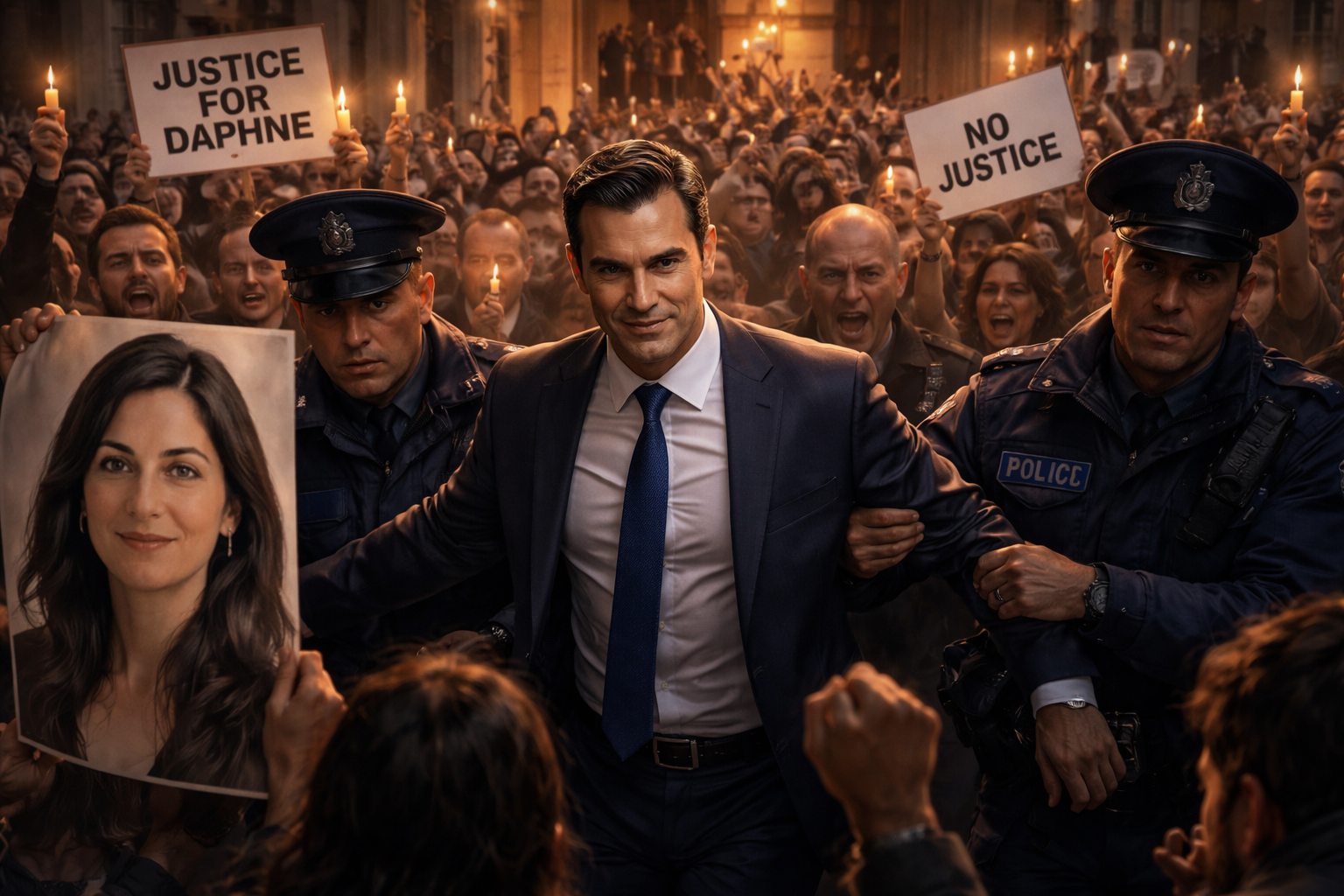
Yorgen Fenech, a Maltese businessman, was acquitted by a court jury of charges that he ordered the 2017 murder of investigative journalist Daphne Caruana Galizia. The decision on Wednesday stunned the nation and provoked furious protests outside the courthouse in Valletta, where crowds shouted insults including “Murderer!” and “Mafia!” as Fenech left under heavy security.
Caruana Galizia’s family expressed deep disappointment. Her son, Matthew Caruana Galizia, condemned the verdict as a “terrible decision by the jurors that our country may never recover from,” calling it “obscene” and claiming it contradicted all evidence presented during the trial.
Background and Trial Details
Caruana Galizia, known for her investigative work on corruption, was killed in a car bomb attack in October 2017. While those who physically planted and detonated the bomb have been convicted, the individual who contracted them remains unidentified by the courts.
Fenech was detained for over five years after his dramatic arrest aboard his luxury yacht in 2019, a move that triggered widespread protests and exposed suspicions of government involvement. The high-profile trial only commenced in the summer of 2026, culminating in the decisive verdict from a jury of nine, eight of whom rejected the prosecution’s claims that Fenech commissioned the killing.
Prosecution and Defense Arguments
The case against Fenech largely hinged on testimony from Melvin Theuma, who admitted to being the middleman and claimed Fenech hired him to organize the murder. Theuma was granted a pardon in exchange for his cooperation. However, Fenech’s defense questioned Theuma’s credibility, pointing to inconsistencies and prior falsehoods. His lawyers also argued that evidence implicating Keith Schembri, a former chief of staff, was not sufficiently pursued; Schembri has denied any involvement and was never charged.
Prosecutors pointed to Caruana Galizia’s investigations into Fenech’s business dealings—particularly with the company 17 Black and the energy entity ElectroGas—to argue that Fenech had a motive. However, they acknowledged she was not imminently about to publish damaging information against him.
Public Reaction and Institutional Concerns
The acquittal has ignited public outrage and renewed scrutiny on Malta’s justice system and political landscape. Caruana Galizia’s family and supporters criticize what they see as persistent institutional shortcomings that facilitated the assassination, including an “atmosphere of impunity” identified in an official investigation in 2021.
Malta has enacted some reforms aimed at protecting journalists and addressing corruption, but critics argue these measures fall short, especially regarding press freedom. Media reform legislation stalled before early parliamentary elections in 2026, and the European Commission’s recent Rule of Law Report describes progress as limited and core recommendations unfulfilled.
Concerns have also been raised about Malta’s slow-moving judiciary. A report by the Daphne Caruana Galizia Foundation found that nearly half of homicide cases initiated between 2010 and 2020 remained unresolved by mid-2025, highlighting structural challenges in prosecuting serious crimes effectively.
Next Steps
Following the verdict, Judge Edwina Grima ordered that trial evidence be passed to the chief of police for evaluation of whether criminal proceedings should be initiated against others. Former Prime Minister Joseph Muscat mentioned ongoing investigations based on prosecutors’ information.
The Institute of Maltese Journalists has urged authorities to pursue all leads uncovered during the trial, including those implicating former high-ranking politicians. While respecting the jury’s decision, they stressed that the case remains open. Nearly nine years after Daphne Caruana Galizia’s assassination, definitive legal responsibility for commissioning her murder has yet to be established.