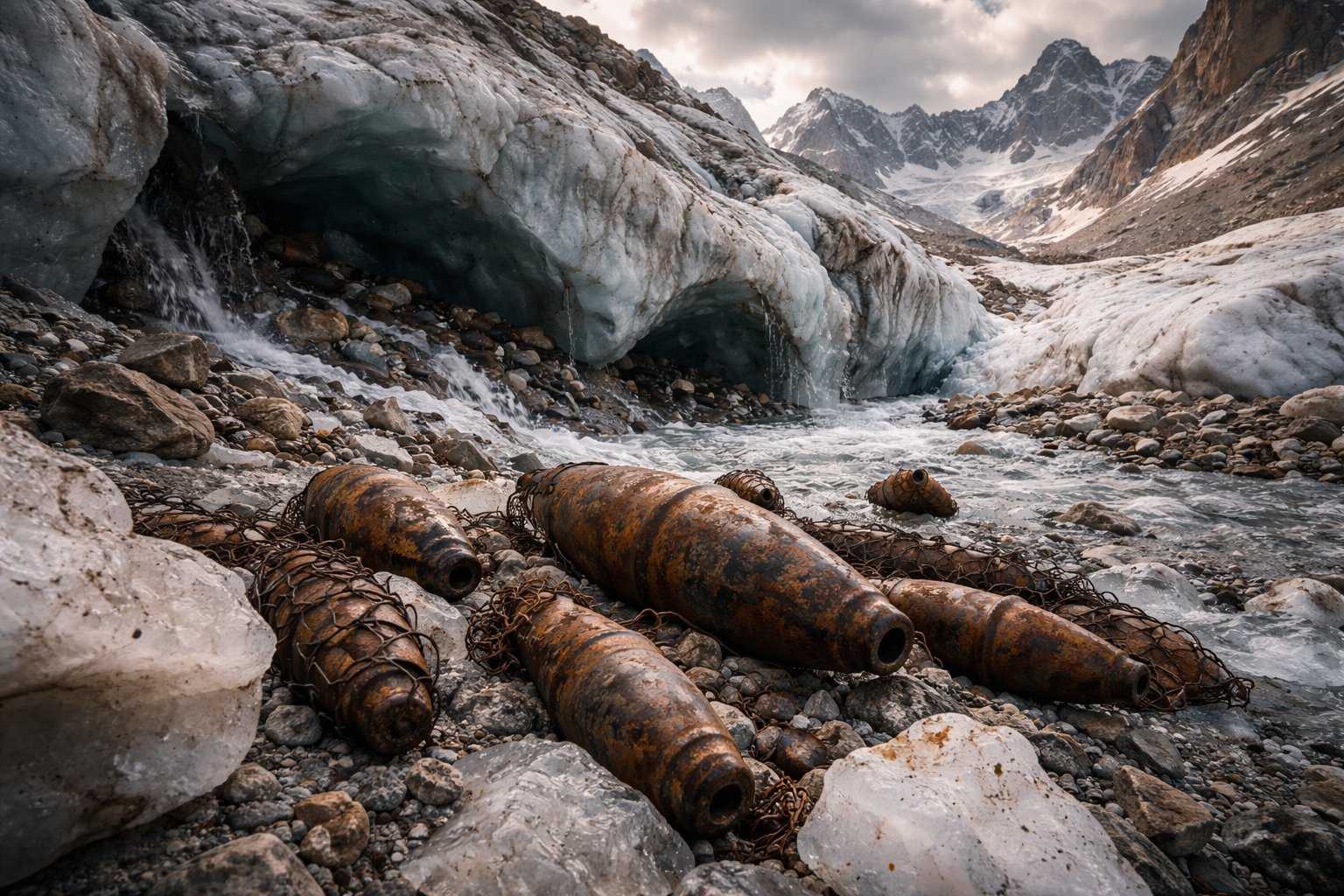
This summer, a large cache of unexploded World War I munitions surfaced from rapidly melting glaciers in Italy’s Dolomites, according to the Italian army’s Julia Alpine brigade. The recovered arsenal included Italian artillery shells and French-made mortar bombs used during the conflict known as the White War, fought between Austro-Hungarian and Italian forces from 1915 to 1918.
Following reports from hikers of bomb sightings in the Canal San Bovo area within the Primiero Valley of eastern Trentino, the military launched comprehensive searches at high-altitude glacier sites across the Trentino-Alto Adige region. Their efforts led to the recovery and safe defusing of 250 hazardous explosives, including 18 Italian 75mm artillery shells and 37 Thevetot mortar shells supplied to Italian troops during the war.
Global Warming Reveals Century-Old Artifacts
The reappearance of these relics is tied directly to climate change. Professor Stefano Morosini of the University of Bergamo, who coordinates heritage projects at Stelvio National Park—another site where explosives were found—explained that global heating has accelerated glacier retreat over the past decade. He noted that dangerous wartime artifacts have been preserved under ice for over 100 years and now frequently emerge at the end of summer seasons, posing serious risks.
Authorities advise anyone discovering unexploded ordnance to avoid touching it and report findings immediately to police to prevent accidents.
Historical Legacy of the White War in the Dolomites
The White War, fought in extreme alpine conditions in the Dolomites and parts of the Lombardy Alps, claimed over a million lives. Most casualties were due to avalanches, falls, or hypothermia rather than direct combat. Melting glaciers have also exposed soldiers’ belongings, letters, and even bodies preserved in their WWI uniforms. In 2015, a wooden barracks sealed for almost a century atop Mount Scorluzzo was uncovered, revealing well-preserved wartime artifacts left behind when the war ended suddenly in 1918.
Safety Concerns and Climate Impacts on Alpine Access
Morosini emphasized that rising summer temperatures are making glacier travel increasingly unsafe. The 2022 collapse of a large mass from the Marmolada glacier resulted in 11 fatalities, highlighting the dangers posed by climate change. He added that long heatwaves are accelerating glacier retreat, making access to these regions difficult and risky.
A museum dedicated to the White War, planned in Bormio, is set to open in June 2027 to preserve and display these historical relics.