

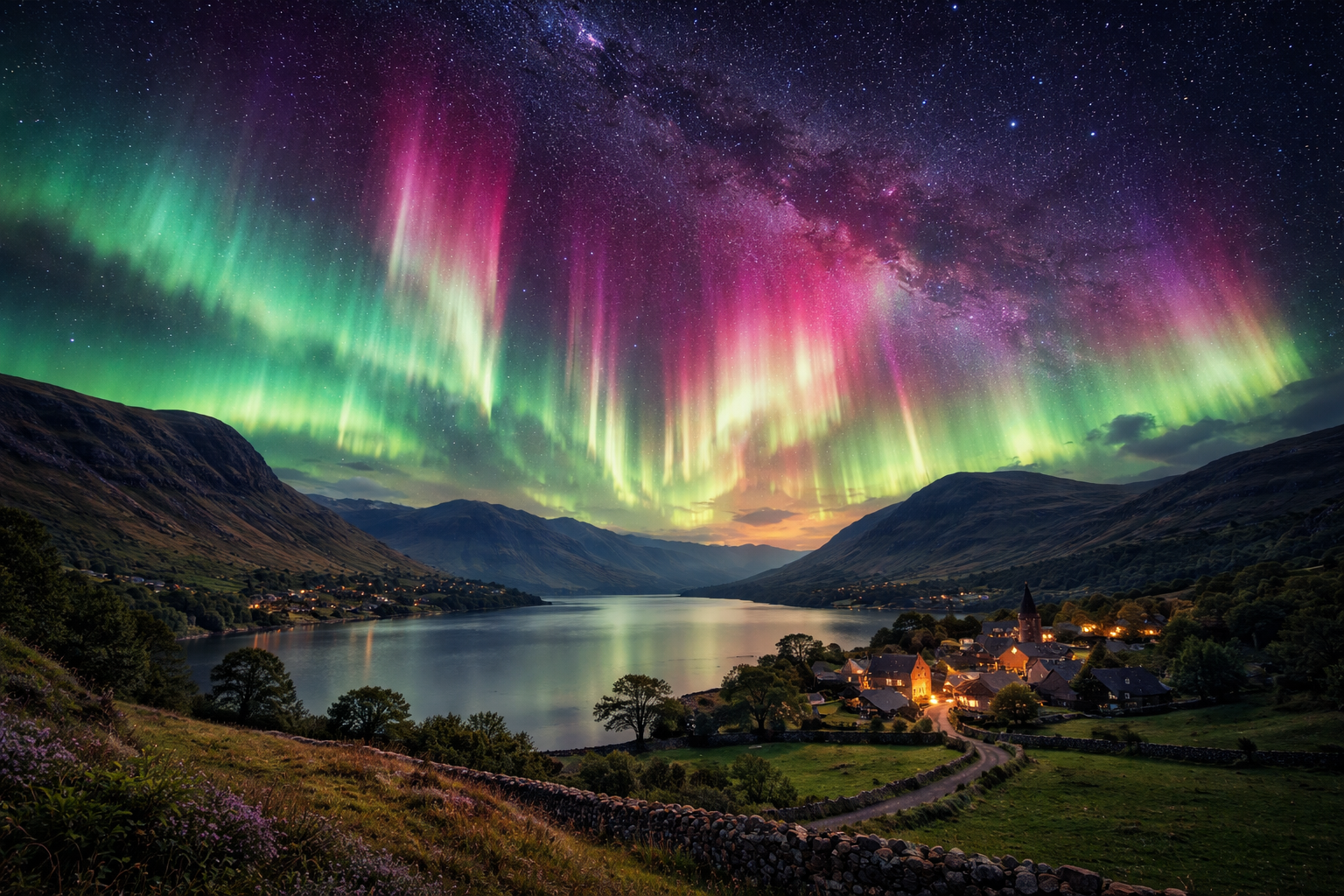
The Northern Lights, or Aurora Borealis, were visible across much of the United Kingdom on Friday and Saturday evenings, offering residents a rare spectacular display. The widespread visibility was due to intense solar activity causing charged particles from the sun to collide with Earth’s atmosphere.
The Met Office reported that such displays typically occur near the Arctic Circle and northern Scotland, but exceptionally strong solar eruptions allowed the lights to be seen across Wales and down to southern regions including Devon, Hampshire, and Kent on Saturday night.
Solar Eruptions Drive Unusual Sightings
The phenomenon was linked to coronal mass ejections (CMEs) emitted by the sun late last week. These powerful solar eruptions send streams of charged particles toward Earth, which are captured by Earth’s magnetic field and funneled into the atmosphere near the poles. The interaction with atmospheric oxygen and nitrogen creates the glowing lights characteristic of the aurora.
On Saturday evening, the geomagnetic activity reached 600 nanotesla (nT), triple the 200nT threshold typically required for northern UK visibility. This surge made the aurora visible across the entire UK, including southern areas where sightings are more rare.
Viewing Conditions and Future Opportunities
The Met Office indicated that clear skies could allow further sightings across Scotland and other northern regions until Tuesday, depending on weather and solar activity. To improve viewing chances, observers are advised to look northwards away from city lights and use a mobile phone camera, as the human eye is less sensitive to color in low-light conditions.
Experts have noted that 2026 is expected to be a peak year for aurora visibility due to the sun’s 11-year activity cycle, suggesting more opportunities to witness the Northern Lights in the coming months.