

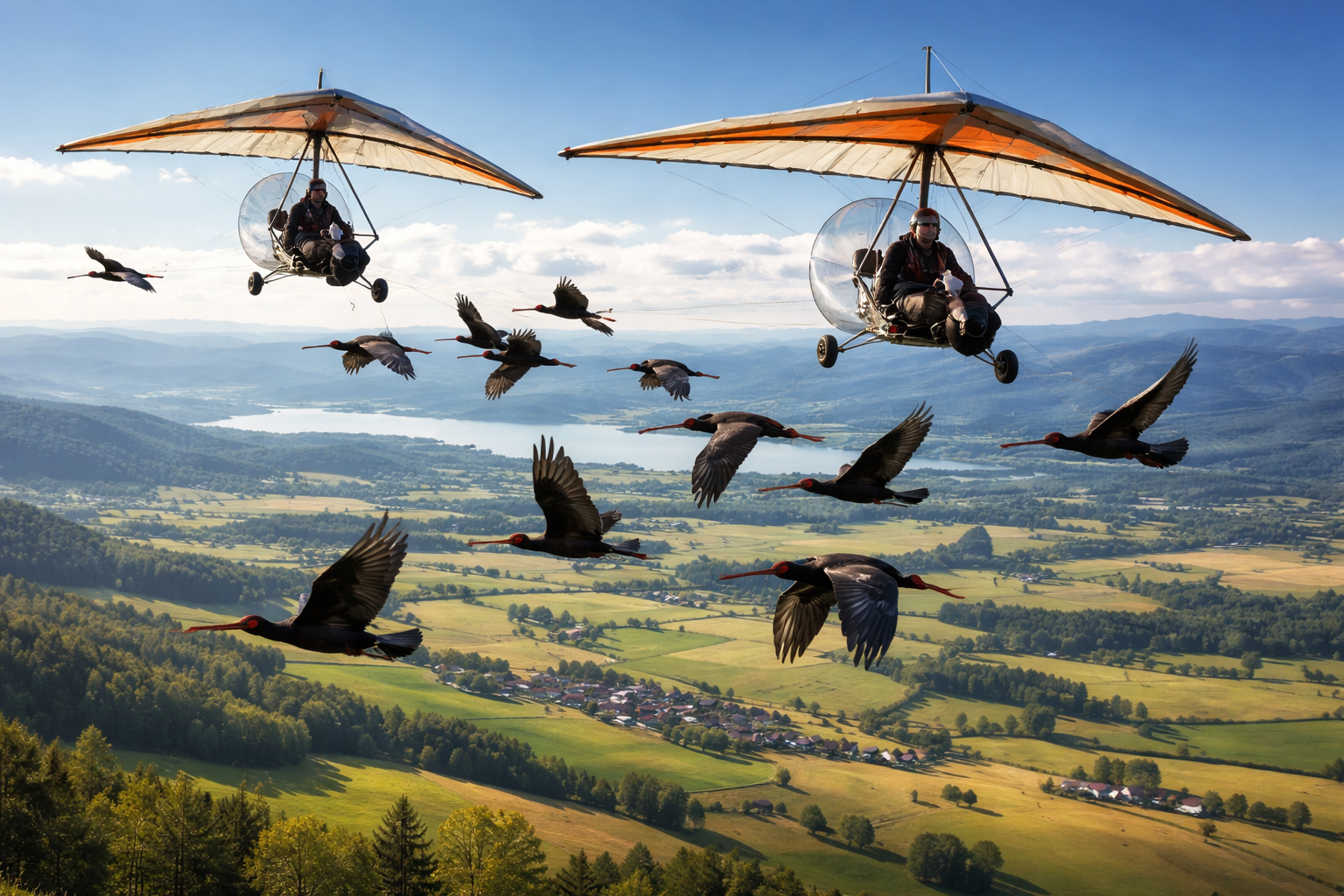
Fifteen newly released northern bald ibises have joined an existing flock in northern Spain, guided by human pilots flying micro aircraft. This migration effort is part of a broader European project aimed at restoring the species, which had been extinct on the continent for 300 years.
The northern bald ibis (Geronticus eremita) once flourished in Europe but declined sharply, with the last major wild population in Morocco dropping from 9,000 birds to just 250 by the late 20th century. Conservationists initiated captive breeding and reintroduction programs in Austria and southern Spain, leading to new colonies, including the recent additions in Alt Empordà, Catalonia.
Project Advances and Human-Guided Migration
Bernat Garrigós, a biologist overseeing the Alt Empordà project, explained that the ibises are intelligent and sociable birds, accustomed to human interaction and free of natural predators. The flock, which reached nearly 60 birds within a year after the project began in 2024, was released in March 2025 from Torre d’en Mornau, a former army stable now serving as a sanctuary.
To help the birds migrate safely, experienced Waldrapp team members pilot ultralight aircraft that act as foster parents, guiding the ibises between Austria, Catalonia, and Jerez in southern Spain. This approach has significantly reduced mortality rates compared to earlier efforts.
Goals for a Self-Sustaining Population
The Alt Empordà team, supported by staff and volunteers and in close collaboration with the Aiguamolls Park nature reserve, aims to establish a breeding colony. They plan to build nests on towers around the premises to assist the birds as they learn breeding behaviors, since ibises do not breed until age three or four. The ultimate objective is a thriving wild population of at least 300 individuals, including 50 breeding pairs, spread across Europe.
Conservation Impact and Community Engagement
Beyond species restoration, the ibis projects contribute to environmental education and awareness. They have inspired local industries, such as the electric utility Endesa, to modify infrastructure to reduce bird collisions. Garrigós emphasized the need for proactive conservation efforts to protect diverse ecosystems essential for both wildlife and human survival.