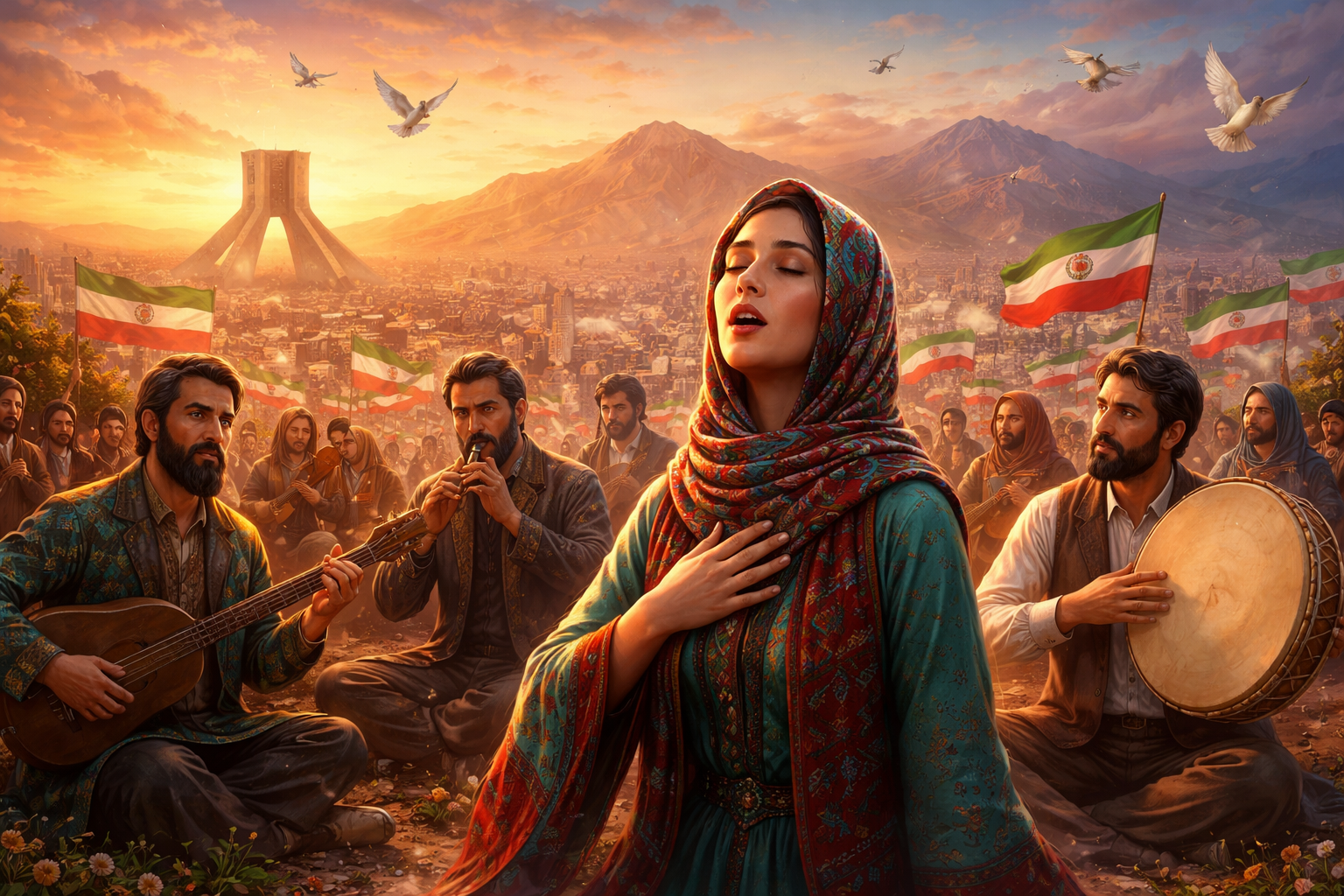
After decades abroad, renowned Iranian musicians Bijan Mortazavi and Mohsen Namjoo have returned to Iran, offering a glimpse into the complex role of music in a country where art intersects deeply with politics and social resistance. Their homecomings highlight music’s significance far beyond entertainment, framing it as a form of cultural identity and political expression under ongoing state control.
Mortazavi, a celebrated violinist, singer, and composer, returned to Tehran in late September after 47 years abroad. Mortazavi is internationally known, having performed at global events such as the 2026 FIFA World Cup closing ceremony. Videos shared on social media show him warmly welcomed by Tehran residents, reflecting his lasting influence and deep ties to Iranian culture. Similarly, Mohsen Namjoo, recognized for blending traditional Persian music with blues, rock, and jazz elements, recently returned after roughly 20 years in exile. Despite having been sentenced in absentia in 2009 for alleged insults to religious sites, Namjoo emphasized his return was motivated by a desire to reunite with family and friends.
Government Outreach and Legal Context
Iran’s culture minister announced a list targeting prominent Iranians abroad to ease their travel or return barriers, framing these moves as inclusive—even for critics of the Islamic Republic. However, he also noted that returning artists may not necessarily perform in Iran but might visit culturally. Legal experts underscore that international law prevents citizens from arbitrary travel bans, regardless of political stance, emphasizing citizens’ right to return home without loyalty conditions.
Music’s Contentious History in Post-Revolution Iran
Ethnomusicologist Sepideh Raissadat explains that following the 1979 revolution, music was heavily suppressed and labeled harmful by the country’s leadership, with instruments banned on television and musicians forced to hide their art. Despite this, music especially re-emerged during the Iran-Iraq War as a unifying force through revolutionary and religious songs. Importantly, while female voices were restricted, they survived through group singing despite official limitations. Over the years, music became a subtle act of resistance, with pop music evolving domestically in response to censorship and cultural restrictions.
Music as a Form of Protest
In recent nationwide protests at the end of 2025 and early 2026, music took on a more direct political role. Families of those killed used music during funerals as an act of defiant mourning, contrasting traditional religious hymns with songs and dances. This ritual challenged the political system’s control over public expression, turning music into a tool of protest and a symbol of resilience against state oppression.