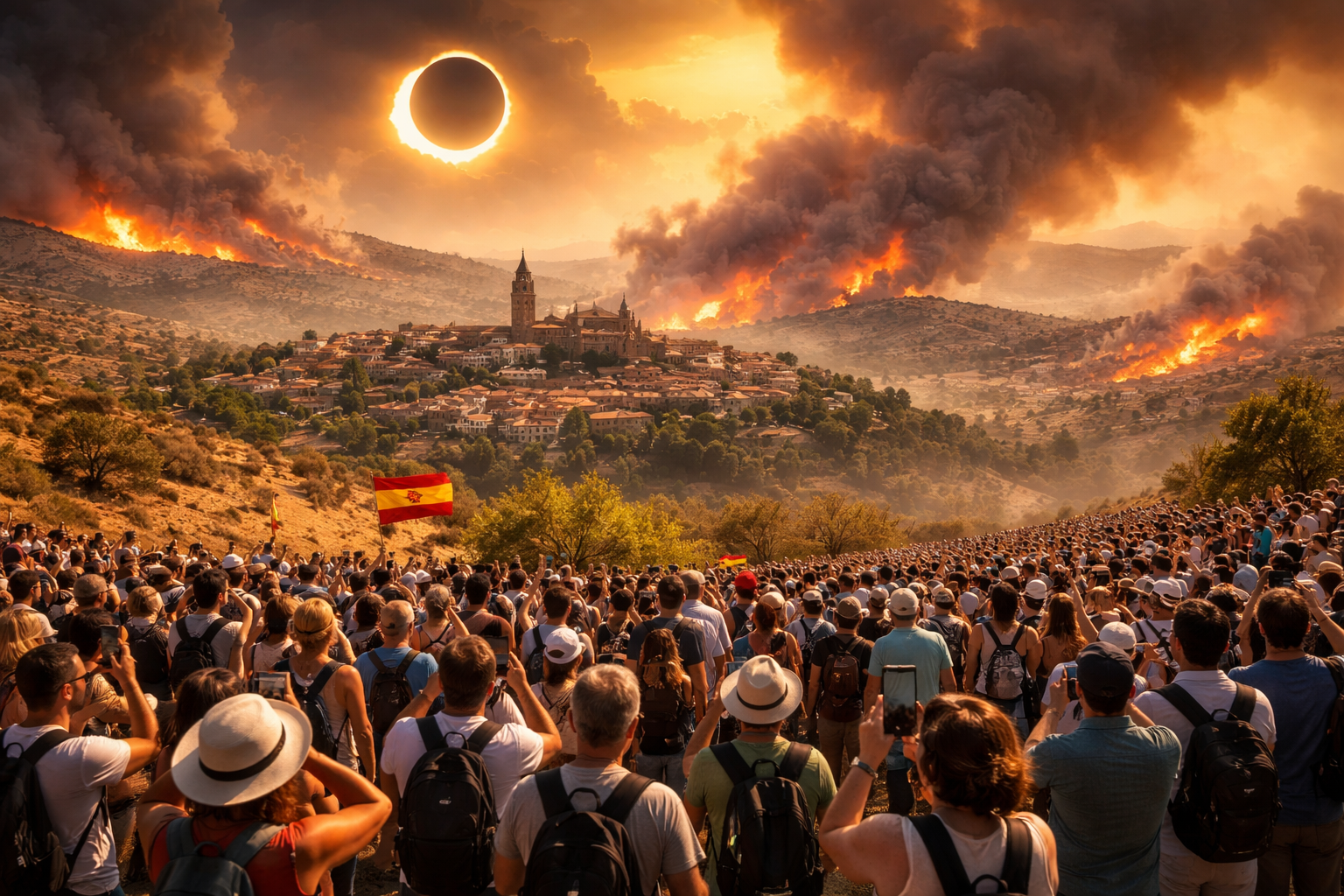
Record-breaking drought and heat in Spain increase wildfire risks as hundreds of thousands flock to view the total solar eclipse
Spain is preparing for a surge of visitors eager to witness Wednesday’s total solar eclipse, one of the best opportunities in Europe to see the celestial event. However, officials are raising alarms about the heightened risk of devastating wildfires due to prolonged drought conditions and the large crowds expected.
The country has suffered from relentless heat and a historic lack of rainfall, with July marking mainland Spain’s joint hottest month on record since 1961 and its driest July ever, according to the Spanish National Weather Agency AEMET. These extreme weather conditions have already caused significant wildfires near Madrid and other regions.
With an estimated 460,000 tourists arriving specifically for the eclipse and about 1.5 million additional car trips expected on Wednesday, emergency services face major challenges managing fire risks and traffic safety. As reported by Spanish authorities, this information was compiled from multiple sources including government statements and meteorological data.
Fire risks escalate due to dry vegetation and crowd pressures
The environment minister, Sara Aagesen, emphasized the danger, stating, “The vegetation is extraordinarily dry and the smallest spark or carelessness could lead to devastating forest fires.” Amid this, safety measures have been implemented, including bans on parking on hard shoulders and near dry vegetation, as well as prohibitions on barbecues and fireworks during the eclipse.
In Valencia, natural parks have been closed and walking on rural footpaths is banned to reduce human-triggered fire risks. Police fear that heavy traffic congestion could block emergency vehicles from reaching fires in remote areas promptly.
Solar eclipse viewing site bookings reflect enormous public interest
Spain’s total eclipse path stretches about 200 kilometers from A Coruña in the Atlantic northwest to Mallorca in the Mediterranean. Small towns and villages in the eclipse’s path have seen accommodation fully booked for months, with reports of house swaps between international visitors including those from Washington DC seeking the best vantage points.
Local enthusiasts have set up makeshift observatories while NASA has installed four powerful telescopes in the tiny village of Villalibado in northwestern Spain. This village, once abandoned and now restored as a holiday destination, was selected after an extensive search for an optimal viewing location. NASA plans to live stream the event to over 10 million viewers worldwide.
Health precautions and safe viewing urged amid eclipse excitement
Hospitals are on alert for potential eye injuries caused by unsafe solar viewing practices. Protective eclipse glasses have been distributed across Spain, but six brands were recently withdrawn for safety concerns by the consumer association FACUA.
Jesús Merayo Lloves, head of the Fernández-Vega Ophthalmology Research Institute, warned, “People should wear the glasses before, during and after the eclipse,” reminding that looking directly at the sun without protection can cause irreparable eye damage.
As millions prepare to witness this extraordinary celestial event, officials urge caution on both fire safety and eye protection. This eclipse spectacle comes at a precarious time for Spain, which remains vulnerable to wildfire threats fueled by climate change and extreme heat conditions.