

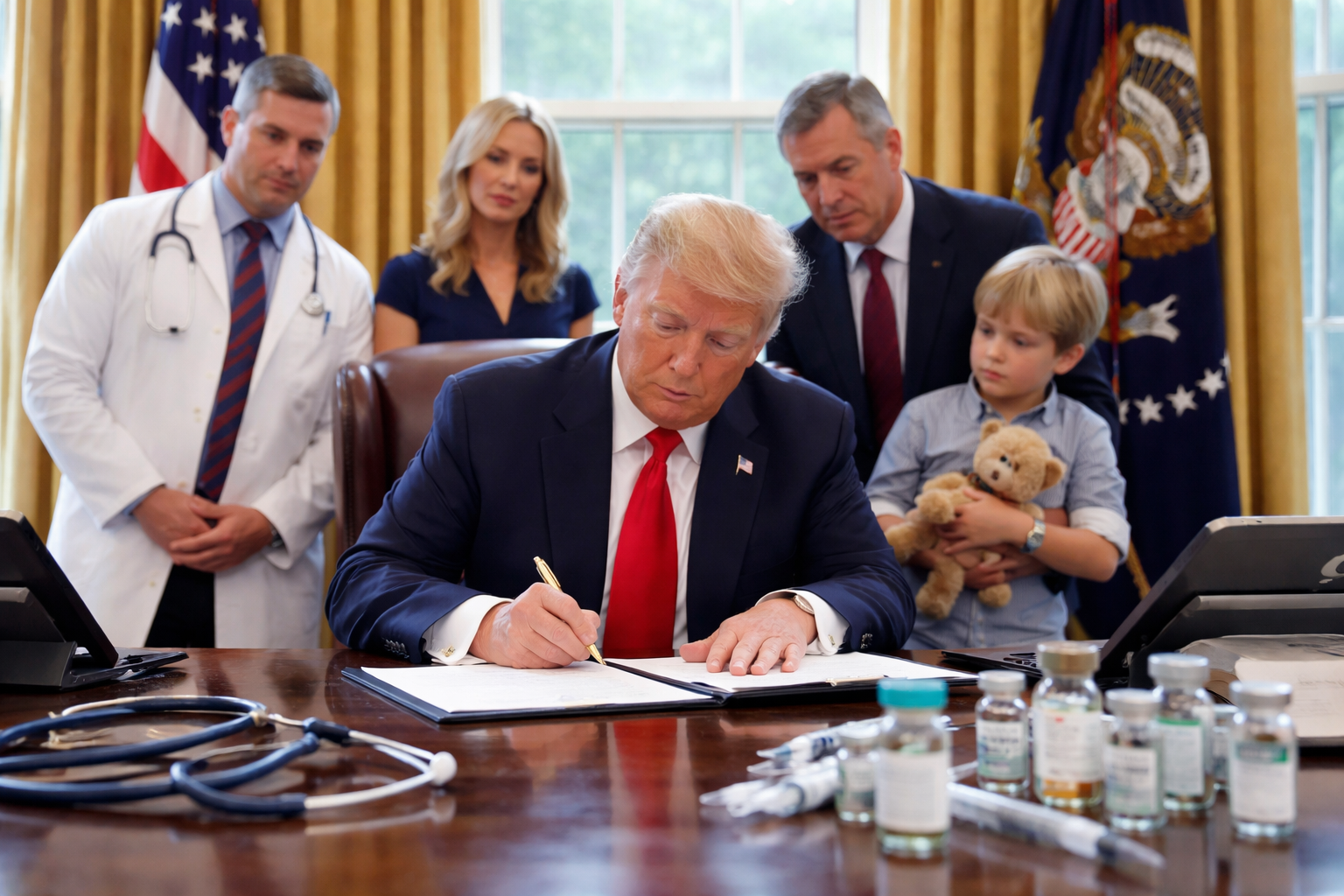
On Monday, former President Donald Trump signed an executive order proposing significant changes to the United States’ childhood vaccination policies. The directive seeks to reduce the number of recommended childhood vaccines and to separate combined vaccines—such as the combined measles, mumps, and rubella (MMR) vaccine—into individual shots given at separate medical visits.
This policy shift has drawn strong criticism from medical and public health experts who emphasize that current immunization schedules are based on extensive scientific research supporting safety and efficacy when vaccines are administered together. They warn that spacing out vaccines may leave children vulnerable to preventable diseases and increase the likelihood of missed or delayed doses.
Key Policy Changes and Government Role
The executive order supports 11 core childhood vaccinations and encourages states and territories to review their school vaccine requirements, although mandates for school enrollment are largely controlled at the state level and thus not directly affected by the federal government. The order directs the Department of Health and Human Services to enhance vaccine research and to develop plans to make single-disease versions of the MMR vaccine available in the U.S., where they are currently not licensed.
This order reiterates previous vaccine policy overhaul efforts led by Health Secretary Robert F. Kennedy Jr., who earlier sought to remove vaccines for six of 17 diseases from the schedule before being blocked in court.
Scientific and Medical Community Responses
Vaccine manufacturers and professional organizations such as Merck and the American Academy of Pediatrics have stated there is no scientific evidence supporting benefits from splitting combined vaccines like the MMR. Experts warn that prolonging vaccination schedules can increase children’s risk of falling ill during delayed intervals. The time required to develop and approve separate vaccines could exceed a decade.
Several health officials have publicly opposed the order. Louisiana Senator Bill Cassidy, a physician who once supported Kennedy’s confirmation, called the executive order misguided and stressed it would require children to receive more injections for equivalent protection. New York City Health Commissioner Alister Martin characterized the move as driven by politics and conspiracy theories rather than science.
Controversial Claims on Vaccines and Autism
In remarks endorsing the order, Trump suggested a possible connection between vaccination timing and rising autism rates, a claim that contradicts the scientific consensus. Decades of research have found no link between vaccines and autism spectrum disorder. Kennedy has previously promoted this disproven association, prior to his current government role.
Context Amid Measles Outbreak and Election Year
The announcement comes amid the worst measles outbreak in the U.S. in 35 years, as communities prepare for children to return to school. Critics of Kennedy and the administration’s vaccine policies say the order could exacerbate vaccine hesitancy and undermine public health efforts. The renewed focus on immunization policy marks a shift from the administration’s recent focus on less contentious health issues ahead of the midterm elections.