

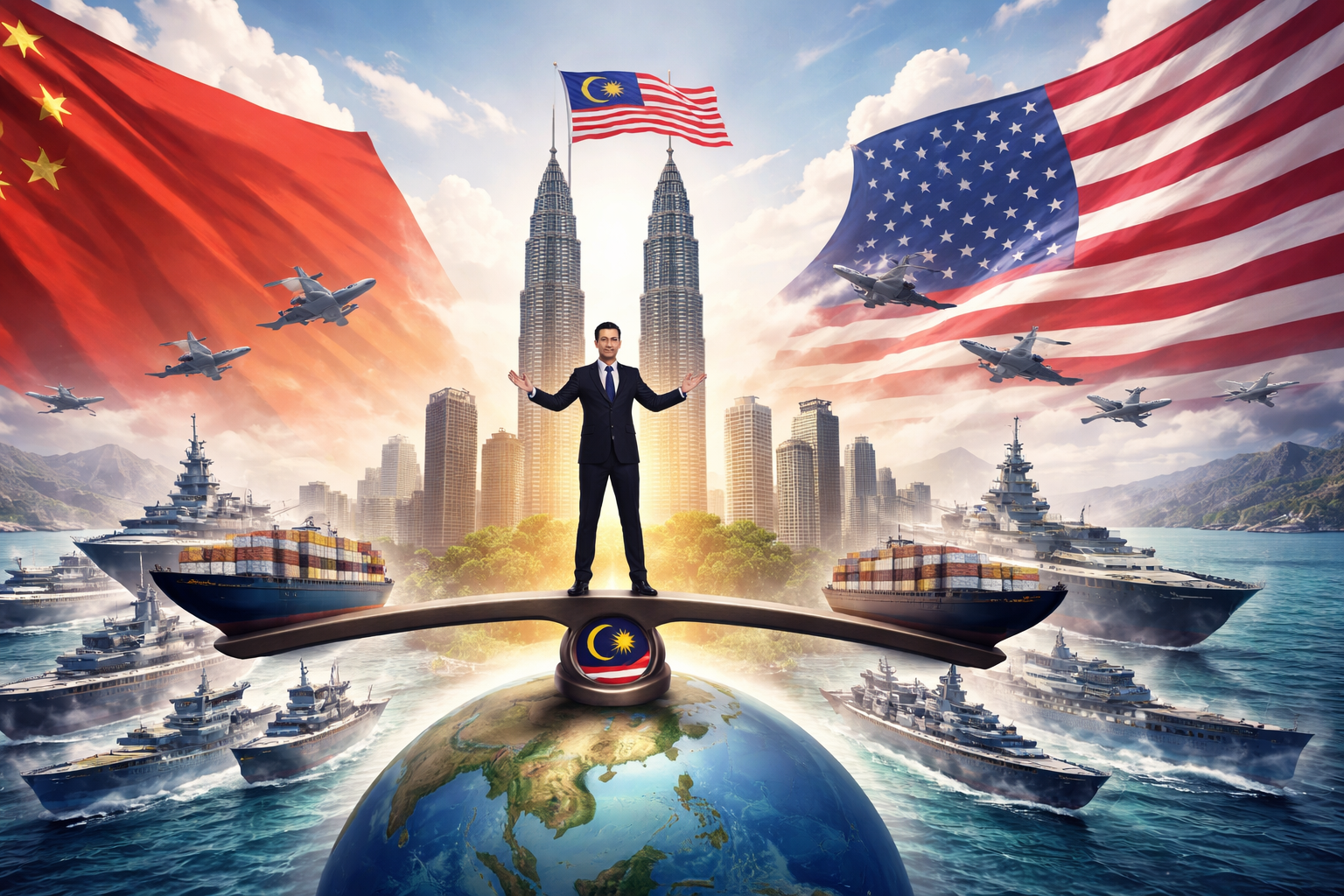
Malaysia’s balancing act between China and the US faces greater challenges
Malaysia’s effort to maintain a middle course between the United States and China is facing new strains as regional tensions rise. Malaysian Prime Minister Anwar Ibrahim’s recent comments acknowledging Taiwan as part of China and endorsing the use of force to preserve territorial unity have drawn praise from Beijing and criticism from Taipei, complicating Kuala Lumpur’s traditionally delicate diplomatic stance.
Further stirring regional unease, Anwar has expressed concerns over the expansion of US-backed military facilities on the Philippine island of Balabac, located near Malaysia’s Sabah state. This has raised questions about Malaysia’s shifting perceptions amid the growing rivalry between the two superpowers spilling into Southeast Asia.
Controversial remarks on Taiwan and regional military developments
In an interview broadcast on August 16, Anwar stated, “I see Taiwan as part of China, period.” This echoed Beijing’s long-standing position that Taiwan is a Chinese province, although Taiwan is governed democratically and claims its own sovereignty. Anwar’s additional comment that force might be justified if a province breaks away appeared to endorse Beijing’s argument that military action could be necessary to maintain national unity.
China welcomed Anwar’s remarks, while Taiwan’s Foreign Ministry warned that such positions risk undermining Taiwanese business confidence in Malaysia, particularly in the semiconductor sector critical to the region’s economy.
Just days after the Taiwan remarks aired, Anwar highlighted the need to strengthen Malaysia’s defenses in Sabah. This call was linked to the expansion of US access to Philippine military bases near Malaysian territory, including the Enhanced Defense Cooperation Agreement location on Balabac Island—approximately 31 miles from Malaysian islands Banggi and Balambangan. The agreement enables US forces to access, construct, and pre-position equipment on designated Philippine facilities.
Malaysia’s nuanced stance amid broader geopolitical pressures
Experts caution against reading these statements as a fundamental realignment of Malaysia’s foreign policy. Ngeow Chow Bing of the Institute of China Studies at Universiti Malaya noted that Malaysia maintains strong ties with the US and Western countries, despite Anwar’s increasingly warm rhetoric toward Beijing. The space for Malaysia’s traditional balancing act is narrowing but remains operational.
Analysts emphasize that Anwar’s concern about military developments near Sabah stems from long-standing territorial disputes with the Philippines over the state, which Malaysia considers indisputably sovereign. Chee Meng Tan of the University of Nottingham Malaysia stated that Malaysia’s call for stronger defenses is a normal response to a neighbor’s military build-up near contested territory, rather than a signal of alignment with China.
After the initial comments, Anwar sought to reassure that Malaysia seeks peaceful resolutions to Taiwan Strait tensions and reaffirmed its adherence to the One China policy established since 1974. Still, Malaysian analysts suggest Anwar’s rhetoric has sometimes appeared more accommodating toward Beijing than necessary, potentially creating perceptions of strategic tilt despite Malaysia’s pragmatic behavior.
Strategic challenges ahead
Beyond rhetoric, Malaysia faces an evolving strategic environment where Beijing’s growing economic and military influence and Washington’s transactional foreign policy approach complicate the traditional hedging strategy.
Anwar’s anticipated visit to China in late September to attend the Global Digital Trade Expo and meet Chinese Premier Li Qiang underscores Malaysia’s pursuit of deeper economic links with its largest trading partner. Yet Kuala Lumpur remains dependent on Western markets and technology and continues to reject Chinese maritime claims in the South China Sea that overlap with Malaysian waters.
The ultimate ability of Malaysia to balance US and China interests relies less on political statements than on its value as a partner to both sides. As Chee Meng Tan explained, China seeks friendly neighbors for trade, and the US relies on Malaysian factories, including those involved in semiconductor testing and packaging. Neither side benefits from forcing Malaysia to choose, preserving space for Kuala Lumpur to maneuver in a landscape of growing geopolitical competition.