
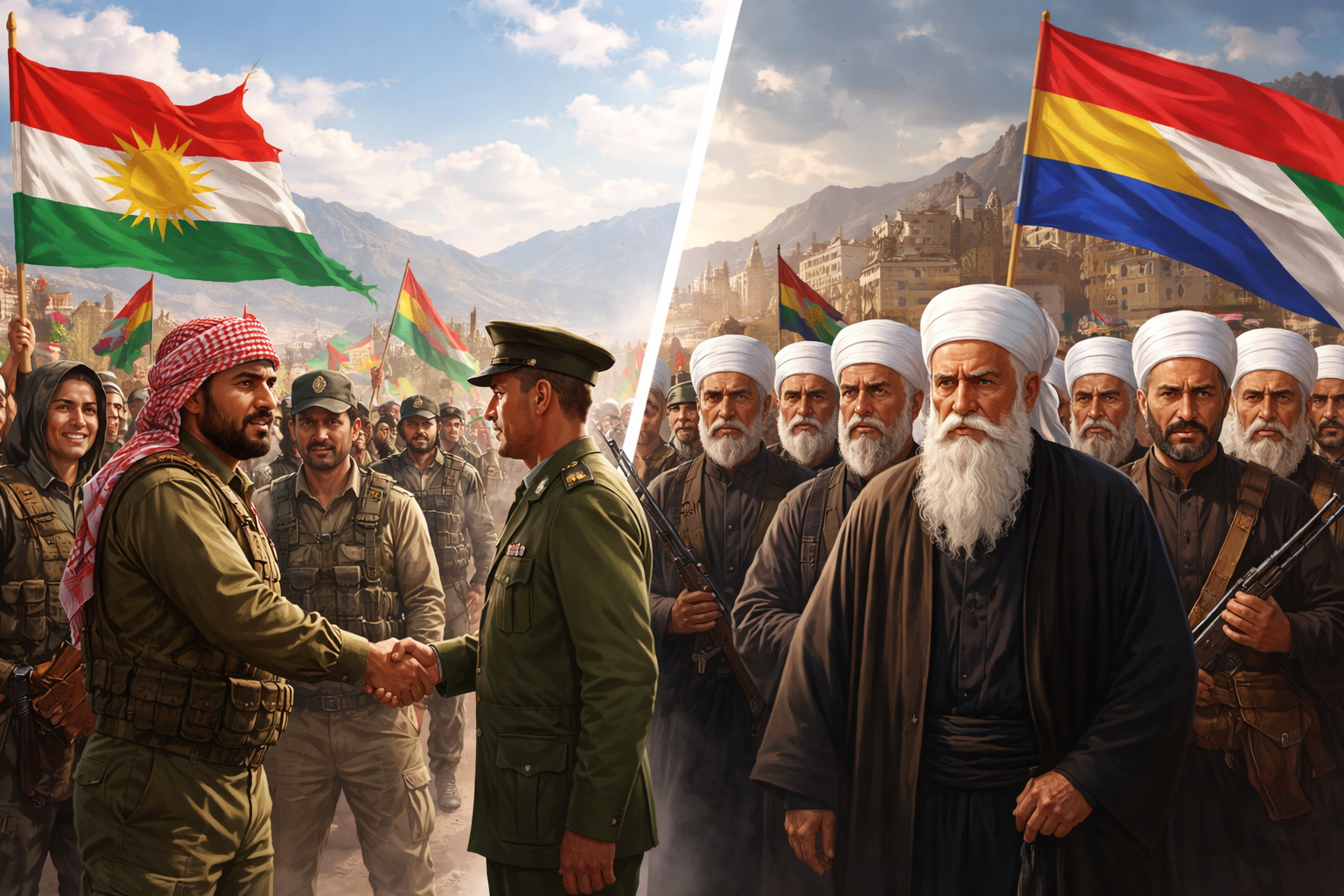
This week, Syria’s Kurdish minority decided to end their nearly 14-year experiment of autonomous governance by agreeing to reintegrate into the central Syrian state. Kurdish forces known as the Syrian Democratic Forces (SDF) will be merged into the national military, and the resource-rich northeastern region they controlled will come under Damascus’s authority.
This significant shift leaves the Druze-populated province of Sweida as the only large area in Syria that continues to reject the Syrian government’s authority. Experts suggest the Kurdish decision undermines prior proposals for a decentralized Syria, which had also influenced Druze political aims.
Kurdish Reintegration Ends Calls for Decentralized Syria
Kurdish leader Mazloum Abdi highlighted changing circumstances as key to the decision to dissolve autonomous Kurdish governance. Previously, Kurdish and Druze leaders had coordinated political strategies calling for a fragmented Syria with autonomous zones for minorities, resembling the Israeli model of regional divisions.
However, with Kurdish forces now under central control, that vision faces a critical setback. Analysts note that this development also influences the Druze community’s position on governance, diminishing prospects for their autonomous zone in the south.
Druze Opposition Deepens After July 2025 Violence
The Druze minority in Sweida remains the Syrian government’s only significant internal challenger. Relations soured following July 2025 intercommunal clashes between Druze and Bedouins, which left over 1,700 dead according to a United Nations report. Subsequent government intervention widened Druze mistrust after accusations that regime forces attacked Druze communities.
Sweida today still depends on Damascus for essential services such as pensions, salaries, power, and water, despite the government’s inability to deploy forces there. Druze leadership under Sheikh Hikmat al-Hijri openly expressed close ties to Israel, declaring the Druze ‘‘an inseparable part of the state of Israel,’’ which complicates reintegration efforts.
Political Stalemate and External Influences
Attempts in 2025 to negotiate a path toward normalization, mediated by Jordanian and American officials, were rejected by Druze factions aligned with al-Hijri. The Syrian central government has pursued a cautious approach, avoiding military escalation and instead relying on administrative and economic measures to manage the crisis.
Observers contend that any resolution will hinge largely on external actors. Israel’s strategic interests, especially in relation to Syria and Druze relations, appear paramount. Analysts predict that future political solutions regarding Sweida depend on potential security agreements between Israel and Syria.
Internal Dynamics and the Role of al-Hijri’s Leadership
Al-Hijri commands local Druze militias with Israeli military and financial support, maintaining tight control over Sweida. Reports indicate repression of dissenting Druze voices, militia infighting, and restrictions on cooperation with Damascus civil servants.
Experts doubt any internal Druze uprising against al-Hijri is likely given his military and political dominance. The current stalemate reflects a complex balance of local control, external influence, and ongoing distrust toward the Syrian government backed by violent events in recent years.