
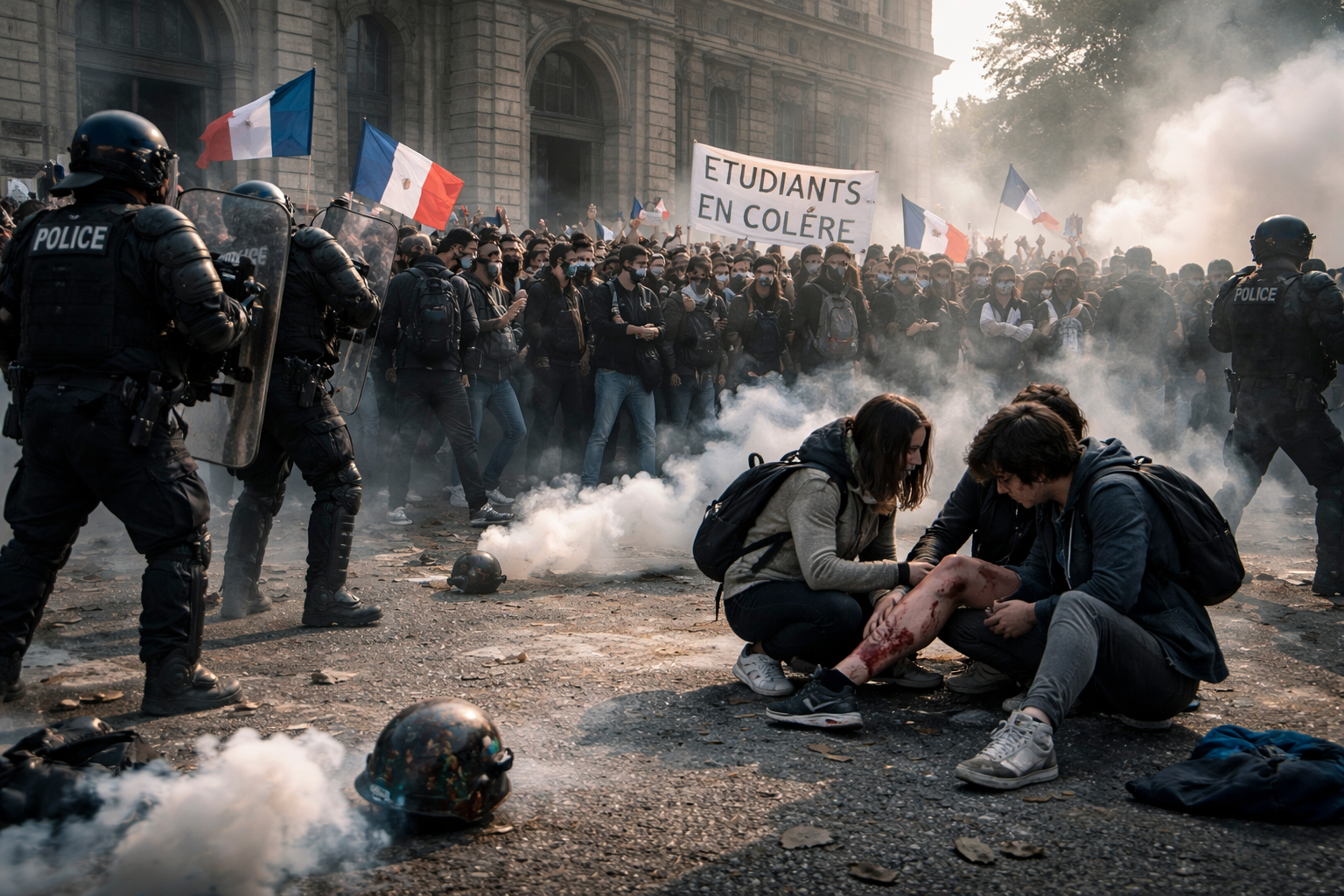
France has suspended the use of sting ball grenades— a type of police stun grenade— at student-led protests after reports of serious injuries raised public concern. The decision affects only protests involving high school students and will remain in place until investigations clarify recent incidents.
Interior Minister Laurent Nunez announced the suspension during an interview on RTL radio, responding to growing unrest and allegations of police brutality amid demonstrations sparked by educational inequality concerns.
Triggering Incidents and Public Response
The suspension follows a critical injury on Monday when a 15-year-old protester lost his hand after picking up a sting ball grenade that detonated prematurely. The weapon is designed to stun but caused severe harm in this case. Additional reports, such as a 14-year-old student injured during protests in northwest Paris, where an officer was charged for firing a tear gas canister hitting the student’s jaw, have fueled public anger.
Prime Minister Sebastien Lecornu acknowledged the underlying frustrations driving the protests, emphasizing that the anger expressed by young people stems from unmet promises and systemic issues in the education system. He reiterated that security forces have no orders to confront protesters forcibly and promised the government would unveil its initial response to the crisis by the end of October.
Misinformation and Official Warnings
The unrest has been complicated by the circulation of AI-generated videos on social media. One widely shared TikTok video falsely depicted the head of Paris police making threats about indiscriminate tear gas use and possible amputations. Paris police chief Patrice Faure publicly denied the video’s claims and warned producers of such fabricated content about potential legal consequences.
Protests’ Scale and Government Challenges
Roughly three weeks into the protests, the Interior Ministry said 761 law enforcement officers have been injured, alongside 215 students and 89 teaching staff. Demonstrations, which began in mid-September around Paris, have spread nationwide to various towns and cities, involving hundreds of thousands.
Trade unions joined the protests recently, and on Tuesday, the Interior Ministry reported nearly 256,000 participants across France. Clashes between protesters and police resulted in over 6,500 arrests over two weeks, with most detainees being minors.
Diplomatic Tensions and Broader Context
The French Foreign Ministry recently summoned Iran’s ambassador to object to what it described as a disinformation campaign by Iranian authorities linking France’s unrest to Iran’s own anti-government protests. Iran had earlier accused France of human rights abuses against protesters, drawing a parallel that France rejected.
These demonstrations unfold amid France’s broader struggles to reduce public debt and meet social spending demands ahead of presidential elections that will not feature the current incumbent, Emmanuel Macron.