

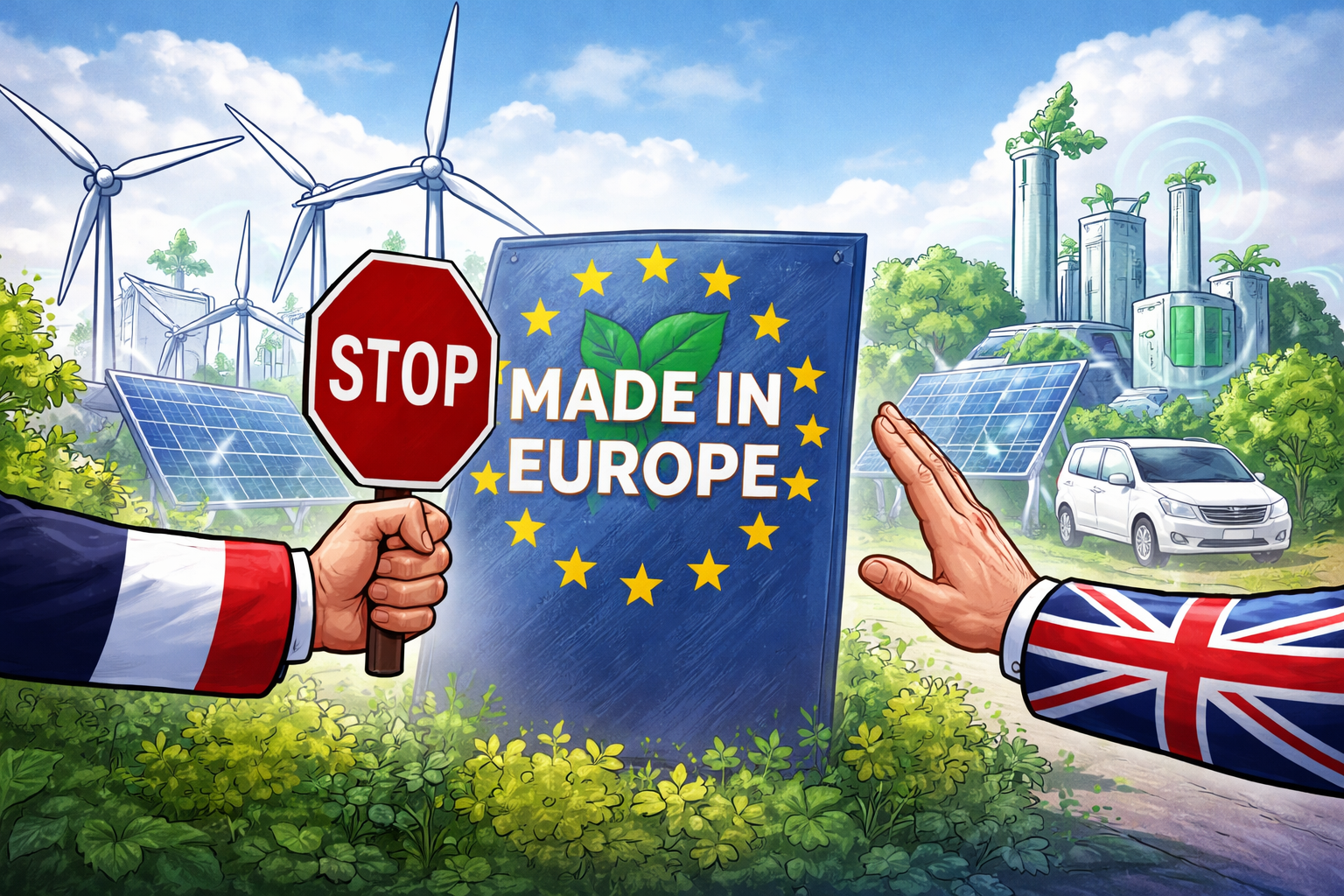
France is spearheading efforts to exclude the United Kingdom from the European Union’s proposed “Made in Europe” policy, which could significantly impact British companies’ access to subsidies and contracts for green technology and electric vehicles within the EU market.
The issue was highlighted recently when a UK official raised concerns during talks with the European Commission president amid ongoing negotiations about the policy’s scope.
Key Elements and Debates Around the ‘Made in Europe’ Policy
The “Made in Europe” framework, central to the EU’s Industrial Accelerator Act (IAA), seeks to prioritize public spending on renewable technologies and electric vehicle sectors by favoring products originating within Europe. This measure aims to shield EU firms from competition perceived as unfair, especially from China, which benefits from state subsidies.
However, there is a contentious debate within the EU about how broadly to define “Europe.” France advocates a restrictive interpretation restricted to the EU27 member countries, excluding the UK, Canada, and Japan from the benefits of the policy.
French industry officials emphasized that public funds should support European workers and factories after the UK’s decision to leave the EU. France’s Europe minister stated that financial contributions to the EU’s internal market are pivotal for receiving such protections.
Opposing Views and Broader Inclusion
Germany and several Nordic countries, including Sweden, take a different stance. Germany’s economic affairs officials argue for a wider definition that would include the UK and other allied nations, emphasizing the importance of not isolating from key partners while reducing dependency on foreign states.
Sweden’s leadership pointed out the necessity of balancing EU membership with the role of essential non-EU countries to maintain a functioning European market.
Implications for EU-UK Relations and Future Negotiations
The heated debate on the policy’s scope complicates the timing and agenda of the much-anticipated EU-UK reset summit, which remains unscheduled since leadership changes in the UK. UK officials hope the summit will occur in November, though earlier plans have been discarded amid ongoing internal EU budget negotiations expected to consume attention toward the end of the year.
EU insiders warn that firm UK demands for a deal on “Made in Europe” criteria before the EU finalizes its position could backfire, as approval among the EU27 is complex and uncertain.
Current discussions led by Ireland, which chairs the EU ministerial negotiations, aim for a December agreement on the Industrial Accelerator Act, including the “Made in Europe” provisions. However, divergent views persist regarding the inclusion of third countries like the UK.
A UK government spokesperson affirmed the UK’s commitment as a trusted European partner, emphasizing ongoing engagement with the EU to foster growth and trade.