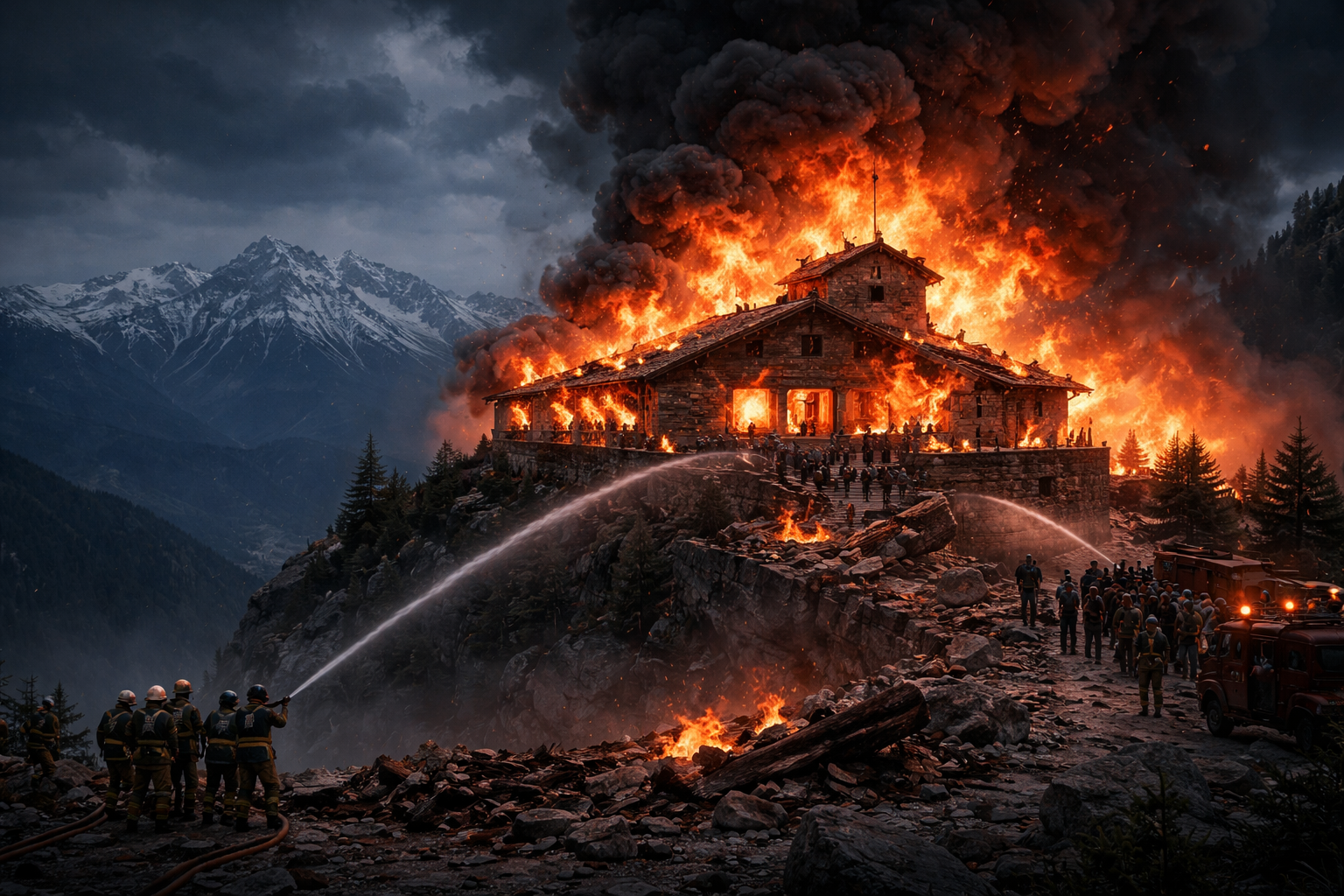
Germany’s Eagle’s Nest, Adolf Hitler’s former mountaintop retreat in the Alps, was reduced to charred ruins following a suspected arson attack on October 23. Despite the efforts of roughly 200 firefighters, the historic structure, perched nearly 6,000 feet above sea level, was severely damaged and remains closed indefinitely.
This incident has reignited a debate among historians, local authorities, and culture officials over the future of the site. The key question is whether the structure should be reconstructed or preserved as a ruin while considering the risk of it becoming a neo-Nazi shrine amid a resurgence of far-right sentiment in Germany and Austria.
The Eagle’s Nest: Symbolism and History
Known in German as the Kehlsteinhaus and designed to project overpowering influence, the Eagle’s Nest was completed in 1938 atop the Obersalzberg mountain. Its architectural style, called Überwältigungsarchitektur, was intended to intimidate visitors. The retreat was used primarily to impress state guests, diplomats, and selected foreign journalists rather than as a frequent residence for Hitler, who visited it only 14 times until 1939. Notably, Hitler’s companion Eva Braun and other close associates used it more regularly.
The lavish interior featured marble donated by Mussolini, Venetian mirrors, and plush English manor-style furnishings. A brass-plated elevator built into the rock ascended visitors directly to the site, which attracted over 300,000 tourists annually. After World War II, the area was converted into a recreation zone for U.S. troops, and the nearby Berghof residence was demolished to prevent the location from becoming a pilgrimage site for Nazi sympathizers.
Arson Investigation and Official Responses
Authorities suspect a 33-year-old individual with a history of mental illness deliberately started the fire. Fortunately, the site was closed to the public on the day of the blaze, and no injuries were reported. The property is owned by the German state of Bavaria.
Bavarian state culture authorities are convening a commission of experts in heritage conservation, architecture, and Holocaust remembrance to determine how to proceed. Markus Blume, the Bavarian state culture official, emphasized that any reconstruction effort must acknowledge the site’s dark historical context and responsibility.
Preserving History Without Glorifying Hate
Experts are divided on the best approach. Felix Bohr, a historian focusing on the Nazi period, opposes reconstruction, arguing that Hitler’s egotistical architectural legacy should remain a ruin to avoid glorifying his regime. He suggests securing the remaining structure and using it to educate visitors about the site’s history.
Sven Keller, director of the Obersalzberg Documentation Centre situated nearby, advocates transparency through public accessibility. He warns that hidden or fenced-off sites may fuel myths and become attractive to neo-Nazi factions. Keller recommends integrating the ruins into educational exhibits that also mark later historical layers, such as its postwar use and the recent arson.
Given the political landscape in Germany and Austria—with far-right parties currently gaining support—any future plans must carefully navigate the risk of turning the Eagle’s Nest into a symbol for extremist groups.