

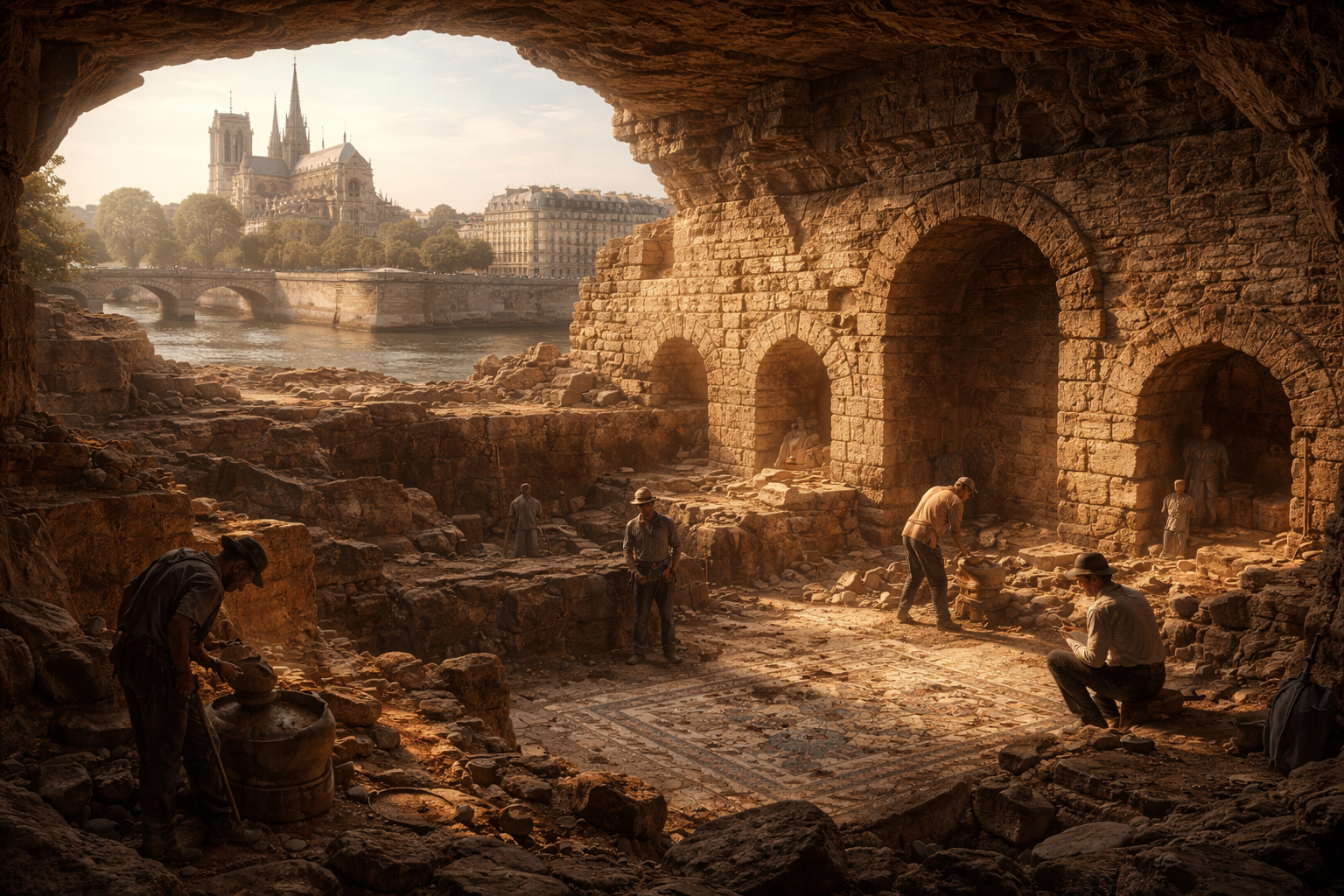
Archaeologists uncovered a roughly 20-meter section of an ancient stone-and-wood wall beneath a building on the Île de la Cité in Paris this summer. The find, dating from the Gallo-Roman period, could confirm the long-debated location of Lutetia, the precursor to modern Paris.
The wall is believed to be part of the ramparts built by the Gallic Parisii tribe who inhabited the area along the River Seine during the Iron Age. Its discovery comes near the Notre Dame Cathedral, long considered the heart of the early settlement.
Significance of the Find
The Culture Ministry of France described the archaeological discovery as a “major breakthrough,” with the wall containing traces of fire. Carbon dating of charred remains places the structure between 200 BC and 10 BC, a period that includes the 52 BC Battle of Lutetia. This correlates with Julius Caesar’s account that the Gauls set fire to their town before facing the Romans.
Confirmation of Lutetia’s Location
The Île de la Cité has traditionally been viewed as the center of the ancient city of Lutetia, though some archaeological theories have suggested the original settlement might have been located westwards in the suburb of Nanterre. This recent finding supports the Île de la Cité as Lutetia’s core, strengthening historical understanding of the city’s origins.
Official Reactions
Catherine Pégard of the Culture Ministry remarked that this could be “one of the most important remains ever discovered for understanding Gallic Lutetia,” while emphasizing the need for further verification of the wall’s exact function and precise chronology.
Historical Context
Lutetia was first referenced in Julius Caesar’s Gallic Wars, described as being situated on an island in the Seine, a description matching the Île de la Cité. The island itself is the largest in the Seine within the Paris region and later became the central point of the Roman settlement and city that evolved into today’s Paris.