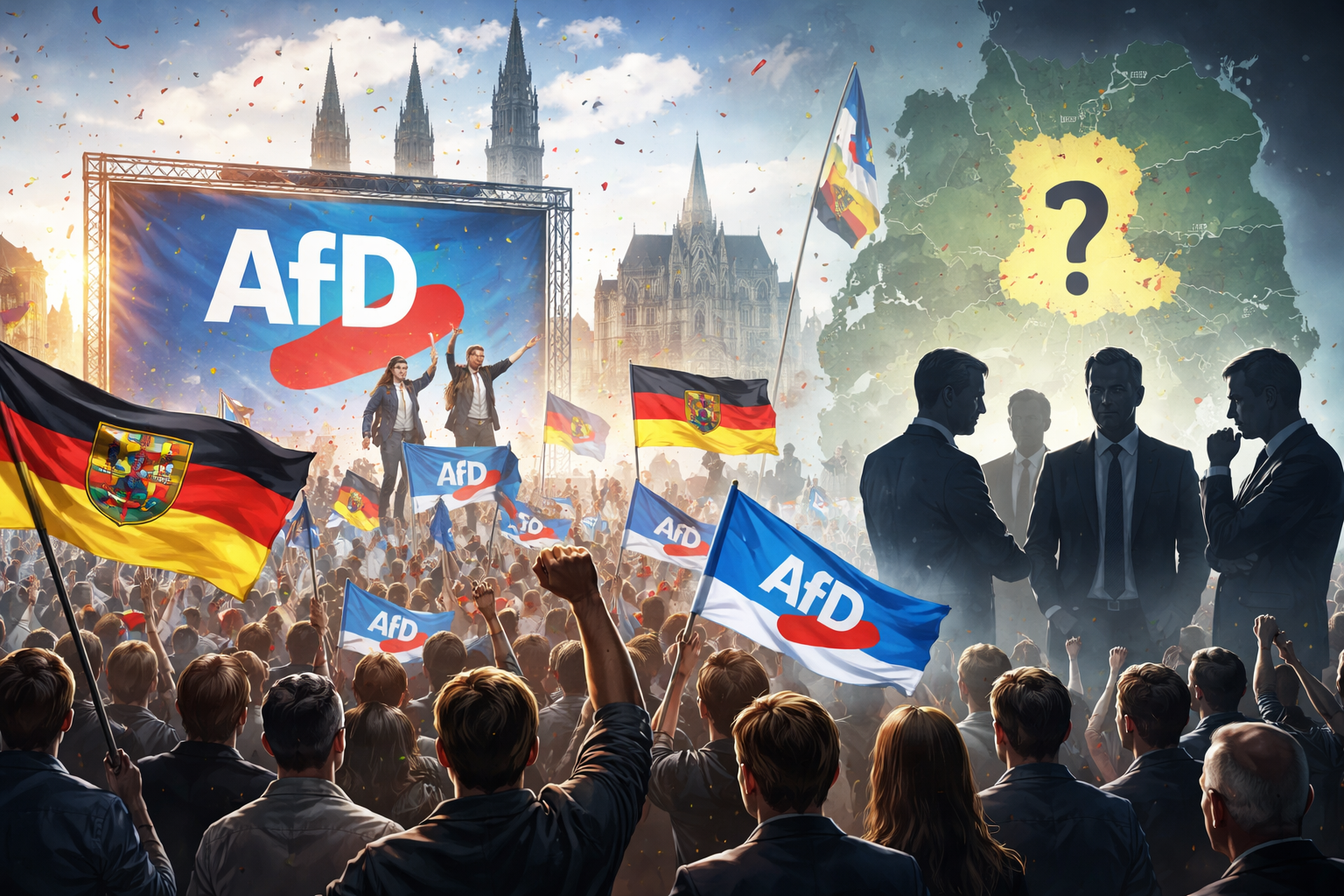
The far-right Alternative for Germany (AfD) won a historic 40% vote share in the Saxony-Anhalt state election, marking its best performance to date. Despite this significant achievement, the party does not hold a parliamentary majority needed to govern alone.
The AfD, classified as a “confirmed far-right extremist” group by the domestic intelligence agency, faces isolation from other political parties who have categorically ruled out cooperation. This situation complicates the formation of a stable regional government in the eastern German state.
AfD leaders, including Ulrich Siegmund, the party’s lead candidate in Saxony-Anhalt, along with national figures Alice Weidel and Tino Chrupalla, expressed confidence about their political future. They aim not only to influence Saxony-Anhalt but to expand their reach nationwide in coming elections.
AfD’s Governing Ambitions and Political Stance
Although narrowly missing an absolute majority, the AfD aims to solidify its position in Saxony-Anhalt and beyond. Alice Weidel indicated that the center-right Christian Democratic bloc (CDU/CSU) will struggle to win future federal elections, setting the stage for AfD’s rise. She set a goal to exceed 40% support in the next federal election, highlighting ambitions to lead Germany.
Ulrich Siegmund stressed that any cooperation with other parties will be limited by the AfD’s principles. The party rejects minority government options that require case-by-case parliamentary support, insisting instead on stable governance aligned with its platform.
Radical Platform and Policy Proposals
The AfD’s political agenda has sparked national debate, centering on stringent asylum and immigration policies. The party proposes accelerated deportation of illegal asylum seekers and a mandatory work requirement for all asylum applicants. It promises a dramatic shift in migration policy aimed at making Saxony-Anhalt and Germany less attractive to immigrants.
Besides immigration, the AfD advocates for extensive changes in public broadcasting, cuts to democracy funding, and measures against social diversity, outlining a broad reorganization of society along its ideological lines.
Coalition Prospects and Opposition Stances
Despite their electoral success, the AfD lacks willing coalition partners. The Christian Democratic Union (CDU), represented by Secretary-General Franziska Hoppermann, rules out any collaboration with the AfD or far-left groups.
The Sahra Wagenknecht Alliance (BSW), a newly represented left-wing party in Saxony-Anhalt’s parliament with a pro-Russia stance, remains a possible yet ideologically unlikely partner. Founder Sahra Wagenknecht has shown openness to dialogue with the AfD, but AfD internal circles do not widely support such cooperation.
Some AfD politicians have indicated a readiness to remain in opposition if forming a government proves impossible, intending to challenge other parties until they can secure a majority on their own.