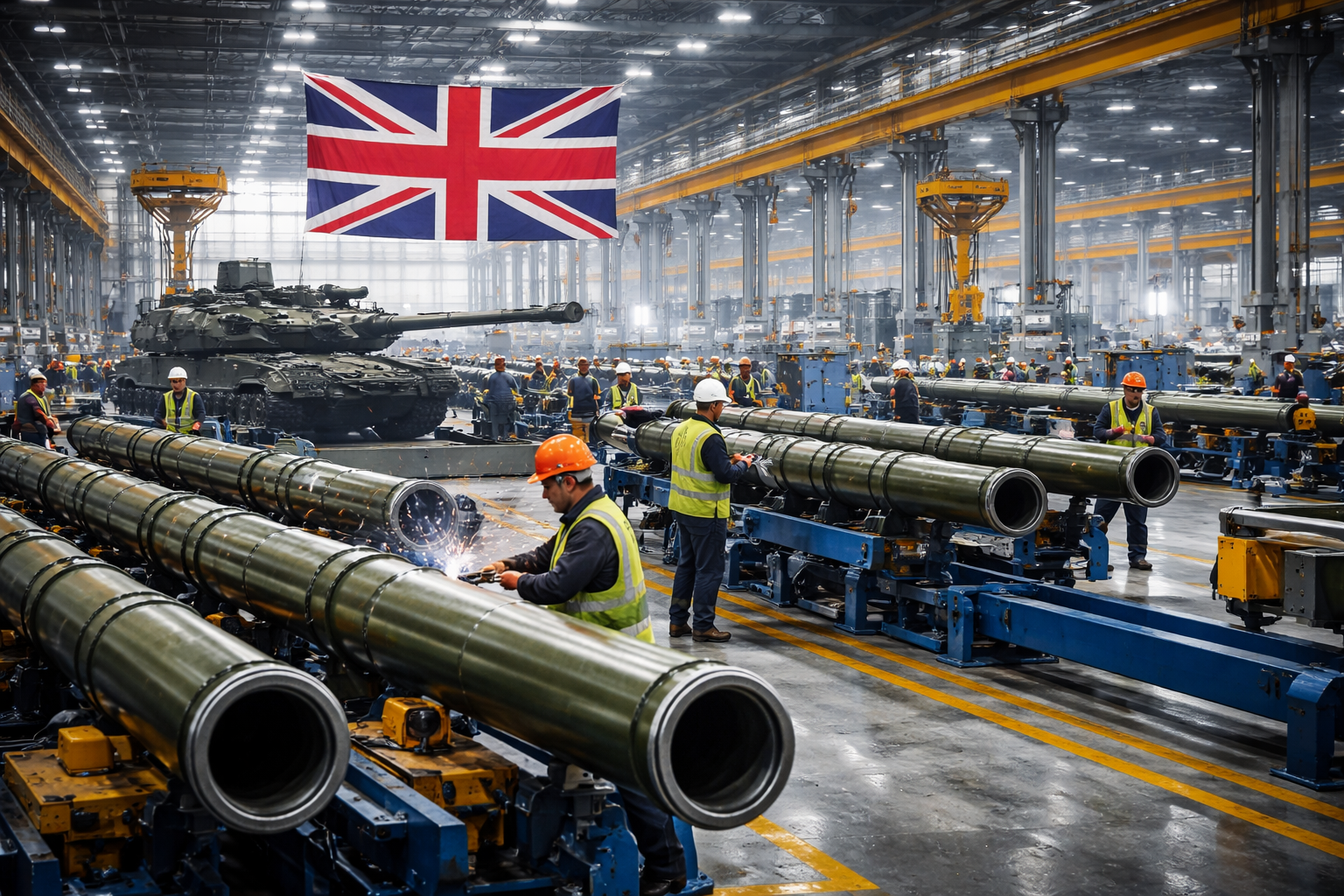
The United Kingdom has resumed domestic production of tank barrels after more than two decades of relying on foreign suppliers, marking a significant shift in the nation’s defense manufacturing strategy. This move comes amid a broader European rearmament effort triggered by Russia’s 2022 invasion of Ukraine.
The new factory, located in Telford, Shropshire, was recently inaugurated by UK defense officials at a facility built by Germany’s Rheinmetall. The company rapidly established the plant, beginning investments before formal contracts were finalized, highlighting the urgency to boost artillery and tank barrel production capabilities.
Production Capabilities and Technology
The Telford facility is equipped to process 3.2-ton, 8-meter steel alloy cylinders, machining them to precise barrel specifications. Unique technologies in the factory allow for spiral rifling to improve artillery accuracy and specialized machines to harden barrels to withstand extreme explosive pressures. The barrels produced can propel shells up to 30 kilometers and boast a lifespan capable of enduring up to 4,000 rounds, significantly higher than comparable Russian barrels.
Initially, the factory focuses on manufacturing barrels for German-made self-propelled howitzers using NATO-standard 155mm ammunition. Plans include expanding to produce 120mm tank barrels, compatible with the British Challenger 3 tank and upcoming remote-controlled howitzers scheduled beyond 2028.
Strategic and Historical Context
The UK’s inability to produce tank barrels for two decades followed the closure of its historic Royal Arsenal operations in Woolwich in 1967. The new Telford gun hall represents a revival of centuries-old artillery manufacturing traditions diminished after the Cold War. UK defense officials emphasized that rapid production at scale is now critical, reflecting the evolving nature of modern warfare which combines traditional firepower with newer technologies like drones.
The factory, with capacity for 245 barrels and 50 breeches annually, can expand production to up to 1,000 barrels per year if demand increases. Rheinmetall, which employs hundreds in Telford primarily for armored vehicle manufacturing in partnership with BAE Systems, sees this expansion as part of a growing European trend toward securing more autonomous weapons production capabilities.
European Cooperation and Defense Industry Implications
The establishment of the Telford factory follows a 2024 agreement between UK and German leadership to bolster collaboration between Europe’s two largest defense spenders. Rheinmetall has notably increased its market value amid increased European defense spending and arms support for Ukraine, partly driven by efforts to reduce reliance on U.S. arms suppliers.
Rheinmetall’s CEO highlighted that strong defense industries underpin strong armies, emphasizing that sovereign manufacture of weapons is becoming a priority among NATO allies. This development also hints at potential future exports and increased ammunition production within the UK as the geopolitical landscape pushes Western nations toward enhanced military readiness.