
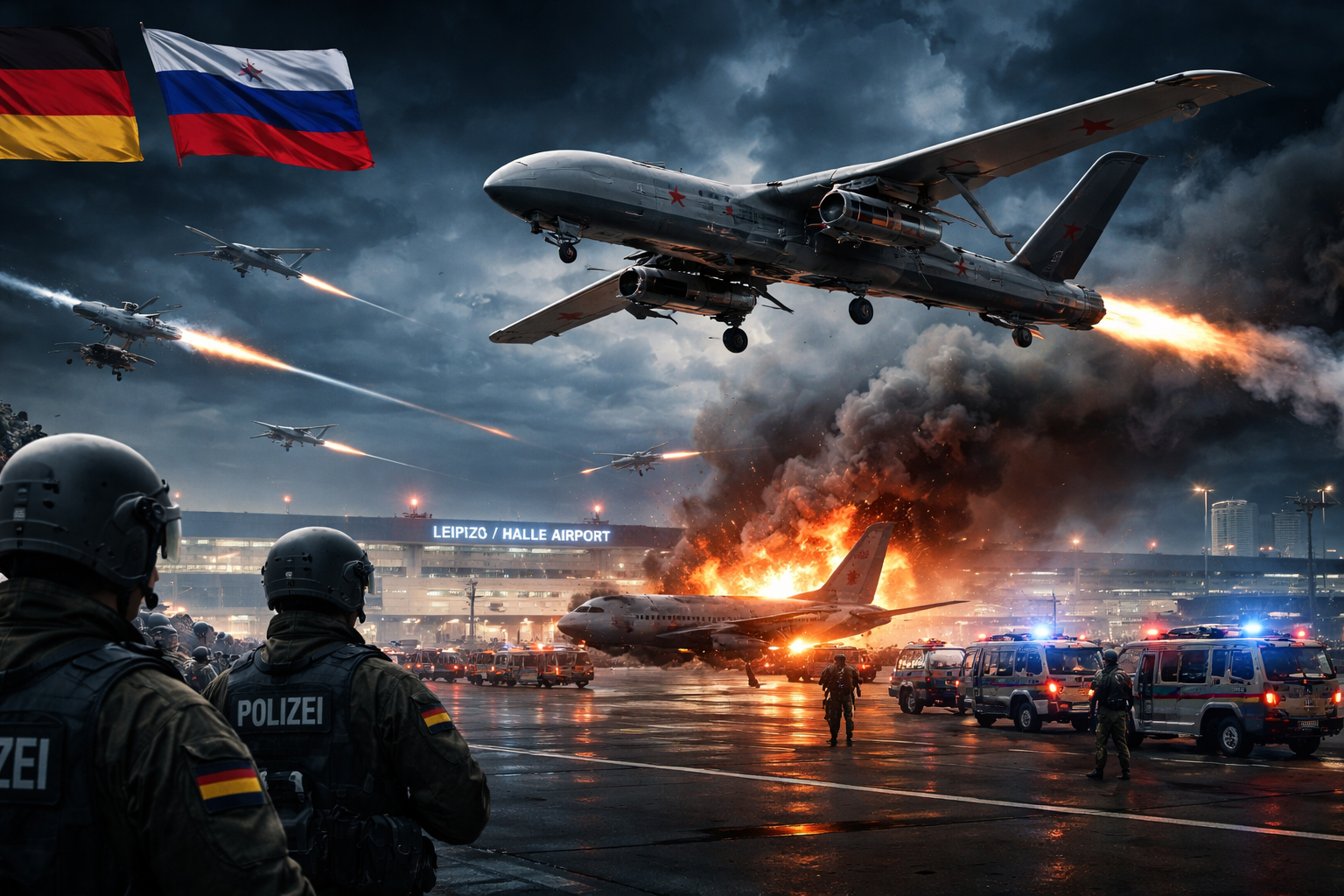
Germany announced on Tuesday that it attributes responsibility to Russia for an attempted drone attack at Leipzig/Halle Airport that occurred on August 4. Authorities discovered drones equipped with explosives and detonation systems within the airport’s security area, which German officials link to Russia through patterns consistent with previous hybrid warfare tactics used in the conflict involving Ukraine.
Interior Minister Alexander Dobrindt stated at a Berlin press conference that the German government concludes Russia orchestrated the hybrid attack. Foreign Minister Johann Wadephul detailed that the drone technology employed matches components and methods known from other Russian operations, describing the incident as part of a broader series of destabilizing actions aimed at Europe.
Details of the Attack and Investigation
The investigation uncovered multiple explosive-laden drones near Ukrainian cargo aircraft and close to a DHL plane at Leipzig/Halle Airport. Federal prosecutors characterized the incident as a serious assault on Germany’s transport and logistics infrastructure. Officials have raised concerns that this is not an isolated event, warning that Germany remains a likely target for future hybrid attacks by Russia.
German Government Response
While emphasizing that Germany is not at war, Interior Minister Dobrindt described the country as a regular target of hybrid warfare and pledged a measured but firm response to the attack. Foreign Minister Wadephul announced plans to tighten entry controls for Russian nationals and to propose additional EU sanctions targeting Russian individuals. Diplomatic steps include summoning the Russian ambassador, closing the Russian consulate in Bonn starting September 18, and withdrawing permission for the operation of the Russian cultural center known as the “Russian House” in Berlin.
Wadephul underscored Germany’s commitment to protecting social cohesion and maintaining a security course aligned with European and NATO partners. He reaffirmed ongoing support for Ukraine in its defensive efforts against Russian aggression.
International Reactions
NATO Secretary General Mark Rutte expressed full solidarity with Germany and affirmed the alliance’s resolve to bolster deterrence and defense against threats. European Commission President Ursula von der Leyen highlighted a unified stance against Russian aggression and pledged to stand with Ukraine for as long as necessary.
The European Union’s foreign affairs chief Kaja Kallas acknowledged Russia’s involvement as clear but reserved further comment pending Germany’s identification of responsible parties. She warned about Moscow’s increasing provocations and the need to deter escalation.
Russian and Ukrainian Responses
Russian President Vladimir Putin denied the accusations, claiming Germany sought to deflect from domestic challenges by blaming Russia and asserting that the evidence had been fabricated. Conversely, Ukraine welcomed Germany’s decisive actions and praised close cooperation to defend critical infrastructure and impose sanctions against Russia.