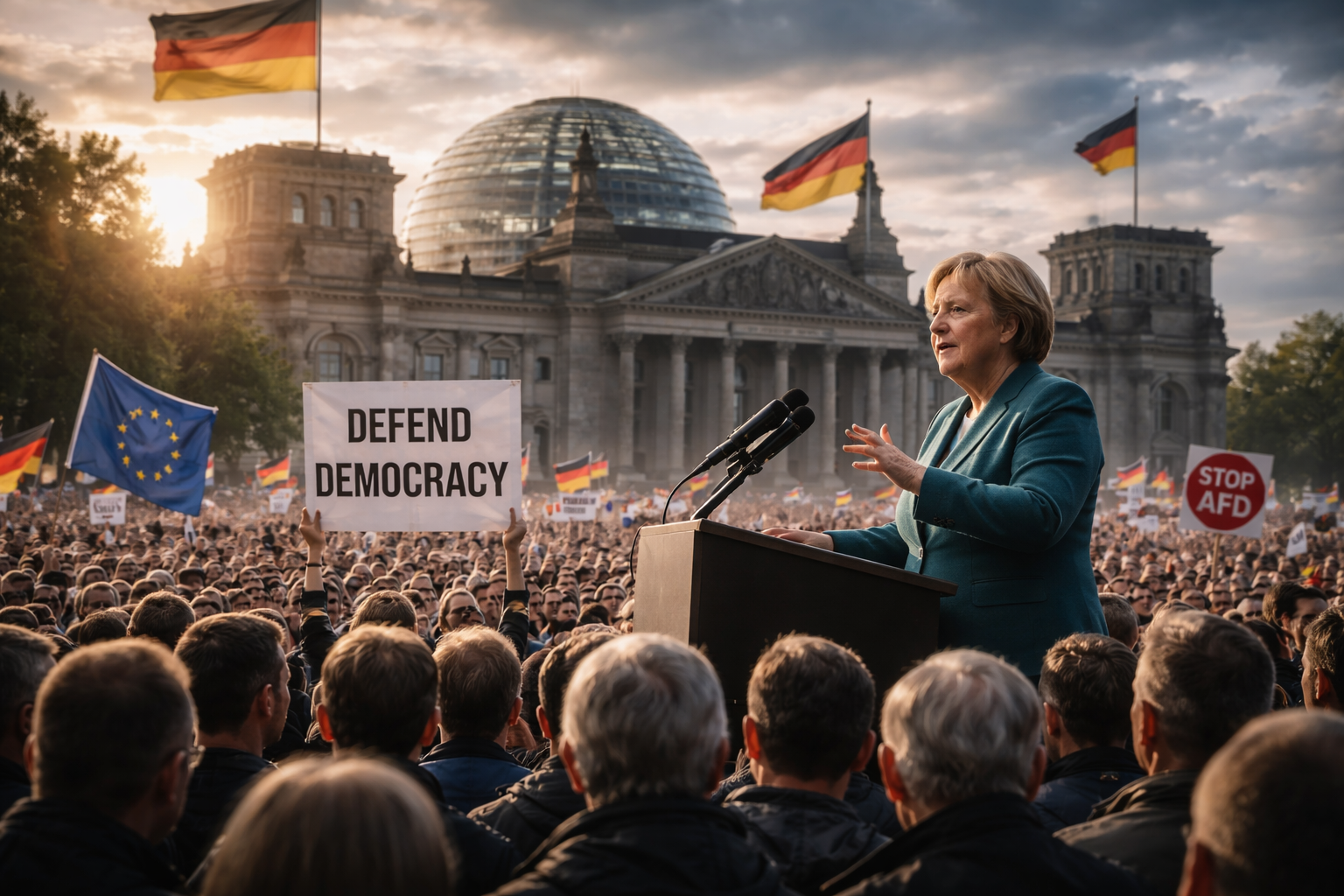

Angela Merkel has called on Germans to “stand up” for democracy as the state election in Saxony-Anhalt approaches, where the far-right Alternative for Germany (AfD) party is leading the polls. In a political event in Berlin, she emphasized the need for citizens to defend democratic values amid rising support for the AfD.
The AfD’s popularity, particularly strong in Saxony-Anhalt, poses questions about the future political landscape in the eastern German state and beyond. Merkel highlighted the importance of acknowledging that the majority of Germans do not support the AfD despite its prominence in political discourse.
Calls to Ban Radical AfD State Branches
Senior politicians, including Defense Minister Boris Pistorius and Baden-Württemberg Premier Cem Özdemir, have urged for legal proceedings to ban the most radical regional AfD branches, especially in the eastern states of Thuringia, Saxony, Saxony-Anhalt, and Brandenburg. Their concern centers on the “völkisch” faction within the party, which reportedly embraces ethnonationalist views conflicting with Germany’s constitutional principles.
However, some politicians caution against selective bans, noting the entire AfD challenges democratic values, not just certain factions, according to Green Party lawmaker Irene Mihalic.
Youth Support and Election Impact
The AfD’s lead candidate in Saxony-Anhalt, Ulrich Siegmund, has gained notable popularity among young voters, presenting himself as a revitalizing figure aiming to restore Germany’s standing. This development marks the first time since World War II that a far-right party could potentially lead a German state government, increasing the stakes of the election scheduled for September 6.
Broader Political Context and Concerns
Merkel pointed out that the AfD’s influence has extended beyond eastern Germany, becoming a nationwide phenomenon. The party’s rise overshadows other political discussions, leading to voter confusion about alternative policies.
As debate around the AfD intensifies, authorities are also focusing on measures to address political extremism, reflecting broader concerns about the party’s impact on Germany’s democratic framework.