

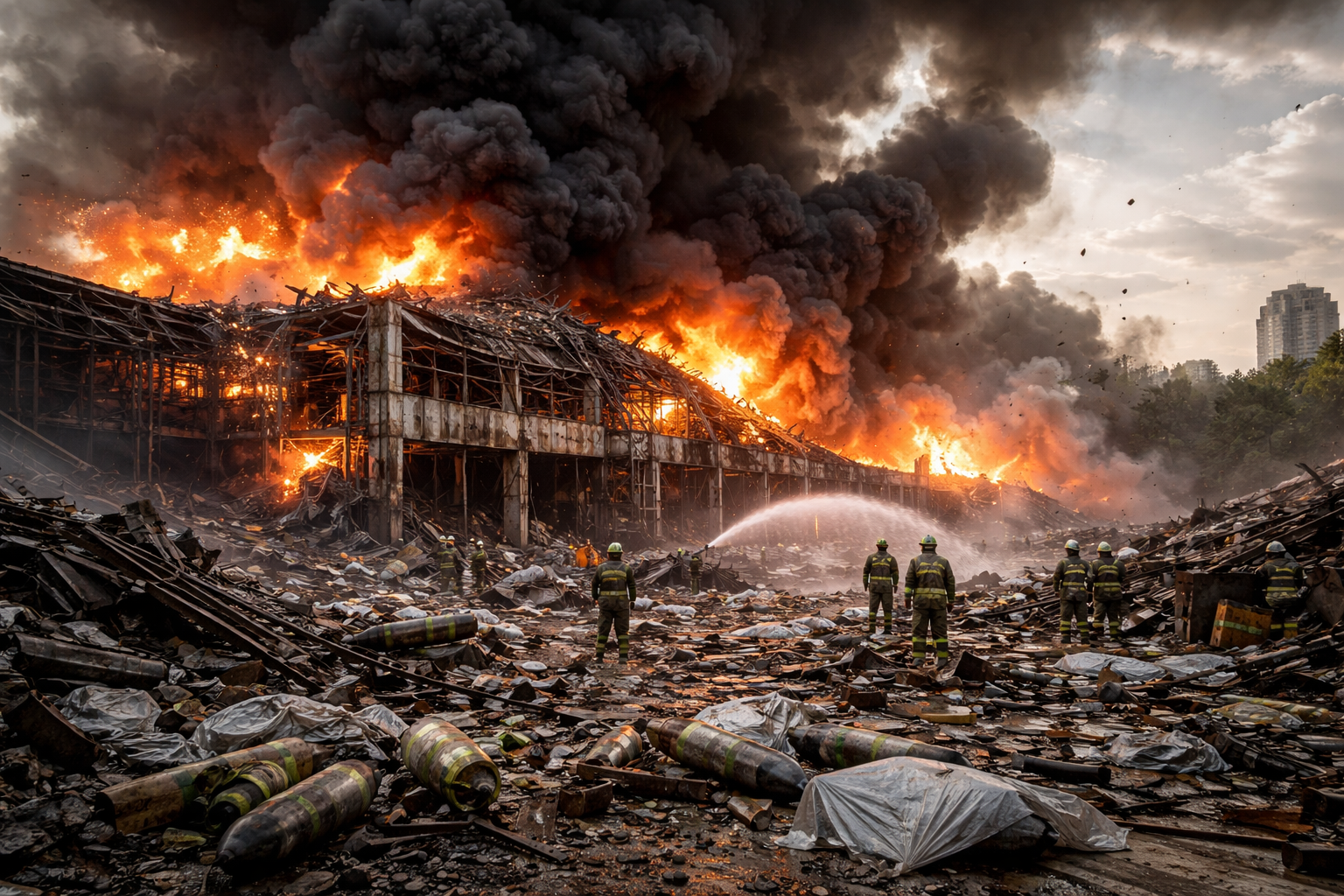
Russian drone attack on Kyiv warehouse storing weapons kills at least 37, prompting Ukrainian probe into munitions storage near homes
A deadly Russian drone strike hit a warehouse near Kyiv’s western suburbs, killing at least 37 people and injuring 42 more, including children, while damaging dozens of residential buildings and sparking massive explosions and fires.
The warehouse in the town of Myla stored shells, drones, and other munitions belonging to the Ukrainian military. The strike has raised serious questions about the legality and safety of storing explosive materials so close to residential neighborhoods.
Ukrainian authorities launched a criminal investigation into how the munitions were kept near homes, highlighting repeated safety failures despite previous tragic incidents. These developments emphasize the ongoing risks faced by civilians in conflict areas.
According to reports from Ukrainian prosecutors and officials, as well as statements from President Volodymyr Zelenskyy and regional authorities.
Devastation and casualties from the Myla warehouse strike
The drone strike caused widespread destruction in the Bucha district of the Kyiv region. At least 50 residential buildings suffered damage, including a care home for elderly and disabled people. The explosion triggered fires and further detonations of shells and mines stored in the depot.
Tymur Tkachenko, regional governor, confirmed that 37 people lost their lives and 42 were injured, among them four children. The Ukrainian president said over 370 residents had been evacuated from the area, a process that remained underway following the attack.
Among the victims was Taras Didych, head of the Dmytrivka community, who died heroically while rescuing others during the strike.
Ukrainian authorities investigate negligence amid repeated storage breaches
The Ukrainian government opened criminal proceedings on charges of official negligence related to the storage of munitions near residential buildings. President Zelenskyy emphasized that regulations clearly prohibit keeping ammunition close to homes, yet this warehouse contained explosive materials that “should not have been there.”
Prime Minister Serhii Koretskyi expressed regret that lessons were not learned from a similar incident in July, when a strike on a munitions depot in Vyshneve killed 22 people and caused fires in nearby homes. Investigations then revealed serious failings by a state company responsible for compliance with storage regulations.
Koretskyi said, translated, “Unfortunately, we can already see that the terrible tragedy in Vyshneve did not become a lesson. In the fifth year of a full-scale invasion, making the same mistakes is criminal negligence. And all those guilty, without exception, must be severely punished so that such situations do not happen again.”
Russian defense ministry claims targeted attacks on military infrastructure
In a statement, Russia’s Ministry of Defence disclosed that the strike hit a warehouse in Myla storing components and launch boosters for long-range drones. The ministry also reported attacks on the ports of Mykolaiv and Izmail, along with warehouses holding parts for Ukraine’s Flamingo cruise missiles near Kyiv.
These coordinated attacks in several strategic locations indicate Russia’s ongoing campaign to disrupt Ukraine’s military supply chains and capabilities.
Continued attacks and casualties in southern Ukraine
In addition to the Kyiv region strike, Russian attacks elsewhere continued to cause civilian casualties. In southern Ukraine’s Kherson region, two people were killed and 27 injured, including a child, according to local officials on Saturday.
The escalating attacks underscore the persistent dangers faced by Ukrainian civilians and the urgent need for improved safety measures around military facilities, particularly those near populated areas.