

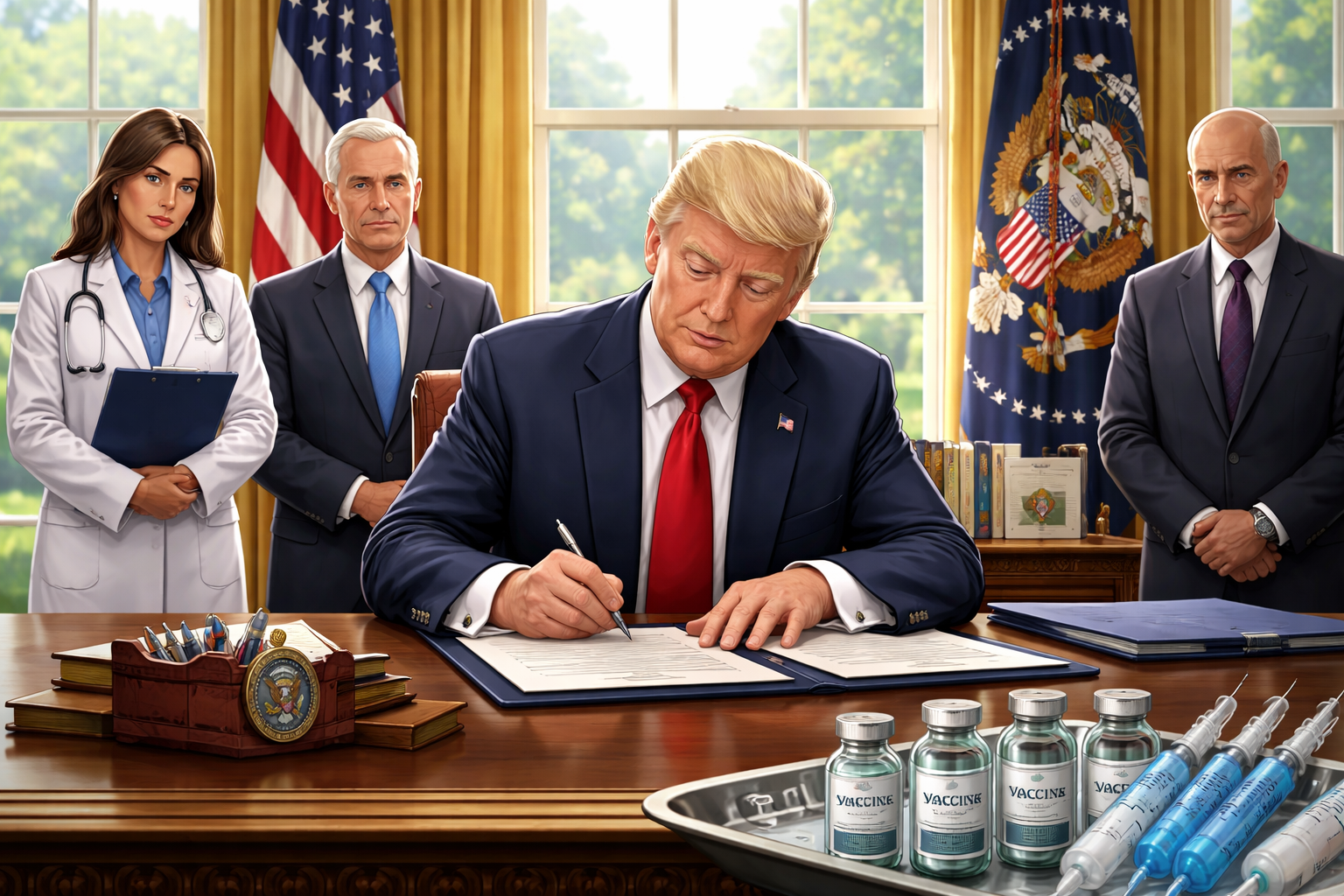
President Donald Trump signed an executive order directing significant changes to U.S. childhood vaccine policies, including recommending fewer combined immunizations and increasing the spacing of vaccine appointments for children. The order proposes splitting the combined measles, mumps, and rubella (MMR) vaccine into three separate shots and encourages administering vaccines during different visits whenever possible.
These changes have raised concerns among public health experts who warn that altering vaccination schedules without scientific support could leave children vulnerable to preventable diseases. The medical community has broadly rejected the claims underpinning the order, emphasizing that current vaccination practices are based on extensive research.
Details of the Executive Order and Proposed Changes
The executive order instructs federal agencies to support 11 core childhood vaccines and urges states to review vaccine requirements for school enrollment. However, the federal government has limited authority over school vaccine mandates, which are primarily regulated at the state level. Thus, the order serves mainly as a recommendation on those matters.
Additionally, the order calls on the Department of Health and Human Services to enhance vaccine research and develop a plan to introduce separate vaccines for measles, mumps, and rubella in the U.S., where such single-antigen vaccines are not currently licensed. These proposals align closely with prior efforts led by Health Secretary Robert F. Kennedy Jr., who has sought to remove certain vaccines from the childhood immunization schedule but faced judicial blocks.
Medical Expert Concerns on Vaccine Scheduling and Safety
Health authorities caution that childhood vaccination schedules are carefully designed based on rigorous scientific studies to ensure vaccines are administered safely and effectively in combination. They warn that spreading vaccines over multiple visits increases the risk that some children might remain unprotected longer or miss required doses altogether.
Merck, a vaccine manufacturer, stated there is no scientific evidence supporting any benefit from separating the MMR vaccine. Experts estimate it could take more than a decade to develop and approve separate vaccines for these diseases in the U.S. The American Academy of Pediatrics advises continuing to use current vaccines with proven safety records.
Controversial Statements Linking Vaccines to Autism
In statements regarding the order, Trump suggested a possible connection between the number or timing of vaccines and rising autism spectrum disorder rates, a claim that contradicts extensive scientific consensus and decades of research showing no link. Secretary Kennedy has also promoted this disproven theory and previously founded an anti-vaccine organization.
Political and Public Health Reactions
Medical professionals and officials have publicly opposed the order. Senator Bill Cassidy, a physician and Senate health committee chair, called it misguided and pointed out that separating combination vaccines could result in children receiving more shots, not fewer. New York City’s Health Commissioner criticized the order as politically driven and lacking scientific basis, emphasizing that vaccination guidelines should not be determined by the president.
The timing of the order is notable as the U.S. faces its worst measles outbreak in 35 years and children prepare to return to school. Critics argue Kennedy’s longstanding vaccine skepticism has contributed to increasing vaccine hesitancy amid this public health challenge.