
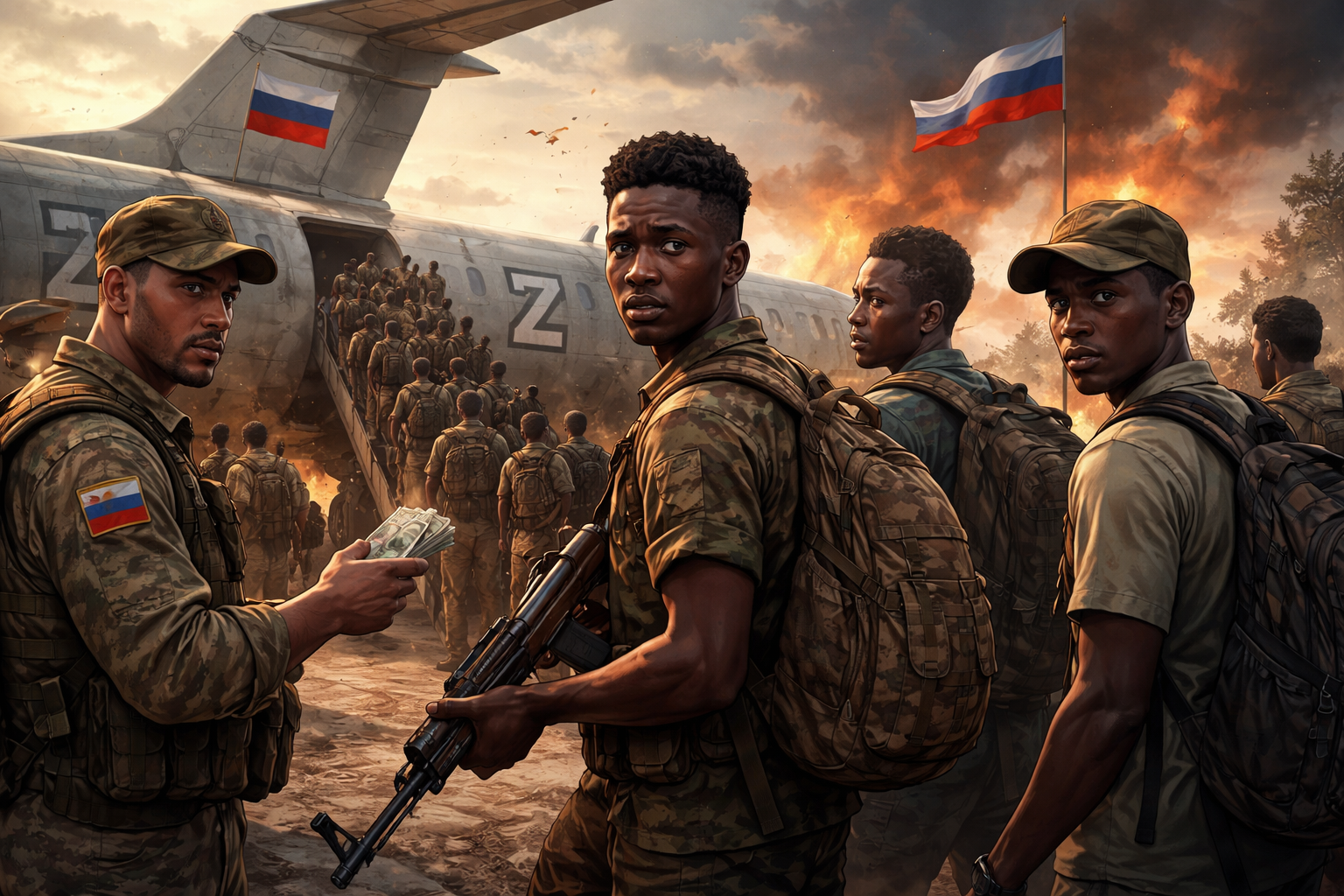
Thousands of young men from Cameroon are reportedly recruited by Russian forces and sent to fight in the war in Ukraine, with many deceived by promises of legitimate employment and rapid citizenship. Ukrainian sources indicate that nearly 3,000 Africans, including a significant number from Cameroon, have fought or are currently fighting for Russia as of May 2023.
The Cameroonian government has confirmed the deaths of at least 16 nationals reported by Russia, seven of whom died directly in combat in Ukraine. Observers believe the actual number is much higher, citing reports from grieving families and investigative accounts from Cameroon’s northwest region.
False Job Offers and Cultural Programs Mask Military Recruitment
Reports detail that many young recruits believe they are securing jobs in construction, security, or educational programs when they travel to Russia. Once there, however, they find themselves conscripted into frontline combat roles. Analyst Banjo Herman from the University of Bamenda highlights Russian operations such as the paramilitary Wagner Group and its successor, the Africa Corps, as central to these recruitment efforts.
Russian government-led initiatives, including the “African Initiative” and “Alabuga” programs, present as cultural or educational exchanges but have been linked to covert military recruitment of Africans. Offers of expedited Russian citizenship within six months also serve as a powerful lure for economically vulnerable individuals.
Economic Desperation Fuels Risky Recruitment
The dire economic situation in Cameroon is a principal driver of this phenomenon. With average monthly incomes often below 100,000 CFA francs (approximately 175 USD), the prospect of salaries exceeding 3 million CFA francs (over 5,000 USD) in Russia appeals strongly to many young men despite the risks. Some recruits accept these offers fully aware of the dangers, motivated by financial necessity and the possibility of legal status in Russia.
In some cases, individuals who have lived in Russia for years have been gradually absorbed into military ranks and appear to be doing relatively well, highlighting a complex mix of voluntary enlistment and coercion.
Families Left in the Dark, Governments Face Challenges
Families often learn of deaths years later, sometimes through fellow soldiers contacting them, with little to no compensation provided by the Cameroonian government. Communication from recruits typically ends abruptly after deployment, leaving families in distress and uncertainty.
International law allows foreign nationals to enlist voluntarily in other nations’ armed forces but prohibits recruitment involving fraud, coercion, or mercenary activity. Analysts argue that Russia shirks legal responsibility by disguising recruitment and by assigning liability largely to individuals and families.
Cameron’s government maintains it does not deploy troops abroad outside international mandates and warns citizens against engaging in foreign conflicts. However, experts call for a threefold response including economic reforms, diplomatic engagement with Russia to stop recruitment networks, and public awareness campaigns. Ghana has formally addressed the issue with Russia, demanding an end to recruitment of its nationals, but longstanding military ties between Cameroon and Russia complicate any firm government stance.
According to analysts, building inclusive governance and creating domestic opportunities will be key to protecting youths from deceptive recruitment while official policies addressing the issue remain limited.