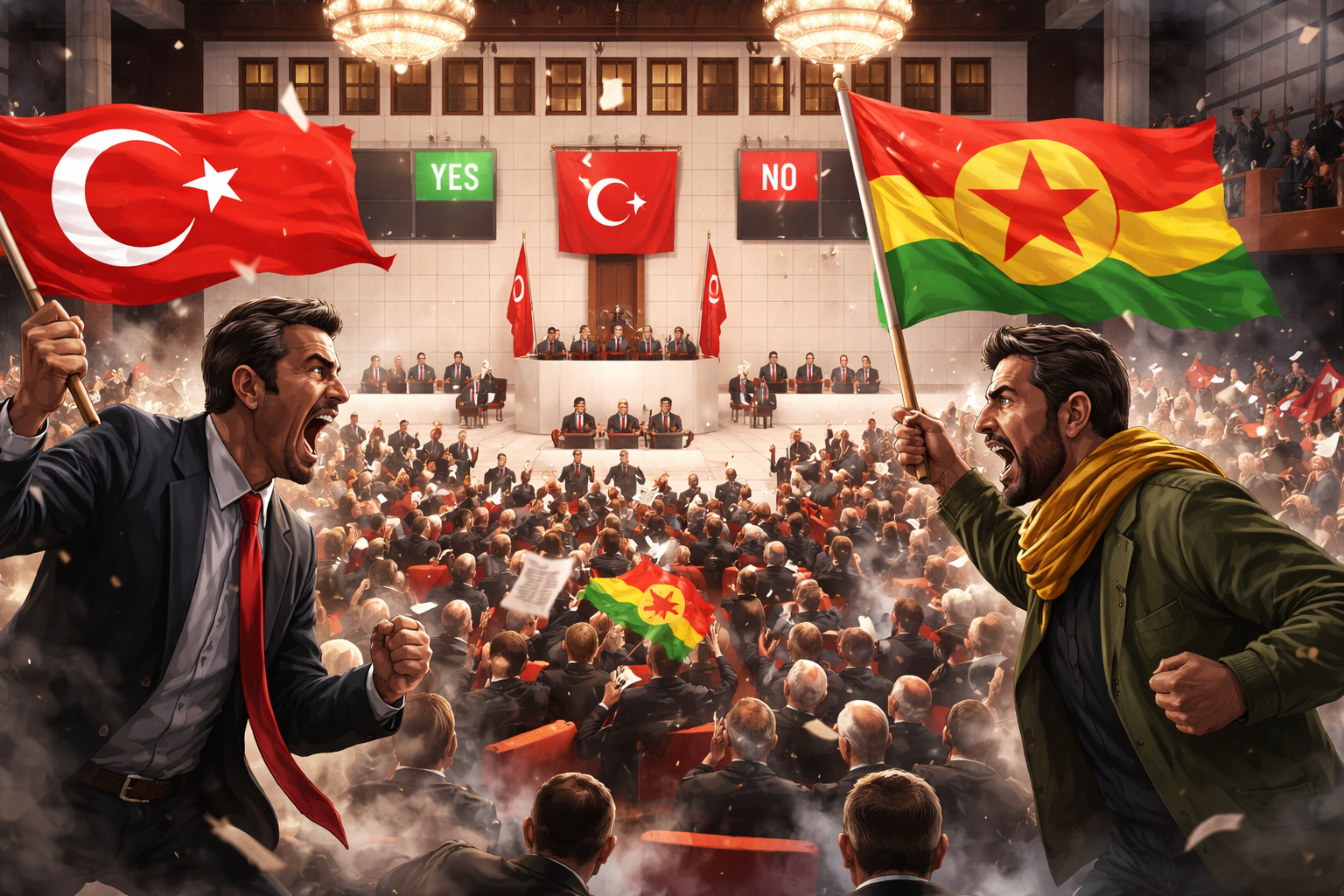
Turkey’s parliament has approved a controversial law designed to support the peace process with the Kurdistan Workers’ Party (PKK), a group outlawed for decades. The bill, officially known as the “Law on Strengthening National Solidarity and Social Integration,” was passed with the support of the conservative ruling party AKP, its ultranationalist ally MHP, and the pro-Kurdish Democratic Party (DEM).
The legislation provides for suspended sentences for certain PKK members contingent on the verified disbandment and disarmament of the group, signaling a significant step in Turkey’s ongoing efforts to resolve its long-standing Kurdish conflict. However, fierce opposition from ultranationalist factions and skepticism from Kurdish representatives highlight deep divisions within Turkish society and politics regarding the bill’s potential effectiveness.
Key Provisions of the PKK Law
The new law applies to convictions related to PKK membership, propaganda, financial support, or intentional backing of the organization. Prison sentences up to 15 years may be suspended for five years; longer or life sentences may see suspensions lasting ten years. Ongoing investigations related to these charges are to be put on hold. Turkish authorities must confirm that the PKK and affiliated groups have fully disbanded and surrendered their weapons before these benefits take effect.
The National Security Council, chaired by Turkey’s President Recep Tayyip Erdogan, holds the final authority to verify the disbandment. Notably, convictions dating before June 1, 2005, or those involving homicide are excluded, including the case of PKK founder Abdullah Ocalan.
Political and Social Divisions
Despite some support, the law has sparked intense debate and opposition. The ultranationalist İYİ Party has opposed the bill, criticizing it for being rushed and too conciliatory toward PKK leadership. Its delegate condemned the government’s approach toward Abdullah Ocalan, whom they label harshly, reflecting longstanding tensions.
Conversely, the MHP has shifted from previous opposition to backing the law, a change observers attribute to altered security dynamics in the region, including conflicts involving Syria, Gaza, Israel, the United States, and Iran, all influencing Kurdish populations and Turkey’s strategic considerations.
Kurdish Perspective and Calls for Further Reform
The PKK and its affiliated groups regard the law only as an initial step, emphasizing the need for broader democratization reforms. They insist that an effective peace process requires Abdullah Ocalan’s ability to participate freely in negotiations. Kurdish politicians and activists highlight ongoing restrictions on pro-Kurdish political activity in Turkey, underlining that many remain imprisoned or barred from office despite the peace efforts.
Concerns About Erdogan’s Role and the Peace Process
Experts express concerns over President Erdogan’s central control of the peace process, given his chairmanship of the National Security Council and past lessons from failed negotiations. Political scientist Berk Esen notes the lack of concrete democratization measures alongside a simultaneous increase in pressure on opposition parties, especially the main opposition CHP.
Reha Ruhavioglu, director of the Kurdish Studies Center, suggests that Erdogan’s cautious approach could lead to gradual implementation of sentence suspensions and political integration for former PKK members, largely influenced by public opinion ahead of the 2028 elections.