
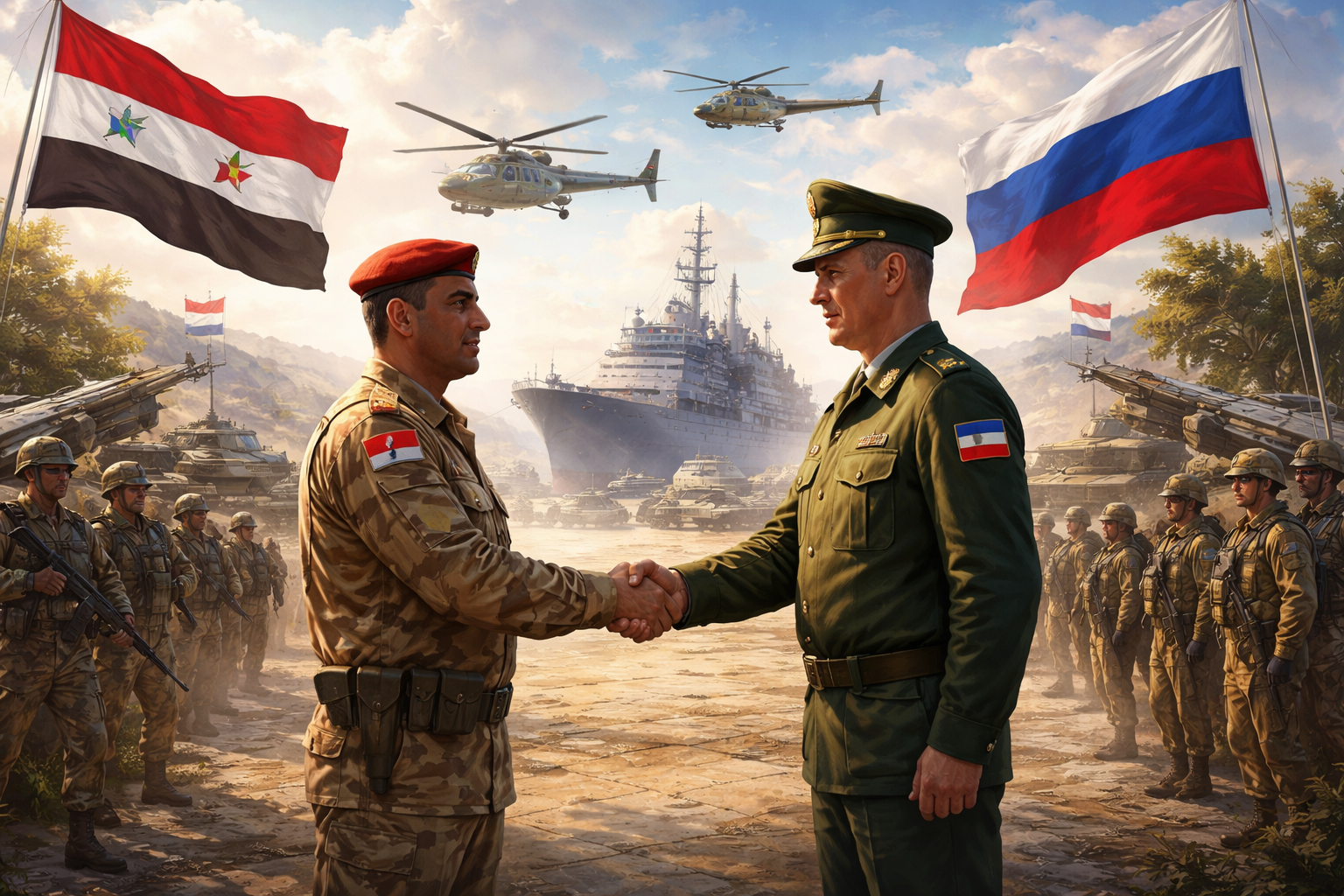
Syria and Russia have reached an agreement regarding the future of Russian military bases on Syria’s Mediterranean coast. This development was announced by Syria’s Foreign Ministry, which confirmed the signing of a Memorandum of Understanding following an 18-month negotiation period.
The arrangement marks a significant shift as Russia will no longer maintain military outposts in Syria, a country where it played a key supporting role during the civil war that lasted from 2011 until 2024.
Transfer of Base Management and New Roles
The agreement specifies that Syria will assume control of the Hmeimim airport and the commercial berth at Tartus port. According to the state media citing the Syrian Foreign Ministry, these sites will be transformed into joint centers for training and capacity-building.
The transition is planned to integrate the facilities progressively into Syria’s civilian administration and is expected to be finalized within three months. The arrangement is designed to safeguard mutual interests, as emphasized by official Syrian statements.
Context of the Agreement and Regional Dynamics
During Syria’s civil war, Russia was the principal ally and military supporter of former leader Bashar Assad. Assad’s overthrow in December 2024 led to significant shifts in Syria’s political landscape and Russia’s influence in the region.
The new Syrian leader, Ahmad al-Sharaa, who headed a coalition of Islamist rebel groups opposed to Assad during the war, has sought to enhance relations with Russia. Since assuming power in January 2025, al-Sharaa has met with Russian President Vladimir Putin twice in Moscow.
Putin acknowledged progress in restoring interstate relations during their most recent meeting, although Russia has not publicly commented on the recent agreement concerning its military bases.
Implications for Russia and Syria
The agreement comes as Syria demands Russia extradite the deposed Assad, who currently resides in exile in Moscow. Russia’s efforts to maintain favorable ties with Syria’s new government reflect its interests in preserving influence at its key military facilities outside the former Soviet Union.
The shift also highlights broader geopolitical realignments in the region following Assad’s removal and the conclusion of the protracted conflict.