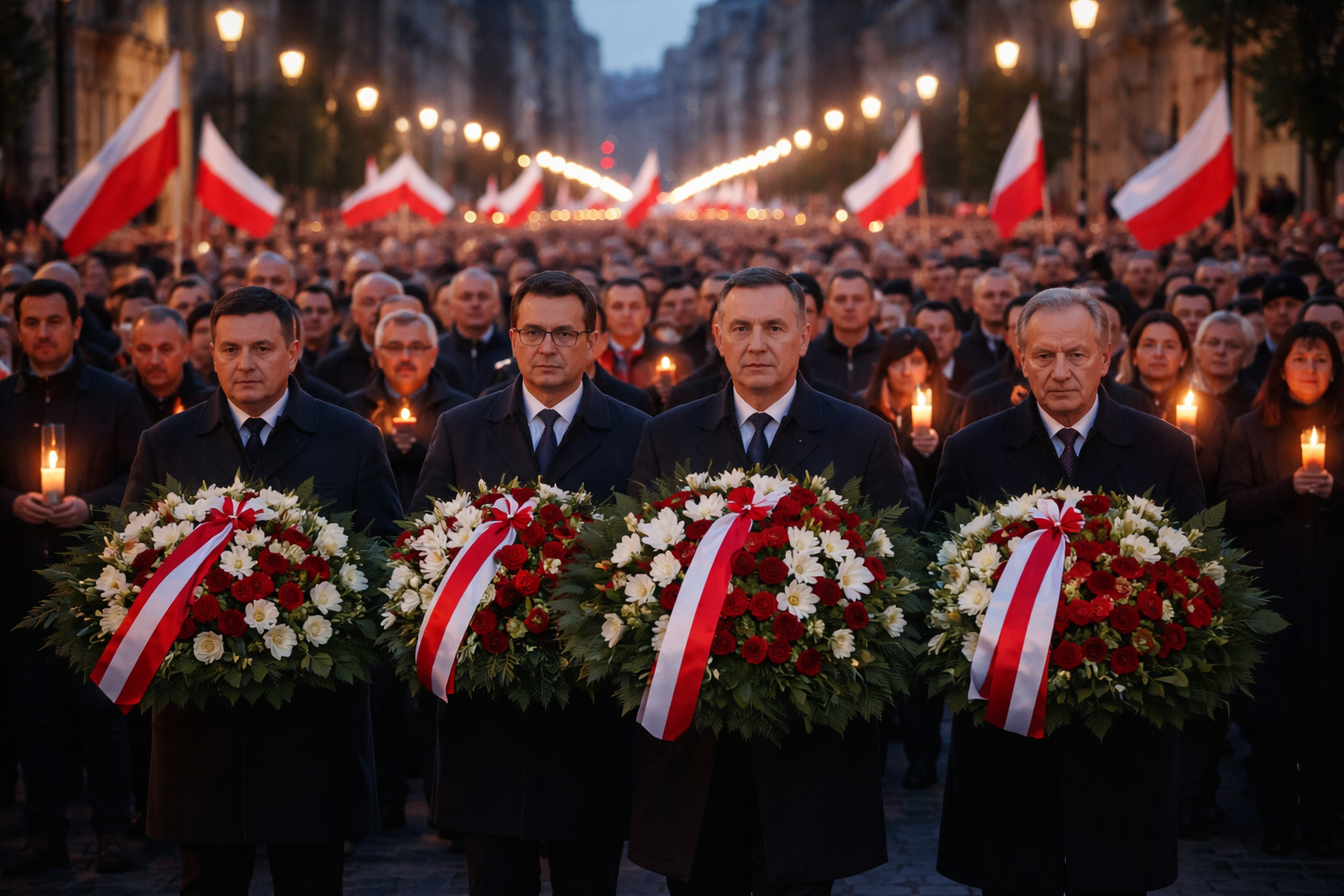
In a rare display of national unity, thousands of people joined a silent march through central Krakow on Monday night to honor those killed and injured during a violent shooting over the weekend. The march, led by Poland’s president and prime minister—who are known political rivals—traversed the historic Market Square where a bugler played solemnly from the tower as attendees carried flowers and candles to mark each spot where victims fell.
The attack, described as Poland’s deadliest in recent times, has deeply unsettled the country, which has long been proud of its reputation for safety. Despite the tragedy, businesses around the market are slowly reopening, though the atmosphere remains subdued with visible damage and memorials serving as reminders of the event.
Details of the Shooting and Perpetrator
The alleged gunman has been identified as 24-year-old Michal Oksinski. Critically wounded in a police shootout, he died in the hospital early Monday without regaining consciousness. Initial statements by the interior minister suggested Oksinski was motivated by far-right extremist views, but the national prosecutor’s office has since indicated it is too early to confirm any ideological inspiration.
Experts warn that political figures may have prematurely politicized the incident. Dr. Pawel Musialek of Jagiellonian University noted there is no clear evidence of strong ideological motives, proposing instead that the attack may have origins in more obscure internet subcultures.
Investigation and Official Responses
Authorities discovered the bodies of Oksinski’s parents and sister at his home, where it is alleged he shot them before traveling roughly 125 miles south to Krakow to carry out the public attack. Investigators have also seized electronic devices and military-style badges from Oksinski’s residence. Among items found was a yellow Gadsden flag, a symbol associated with freedom and rebellion, which officials stressed does not necessarily imply negative connotations.
Legal firearms and hundreds of rounds of ammunition were recovered from Oksinski’s car, which he used during the rampage. Both he and his father were members of a local shooting sports club that reportedly focuses on fixed-target shooting rather than combat training. Growing gun ownership in Poland, heightened by the war in nearby Ukraine, has brought increased scrutiny on gun licensing procedures, including psychological evaluations, all of which Oksinski had passed. Following the attack, the government announced an urgent review of these processes.
Community Impact and Ongoing Questions
The quiet memorials at the shooting sites, including a tribute to police officers wounded during the confrontation, reflect a community grappling with shock and grief. Residents expressed a mix of fear and sadness, with some noting that such violence was previously unthinkable in their city.
Many are left mourning lives lost, including a Polish painter and mother of four, along with other victims whose identities have not yet been publicly disclosed. Survivors and witnesses recount a terrifying scene that began with misinterpreted rifle shots and ended with lasting trauma.
While some locals hope for resilience and recovery, frustration lingers over the lack of clarity concerning the shooter’s motives, as Oksinski died without providing answers. The incident has challenged Poland’s image as a safe, low-crime nation and sparked debate over political responsibility and gun control.