

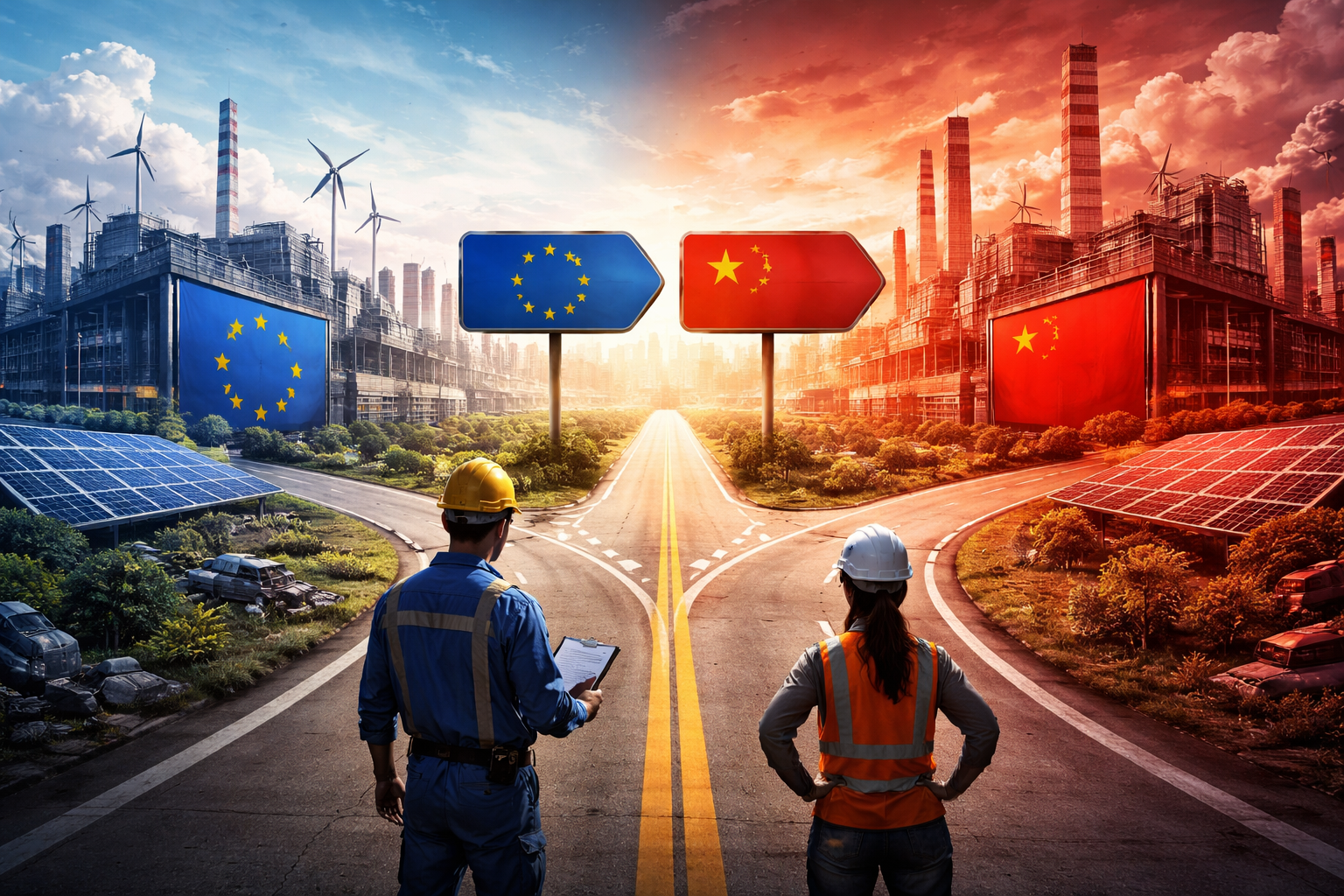
European manufacturers could concede ground to their Chinese counterparts by 2030 if current economic and trade trends persist, raising alarm over significant job losses and economic impacts across the region. The head of the European Union Chamber of Commerce in China, Jens Eskelund, cautioned that European firms face an existential dilemma, potentially having to reconsider the value and purpose of trade with China.
Eskelund, who also oversees Maersk’s Chinese operations, indicated that many European companies are shifting from a “Made in China for China” mindset toward a “Made in China for the world” philosophy. This approach involves integrating more closely with Chinese supply chains to maintain global competitiveness rather than competing head-on.
Trade Deficit and Economic Impact Raise Questions
The EU currently runs a record trade deficit with China, approximately £1 billion (€1.18 billion) daily, fueling protectionist sentiment in European capitals such as Brussels, Berlin, and Paris. Eskelund pointed to a Goldman Sachs report forecasting that Chinese exports might reduce the EU’s GDP by 0.5% and Germany’s by up to 0.9% by 2030. This imbalance prompts hard questions about the rationale behind continued trade if it delivers net negative value to Europe.
Such a scenario risks triggering widespread manufacturing decline in Europe, resulting in mass unemployment, a shrinking tax base, and escalating social welfare costs. The automotive, chemicals, and renewable energy sectors are already feeling pressure, with German automakers like BMW noting significant sales drops in China, compounded by competition from Chinese companies such as BYD, Geely, and SAIC Motor.
Strategic Shifts and Supply Chain Integration
Eskelund advised a strategic rethink in Europe, suggesting that rather than treating Chinese firms purely as competitors, European manufacturers might benefit from becoming integrated parts of Chinese supply chains. This would involve joint ventures and production partnerships aimed at serving global markets while leveraging China’s industrial ecosystem and state-backed incentives.
Highlighting the long-term focus of China’s industrial plans, Eskelund dismissed the notion of a so-called “China shock 2.0” as an unexpected disruption. Instead, he emphasized that China’s commitment to self-reliance and reducing import dependencies has been consistent since the “Made in China” strategy was introduced in 2015 and remains central to its latest five-year plan covering 2026 to 2030.
Future Outlook and Recommendations for EU Policy
China’s five-year plan targets advanced sectors including AI, quantum computing, robotics, smart green technology, biomanufacturing, brain-computer interfaces, and 6G communications, positioning the country for global dominance in these fields. Eskelund urged European industries not to retreat but to prepare for robust Chinese competition and to engage in open dialogue to find mutually beneficial trade frameworks.
He also highlighted a fundamental difference in approach: China’s results-oriented mindset versus Europe’s principle-focused policies, questioning whether Europe’s adherence to principles might be hindering effective responses to evolving global trade dynamics. Increasing exports alone will not solve the trade imbalance, he said, citing Europe’s growing surplus with the rest of the world and the challenge of competing with lower Chinese costs aided by an undervalued currency.
Ultimately, Eskelund suggested that European companies must adapt by embracing cooperation within Chinese supply chains, shifting from serving solely the Chinese domestic market toward producing in China for export worldwide. This adaptation has already contributed to increased confidence among EU Chamber members amid a saturated Chinese market.