

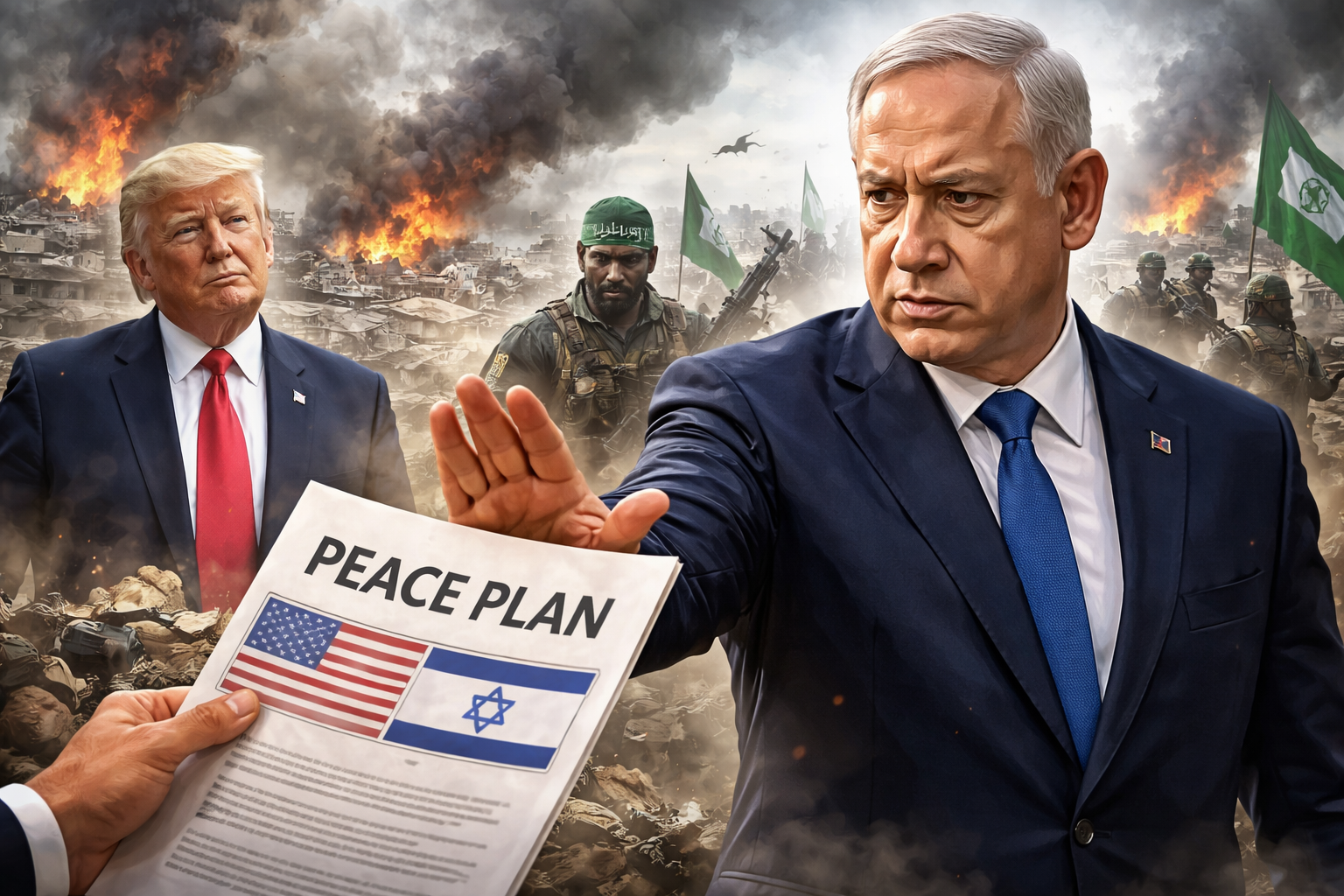
Israeli Prime Minister Benjamin Netanyahu has rejected a 15-point peace plan proposed by U.S. President Donald Trump aimed at ending the conflict in Gaza. Speaking at a Cabinet meeting, Netanyahu emphasized that Israeli forces will not withdraw from Gaza until Hamas is fully disarmed, including all heavy and light weapons, according to information released by the Israeli government.
The plan, announced last month by Trump’s Board of Peace, outlines a phased Israeli troop withdrawal contingent on Hamas surrendering its arms. It also proposes establishing an International Stabilization Force alongside a new Palestinian police force overseeing Gaza’s security. Despite rejecting the plan, Netanyahu described Trump as “our greatest friend in the White House” but indicated that Israel would only accept components of the plan aligned with its security concerns.
Key Points of the Gaza Peace Roadmap
The U.S.-backed peace roadmap requires Hamas to surrender weapons before Israeli forces begin sector-by-sector withdrawal. Hamas, which is classified as a terrorist organization by Israel, the United States, and the European Union, has avoided using the term “disarmament.” Instead, Hamas has agreed to transfer weapons to storage controlled by a U.S.-supervised Palestinian technocratic administration governing Gaza. Hamas insists that its full compliance depends on Israel withdrawing troops and halting attacks in return.
Board of Peace representative Nickolay Mladenov highlighted that Israel will have no obligations until Hamas complies with disarmament conditions, emphasizing that the plan is designed to prevent another tragic outbreak like the October 7, 2023 Hamas-led attacks on Israel. Negotiations with Israel continue, with hopes for a positive resolution.
Political Context Surrounding Netanyahu’s Stance
The rejection occurs amid politically sensitive circumstances, as Israel prepares for national elections on October 27, its first since the Hamas attacks and ensuing military operation in Gaza. Netanyahu faces electoral competition and pressure from far-right coalition members opposing concessions to Hamas.
Finance Minister Bezalel Smotrich supported Netanyahu’s firm position, stating the military objective to destroy Hamas and refusing any Israeli withdrawal, even minimally, from Gaza. This disagreement signals recent strategic differences between Netanyahu and Trump, despite their long-standing alliance, particularly over conflicts in Gaza, Lebanon, and Iran.
Current Situation in Gaza
Since the ceasefire mediated by the U.S. in October 2025, Gaza health authorities report over 1,250 Palestinians killed in Israeli operations, while Israel has lost five soldiers during the same period. Israeli forces continue to control major portions of Gaza, with over two million residents displaced into a significantly reduced coastal area, many living in temporary or damaged shelters.
Despite ongoing discussions around the peace plan, the ground realities remain tense as both sides negotiate the roadmap’s implementation amid continuing military and political challenges.