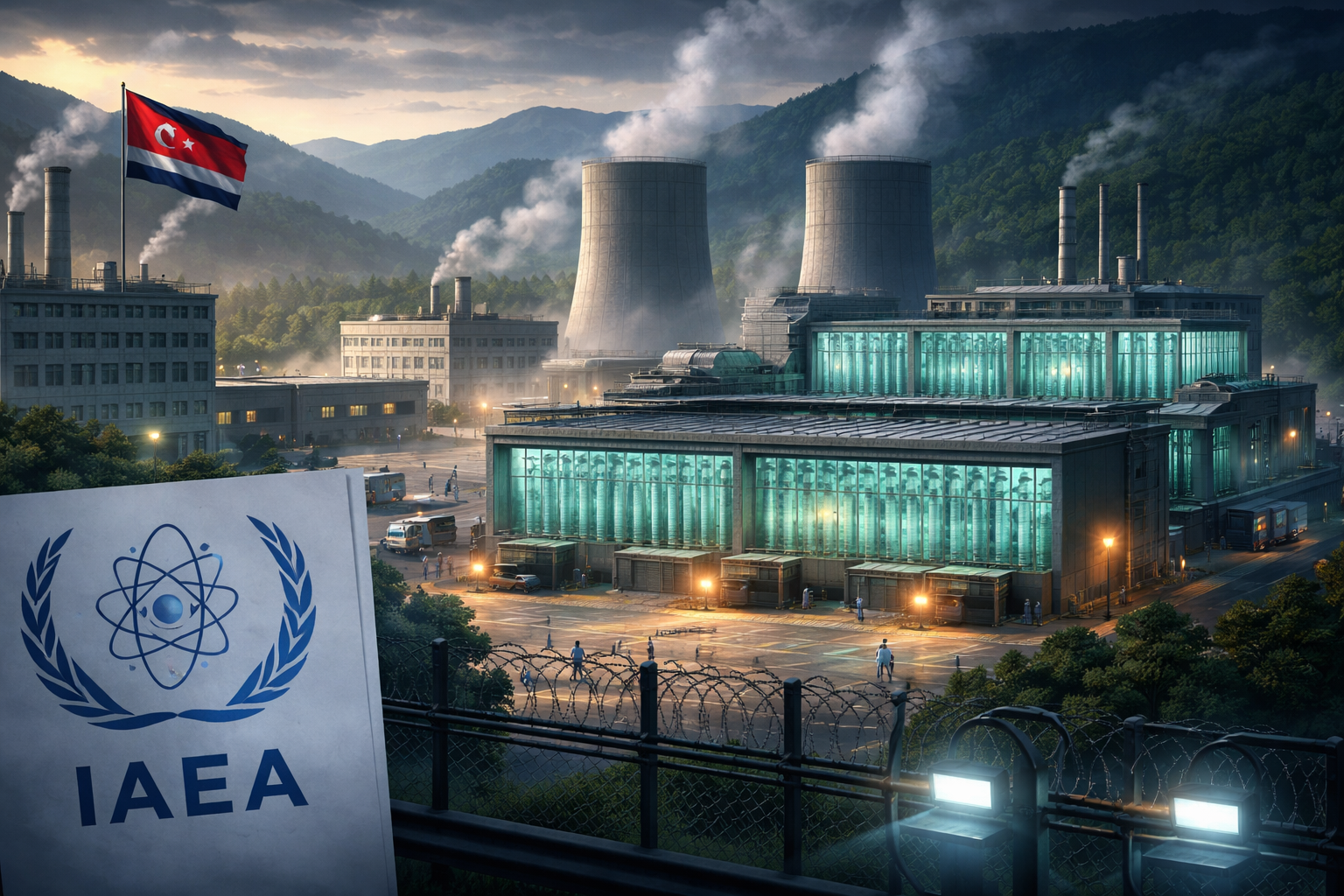
The head of the International Atomic Energy Agency (IAEA), Rafael Grossi, announced on Wednesday that North Korea has constructed an extension to its original uranium enrichment plant at the Yongbyon nuclear complex. The new addition was externally completed by late October 2026, marking a notable expansion of Pyongyang’s nuclear capabilities.
Since North Korea expelled IAEA inspectors in 2009, the agency has relied heavily on satellite imagery to observe the country’s nuclear activities. During the IAEA’s quarterly Board of Governors meeting, Grossi highlighted continued operations at the Yongbyon and Kangson facilities, the latter being closer to the North Korean capital Pyongyang, while the larger Yongbyon site lies farther north.
IAEA’s Findings and Concerns
Grossi emphasized that the expansion of North Korea’s uranium enrichment program remains a matter of serious concern for the international community. Uranium enriched in such plants can serve dual purposes: as fuel for nuclear power reactors and naval propulsion, as well as material suitable for nuclear weapons.
North Korea’s uranium enrichment activities took a more overt form in September 2024 when the country revealed its first covert enrichment plant, alongside Kim Jong Un’s call for an exponentially expanded nuclear arsenal.
Wider Context and Reactions
The developments come amid continuing tensions involving the United States and South Korea, which North Korea views as primary threats. North Korean leader Kim Jong Un has repeatedly expressed intent to build a formidable nuclear force. Commenting on recent conflicts such as strikes against Iran by the US and Israel, Kim accused Washington of “global terrorism and aggression,” reinforcing North Korea’s stance that its nuclear program is essential for self-defense.
In parallel, North Korean state media have remained silent on diplomatic engagements, only releasing images of Kim visiting domestic locations. Meanwhile, the potential for direct dialogue between US and North Korean leaders has been mentioned but remains uncertain.
International Responses and Outlook
The IAEA continues to monitor North Korea’s nuclear activities through satellite technology and resolutions passed at its annual conferences underscore global concern over the regime’s nuclear ambitions. Kim Yo Jong, sister of Kim Jong Un, has responded firmly, declaring North Korea’s nuclear status as “absolute” and dismissing any calls for denuclearization.
The situation underscores the ongoing challenges Iran’s conflict and related global security developments pose to nonproliferation efforts, as well as the difficulties in curbing North Korea’s nuclear expansion through sanctions and diplomatic pressure.