

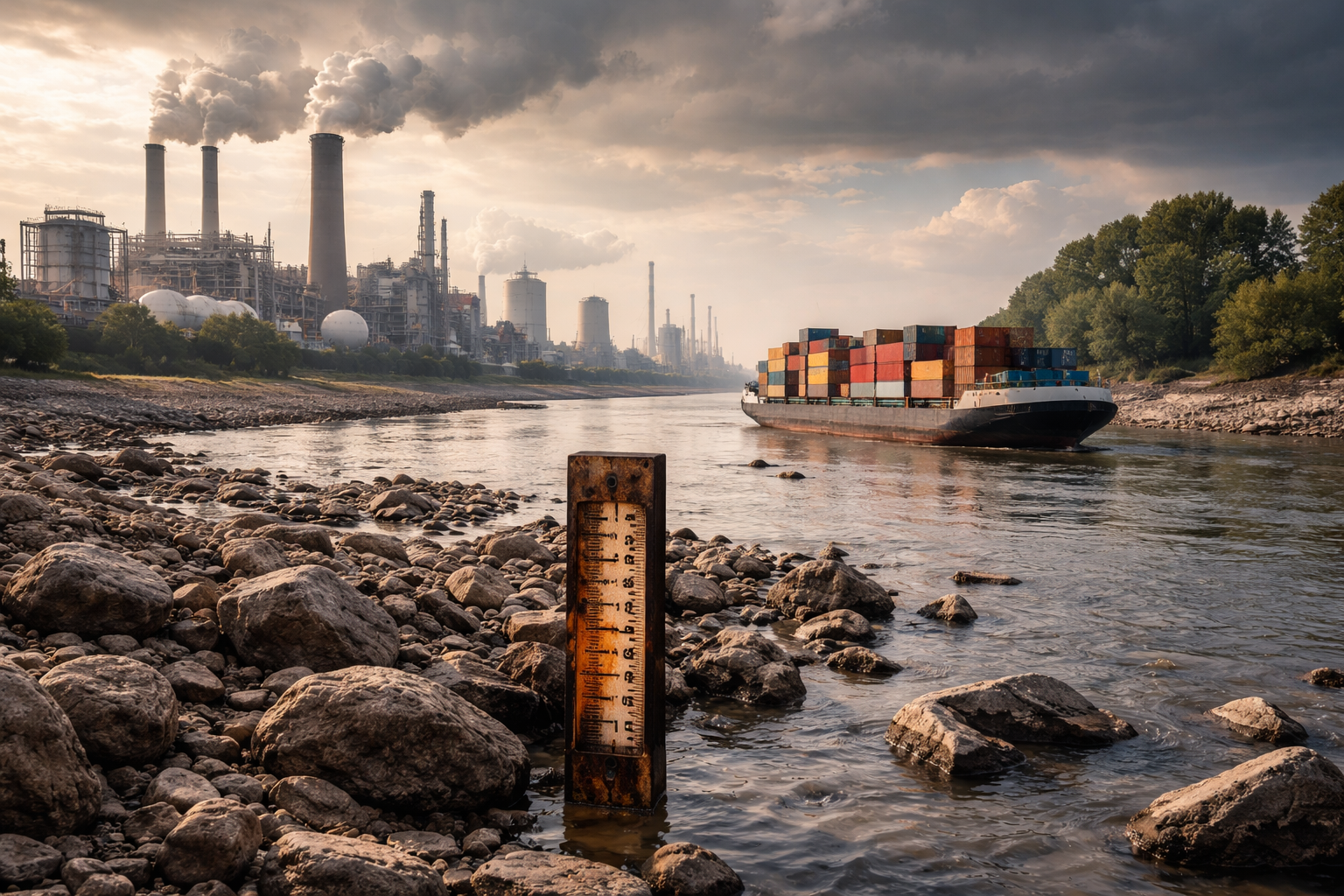
Germany faces significant industrial risks as the Rhine River hits historic low water levels, severely limiting its capacity as a crucial transport route for raw materials and goods. The German Economic Institute (IW) warns that these conditions may compel industries relying on Rhine shipping to reduce their output due to disrupted supply chains and rising transport costs.
The sustained drought and recurrent heat waves, linked in part to human-induced climate change, have led to Rhine water gauges registering unusually low depths, with the critical measurement point at Kaub dropping to 16 centimeters—far below the previous record lows. This situation constricts navigation and cargo capacity, leading to severe logistical challenges for German industries.
The Rhine’s role in European transport and the current crisis
The Rhine has served as a vital transport corridor in Western Europe since Roman times, connecting industrial zones in Germany and Switzerland to major North Sea ports like Rotterdam. While river transport accounts for roughly 10% of freight movement in Germany, it disproportionately carries bulk goods such as ore, chemicals, oil, and coal.
Currently, due to low water levels, ships can transport only about 20% of their usual cargo loads, with many vessels forced to cut capacity by as much as 80%. The narrow Middle Rhine section near Kaub is of particular concern since it acts as a chokepoint, potentially dividing the river into two segments that are difficult to navigate.
Industry impact and transportation challenges
The German Economic Institute’s transport expert, Thomas Puls, noted that if the Rhine’s navigability deteriorates further, industries dependent on timely shipments will likely react by scaling back production. This assessment is echoed by representatives such as a spokesman from chemical company Covestro, who confirmed that supply disruptions already affect their operations.
Attempts to compensate with road transport are limited. For example, one cargo vessel capacity equals roughly 60 trucks, making complete substitution impractical. Although certain temporary measures, like permitting truck traffic on Sundays, offer slight relief, they cannot replace the efficiency of river shipping.
Additional context: safety, security, and infrastructure concerns
Besides economic repercussions, the Rhine’s low water levels have not deterred endurance swims aimed at raising awareness for water safety, such as the 200-kilometer swim from Frankfurt to Cologne by athlete Nathalie Pohl. German authorities, however, officially caution against swimming in large rivers due to safety concerns.
In related news, Germany is confronting emerging hybrid security threats highlighted by recent drone incidents, prompting proposals to expand intelligence agencies’ oversight powers. Coupled with rising transport disruptions, these challenges underscore the complex pressures facing Germany’s infrastructure and public safety systems amid evolving environmental and geopolitical landscapes.