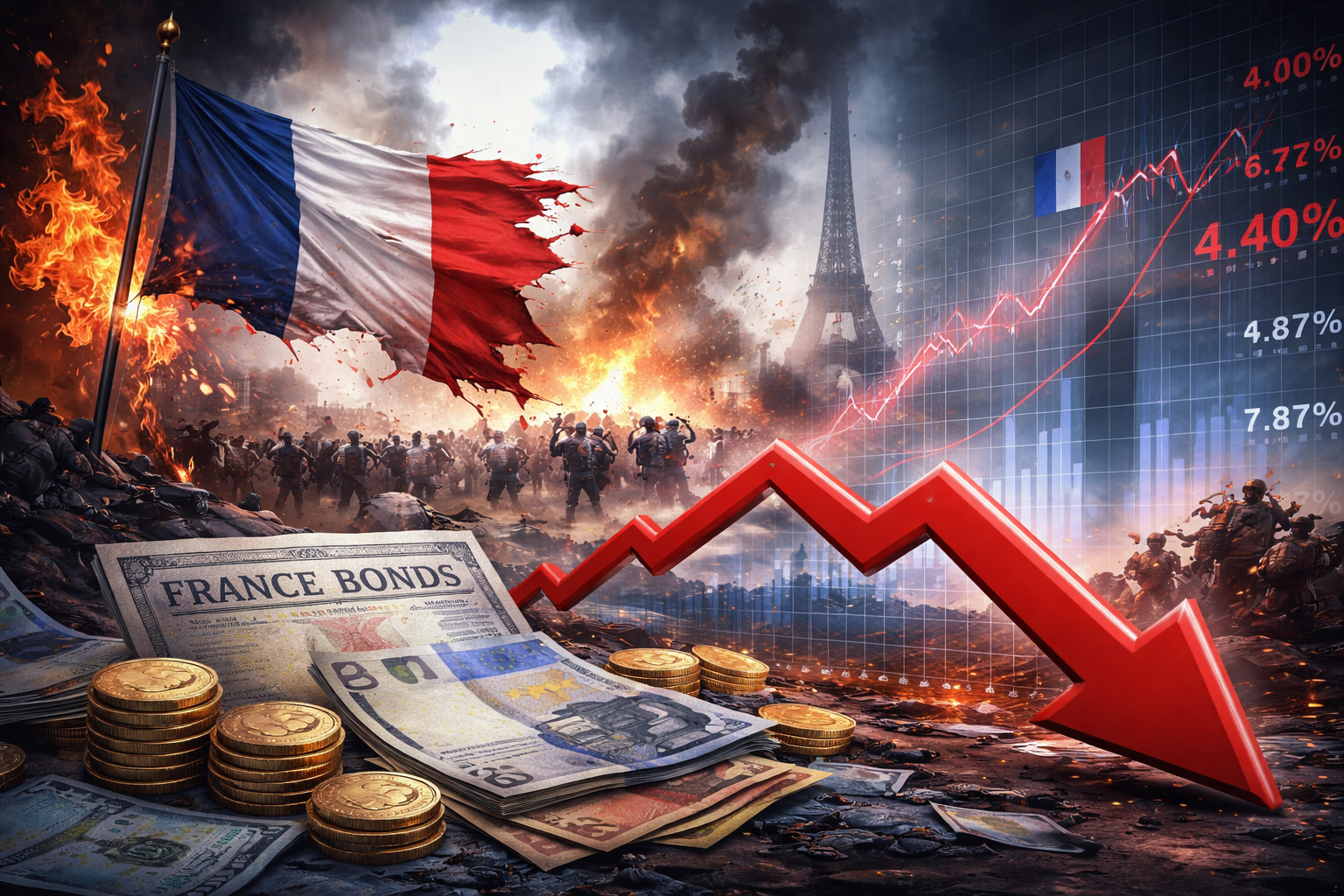
France is facing renewed financial stress as violent protests over the weekend triggered heavy selling in both bond and stock markets, unsettling investors concerned about the country’s fiscal stability. The unrest, which saw thousands arrested and damage to public and private property, has heightened worries about Paris’s capacity to maintain fiscal discipline amid social and political turmoil.
On Monday, yields on France’s 10-year government bonds rose sharply by up to 16 basis points, reaching 4.94%, close to a 24-year high. Since bond yields and prices move inversely, this signals investor retreat and rising borrowing costs for the French government. The spread between French and German 10-year borrowing costs—a key indicator of sovereign risk—also expanded to levels unseen in 14 years.
Protests Compound Fiscal Challenges Ahead of Budget Plans
The demonstrations, initially sparked by concerns over education funding and the cost of living, escalated into violent clashes across cities such as Paris, Bordeaux, Nice, and Marseille. President Emmanuel Macron criticized the “unbridled violence” in a televised address, emphasizing the seriousness of the unrest.
Financial analysts, including those at Goldman Sachs and Deutsche Bank, pointed to the protests as adding layers of political risk just as France prepares a stringent budget aimed at cutting pensions and departmental expenditures. The government faces significant resistance, raising fears that fiscal consolidation efforts could be derailed, which might further increase France’s debt burden.
Market Impact and Investor Sentiment
The turmoil triggered a sell-off across French financial markets. The CAC 40 index declined by 1.4%, with major banks like Société Générale and BNP Paribas losing more than 3%. Other European markets also weakened, reflecting heightened regional concerns.
Currency markets responded with the euro falling to a 17-month low against the British pound (€1.188) and easing against the U.S. dollar to around $1.1197. The 30-year French bond yield rose to 5.46%, signaling increased long-term borrowing costs amid growing fiscal concerns.
Broader Implications for France and Europe
With France’s debt-to-GDP ratio projected at 115.6% for 2025 and a budget deficit of 5.1%, the country faces significantly greater fiscal pressures than some other European nations like the UK. Saxo Bank’s investor strategist Neil Wilson highlighted how the protests expose the difficulty of implementing the necessary austerity measures to reduce the deficit.
Goldman Sachs warned that although the risk of disorderly market turmoil appears lower than during the eurozone debt crisis of 2011-15, the fundamental fiscal challenges for countries like France are more acute today. This intensifies the unresolved issue of credible fiscal consolidation measures within the eurozone, essential to maintain investor confidence and economic stability.