

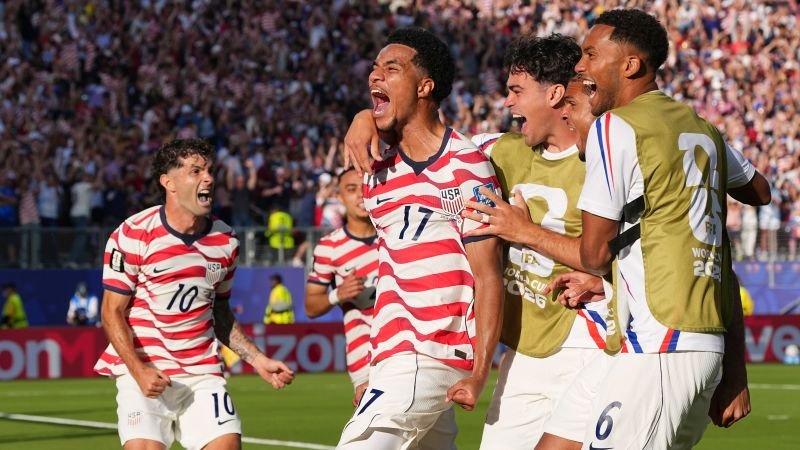
The biggest American men’s soccer victory in a generation came at a high cost. But the price the USA paid at Levi’s Stadium to earn a 2-0 victory over Bosnia and Herzegovina in the World Cup’s Round of 32 made one thing very clear.
This team is different. Very different.
Leading 1-0 on a first-half goal from Folarin Balogun, a long ball was played into the Bosnian half and the US goal scorer tussled with Bosnia defender Tarik Muharemovic for the ball. Balogun reached his right leg toward the ball and ended up swiping his cleat down Muharemovic’s calf, eventually landing with a stomp on the defender’s ankle.
There wasn’t any intent to injure in the play; both men were going for the ball and Balogun was not moving like he intended to harm Muharemovic. But when slowed down in instant replay – as it was seen by referee Raphael Claus after video assistant referee flagged the play – it looked awful. The difference between the full-speed initial read – no call at all, not even a foul – and the replays served up by the VAR could not have been starker.


Claus came back from the monitor and ruled Balogun deserved a red card for serious foul play, sending him off the pitch for the remainder of the game.
That very easily could have been the story of the game (and if Balogun is dearly missed in the next match against Belgium, it will be examined again and again). But the most shocking moment in the match was still to come – and it’s something that American fans can latch onto as they continue to daydream about a deep run in this tournament.
Faced with playing a man down for 35 minutes against a determined opponent that could suddenly send wave after wave of attacks at their net, the USA … didn’t fold.
Instead, led by midfield star Weston McKennie, the whirl of motion that was Christian Pulisic and the inspired play of Malik Tillman – not to mention the suddenly stout defending from the American back line – the United States did what good teams do: They weathered the storm, stayed under control, picked their moments, struck when they had an opportunity and saw out the game.

It’s a level of cool, calm and collected that Americans are not used to seeing from their men’s soccer team. It’s a level that some teams never reach – just ask the Italians sitting at home because they could not stop Bosnia and Herzegovina from scoring after a red card in the World Cup qualifier, a loss that kept the Azzuri home watching this tournament.
That mentality is something expected of, and achieved by, the world’s best teams. It might be a signal that the USA is moving toward joining that club.
“It’s a proud moment and it’s a moment that we can gain a lot of confidence from, that we’ve kept two clean sheets in the last four games,” defender Chris Richards said post-match. “I think before then we didn’t quite have the best record when it came to clean sheets.”
From the solid defending that came after that ejection to Tillman’s brilliant free-kick goal in the 82nd minute, the USA displayed a professionalism and maturity that other US teams have struggled to show on the biggest stages. Memories of World Cup collapses long past – the two goals in extra time scored by Belgium in 2014, Asamoah Gyan’s goal in extra time that eliminated the USA in 2010, being cut into ribbons by the Dutch four years ago – crept up in the minds of American fans after Balogun was sent off.

In pictures: USA defeats Bosnia and Herzegovina in World Cup knockout match
What fresh hell awaited the 2026 team? When would the moment come that shattered American dreams in the knockout round again? Now that they were outnumbered, when would they be outscored?
The Bosnians prepared to put the US under siege. They put as many attackers as they could onto the pitch. They intended to turn up the pressure higher and higher until the Americans broke and allowed the critical goal.
And then the person who scored the all-important second goal of the match had a German accent, not Bosnian.
Tillman – born in Germany to an American father and German mother – stepped up after Sergiño Dest was fouled by Stjepan Radeljic just outside the Bosnia box. Winning the free kick itself served as a pressure release valve, allowing the USA some time to breathe without being backed up against their own goal. But it was also in a dangerous position.
Tillman took a short run-up and curled his right-footed shot over the Bosnian wall, off the glove of keeper Nikola Vasilj and into the net. He wheeled away toward the stands, his team rushing toward him as the crowd went bonkers. It was a golden moment, born of steel and skill.

American men’s soccer has always had plenty of the former. The latter comes and goes. They combined for one of the biggest results in the country’s history on Wednesday night in the Bay Area.
“For me, I’m a different type of person on the pitch. … You don’t really see my emotions, but then if you score a goal like this, I mean, I think also you guys saw my emotions then,” Tillman told reporters after the game.
“It’s a great feeling and, of course, a proud moment for me.”
It’s fairly rare for a 10-man team to pad a lead, even more rare for it to do so in a World Cup knockout match when caution is the name of the game.
But this team appears to have taken on the personality of its manager and Mauricio Pochettino’s best squads have always been known for their fearlessness, their willingness to fly forward in attack and defend doggedly until the final whistle blows. Pochettino’s teams run and run and run, until their opponents tire and are vulnerable.

That mentality is what the Argentine will need to spend the next few days instilling in his team because the task they face against Belgium got a lot harder when Balogun saw red.
The Red Devils are not the same team that they were in 2014 when they knocked the USA out in the Round of 16. They’re far from the team that finished third in this tournament in 2018 or went to the quarterfinals of the European Championships in 2016 and 2020.
That golden generation of players is largely gone, with just Romelu Lukaku and Kevin De Bruyne still hanging around. For the first two games of this World Cup, it seemed like the sun had truly set on Belgium’s best years after dire draws with Egypt and Iran.
But a 5-1 thrashing of New Zealand woke them up and an incredible late comeback against Senegal on Wednesday, fighting back from a 2-0 deficit with two goals in the final five minutes and then an extra time penalty winner, made it clear that Belgium is no pushover.
Add to that the fact that the USA will now be playing without their top forward, the man at the center of most of their goals in this tournament, and suddenly the US feels like they’re back in a familiar position: the underdog.
Without their star striker, Pochettino could turn to Ricardo Pepi, who combined well with Pulisic before the tournament, or Haji Wright, who scored the US’ only goal in the loss to the Dutch four years ago. Or the Argentine could do something no one expects and totally change his formation for the Round of 16 tilt.
One thing is clear: The Americans proved on Wednesday that they have the mentality to make a run in this tournament. Bosnia and Herzegovina might not have been the most talented team and may not be a nation with an intense soccer pedigree, but they were handed a scarlet-tinged opportunity to force the USA into the kind of humiliating collapse Americans are used to seeing when the lights shine brightest in the World Cup.
But this team? This team is different.