
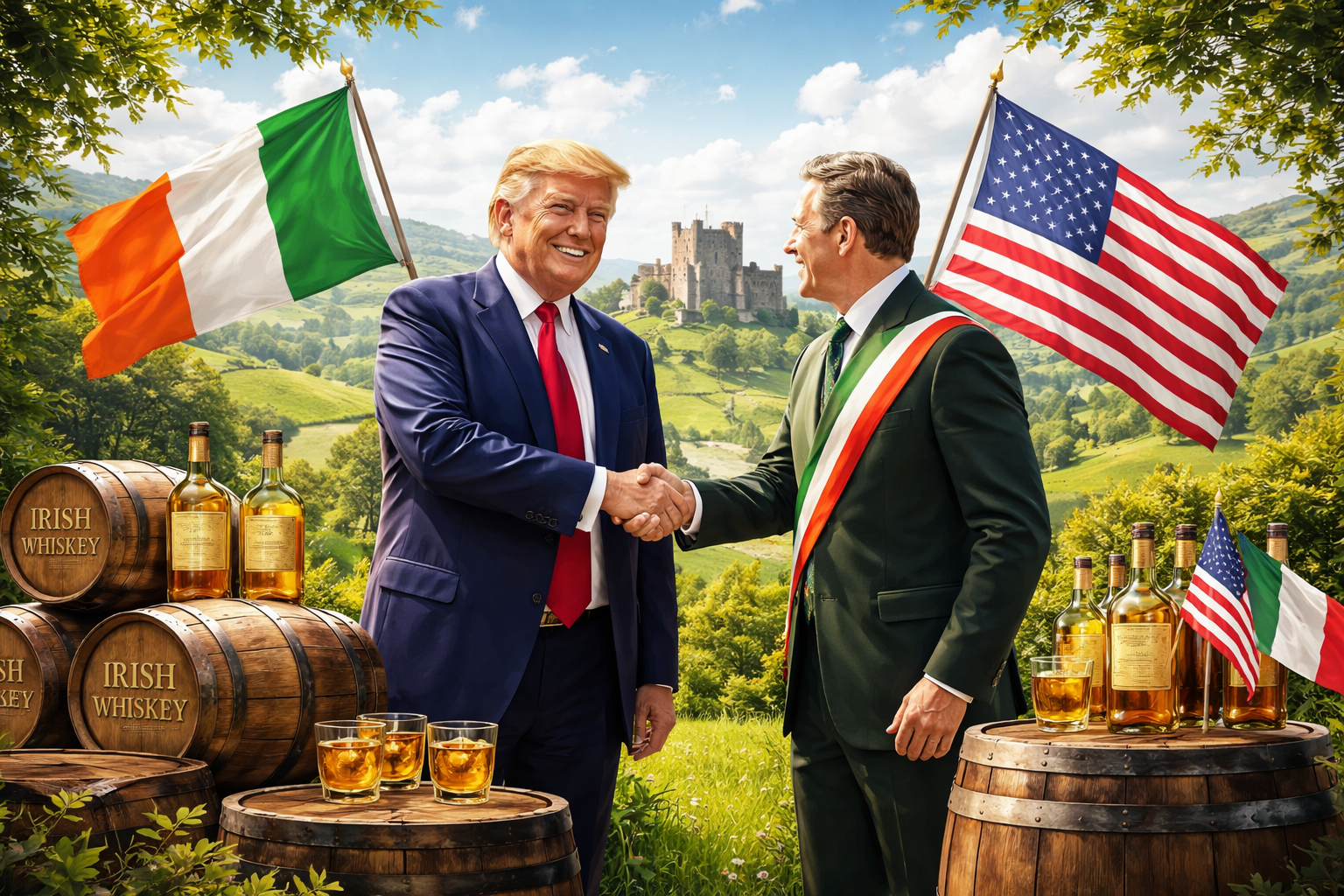
During a visit to Ireland, Donald Trump reiterated his support for a united Ireland, despite opposition from UK officials. He also announced plans to remove tariffs on Irish whiskey, which have been impacting the industry due to prior White House trade measures.
Trump expressed confidence that unification of Northern Ireland and the Republic of Ireland is a natural step, brushing off objections from UK communities secretary Andy Burnham who has opposed a referendum. Trump said, “Everybody says that. Then things happen,” referring to the British reaction.
Tariff Removal for Irish Whiskey
At his Doonbeg golf resort in County Clare, Trump concluded his visit by presenting the Irish Open trophy and declaring he would eliminate the 10% tariff on Irish whiskey. This tariff was part of broader White House restrictions on European Union imports and placed Irish whiskey at a competitive disadvantage compared to Scotch and Northern Irish whiskey, which face no tariffs.
Trump cited frequent requests to change the policy, announcing, “On behalf of the United States of America, I’m going to take the tariffs off Irish whiskey.” Some attendees responded enthusiastically, chanting his name and “USA.”
Reactions to Trump’s Remarks on Irish Unification
Trump’s support for Irish unity challenged longstanding U.S. neutrality over Northern Ireland’s constitutional status and stirred reactions on both sides of the Irish Sea. While Irish nationalists welcomed his comments, unionist leaders and the UK Conservative party criticized them. Ian Paisley Jr., a former Democratic Unionist party MP, emphasized the desire of many in Northern Ireland to remain British, saying, “Everyone is allowed a personal opinion even when it’s wrong.”
The UK government maintained its commitment to the 1998 Good Friday Agreement and Burnham continued to assert that a referendum on unification is not currently justified because the necessary support is lacking. Burnham had previously described such a referendum as “off the table.” Angela Rayner, the UK communities secretary, downplayed Trump’s statements, noting, “Donald Trump is Donald Trump, and the president will say and speak his mind as he sees it.” She affirmed that the UK government intended to continue following the peace agreement.
Irish Government and Sinn Féin Responses
The Irish government appeared cautious, preferring to focus on cross-border cooperation rather than outright calls for unification. Taoiseach Micheál Martin said there had been an “overreaction” to Trump’s remarks and described the president’s perspective as unique. Martin stated, “If everyone keeps a calm perspective on things, you know, we will take it from there.”
Sinn Féin figures welcomed Trump’s backing, highlighting it as reflecting broad North American and diaspora support for Irish reunification. Former party leader Gerry Adams criticized previous Irish governments for being “incredibly shortsighted” in planning for unification.
Trump on Scottish Independence and Next Steps
When questioned about Scottish independence, Trump refrained from taking a position, stating, “I won’t talk about Scotland yet, I will save that.” Meanwhile, leaders of Plaid Cymru, the Scottish National Party, and Sinn Féin were scheduled to meet in Cardiff to discuss strengthening cooperation on constitutional change.