
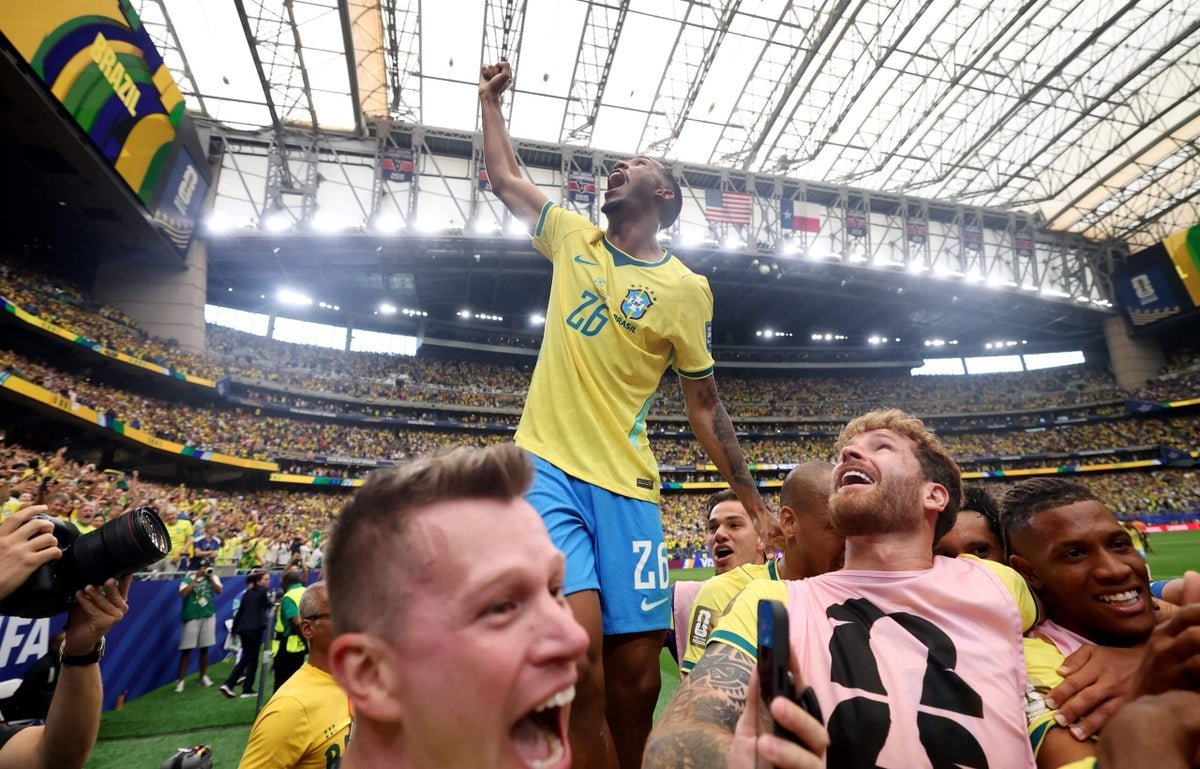
Brazil breathes again.
The five-time World Cup winners were in danger of slumping to a historic low in the tournament they have dominated more than any other nation after going behind to Japan in Houston.
Carlo Ancelotti’s side were insipid in the first half but an inspired comeback — capped by goals from Casemiro and a last-gasp winner from Gabriel Martinelli — sealed a dramatic 2-1 victory and a place in the last 16, where they will face Norway or Ivory Coast.

Here, The Athletic’s experts analyse the major talking points.
How big could this be for Brazil?
The margin looked tight, but Brazil more than deserved to beat Japan and progress to the last 16.
Had Brazil gone out, it would arguably have been their worst performance at a World Cup — if not their most traumatic, with the 2014 semi-final in mind — since 1966, in terms of progress into the tournament. That was the last time they exited at the group stage of a World Cup: there were only 16 teams at that tournament, so while it’s tricky to compare that tournament with this, not reaching the last 16 here would have been a significant blow.
It would have made the gamble they took in appointing a non-Brazilian, Carlo Ancelotti, seem not worthwhile: they traded their traditions… for this?
As it is, they’re through, and this game provided a reason why they brought in Ancelotti, after a chaotic string of domestic coaches couldn’t make sense of this team.
The pressure on any Brazil team, or coach, is always astonishing. But, as ever, Ancelotti was the coolest head in Houston.
Can this team win the whole thing? Before the game, Ancelotti said there’s no outstanding favourite: of course, he’s right, again.
Nick Miller
How did Martinelli step up?
Gabriel Martinelli has grown into a man for big moments at Arsenal, and has now transferred that skill to world football’s biggest stage.
Over the years in north London, he has scored crucial late winners and equalisers and Manchester City, Liverpool, Chelsea and more. His only Premier League goal last season, against Manchester City, proved pivotal as it earned Arsenal a point at a moment that could have made their hunt for a title even tougher.
Now in North America, the most interesting aspect of Martinelli’s cameo was his positioning. From the moment Carlo Ancelotti called upon the 25-year-old, he was perched more centrally than he usually is for Arsenal.
It seemed like, with Brazil throwing crosses into the box, he could be well positioned to apply a finishing touch at some point. For him to be on hand in a central position late in added time would not have been a surprise to the Brazil head coach but not an unwelcome one.

Gabriel Martinelli scores a dramatic winner (Molly Darlington/Getty Images)
Brazil may not have convinced in the first half, but their reaction after the break and Martinelli’s positioning proved vital to avoid an upset.
Art de Roche
How did Suzuki and Japan keep out Vinicius Jr?
Japan were excellent across the pitch in the first half, but one of their primary aims going into their last-32 clash will have been to stop Vinicius Jr, as Brazil’s main attacking threat.
The 25-year-old had bagged four goals in his opening three games, but Brazil’s No 7 was frustrated by Japan before the interval as his side struggled to break down an incredibly disciplined 5-4-1 shape.
Stationing himself between Ritsu Doan (right wing-back) and Takehiro Tomiyasu (right centre-back) in the opening 45 minutes, Vinicius was unable to get on the ball in a dangerous area — often looking to get on the end of threaded balls in behind as opposed to receiving the ball out wide and driving forward.
Given Brazil rarely put five players on Japan’s back line to match up their players, Doan and Tomiyasu were able to take it in turns to jump forward and close down Vinicius whenever he did look to threaten. With space at a premium, this forced a frustrated Vinicius Jr to occasionally come deeper and more centrally to get himself onto the game — albeit from a far less threatening position on the pitch.

With the game opening up in the second half after Ancelotti’s tactical tweak, Vinicius began to enjoy himself — taking up more of a traditional role in the wide channel to run at Doan from the touchline.
The highlight was an incredible run that nutmegged Tomiyasu and turned Kaishu Sano inside out, before poking a finish towards the far post that was superbly saved by Zion Suzuki — who got a thumb to the ball to tip it onto the post.


Competing in his first World Cup for Japan, Suzuki has had an excellent summer as he returned to play in the country of his birth — having been born in New Jersey to a Ghanaian father and Japanese mother. He got a hand on Gabriel Martinelli’s effort in the dying stages, but was unable to keep it out as Brazil’s comeback was complete.
Vinicius’s battles with Japan’s defenders and goalkeeper did not relent throughout the game, but the Brazilian’s persistence paid off after a frustrating first half.
Mark Carey
How did Japan overpower Brazil in the first half?
If there was one moment that encapsulated the difference between Brazil and Japan in the first half, it was the one-minute period that led to Kaishu Sano’s opener.
Where Brazil’s midfield looked leggy, with a 34-year-old Casemiro seemingly caught in time while chasing the goalscorer, Japan’s bravery and fitness is what created the moment for them. Casemiro’s early booking for a foul just outside the Brazil box may have played a part in his reluctance to bring Sano down, but this is not the first time he has failed to track an onrushing opposition midfielder in recent years.
Most of the attention will go to Sano intercepting a loose pass from Danilo and bursting past Casemiro as if he wasn’t there (below), but the traps Japan set moments before deserve credit.

Just a minute before Sano scored, Brazil goalkeeper Alisson was on the ball looking for passing options. Not just Japan’s front three, but the bank of four behind them also chose the right moment to press high, forcing Brazil to go long.
Even though Japan did not keep the ball after Brazil punted forward, the chaos that came from that moment left the game more open than it previously was, and Sano was positioned perfectly to take advantage.
Sano’s running power against Casemiro should not come as a surprise either, as he ranked third in the Bundesliga for distance covered last season, with 401.1km.
From a Brazilian perspective, age always looked like it could hinder them this summer. Gabriel Magalhaes was their youngest starting defender against Japan (28) alongside Danilo (34), Marquinhos (32) and Douglas Santos (32).
But what Casemiro lacked in legs, he certainly made up for with his head. The Manchester United midfielder scored more headers than any Premier League player last season (eight — Virgil van Dijk was next highest with five) and was perfectly positioned at the back post for Gabriel’s cross. Brazil could miss him in the last 16 if the injury that forced him off towards the end of this tie proves serious.
Art de Roche
What did Ancelotti do to turn it around?
There has been a significant clamour for Endrick to be in this Brazil team since the start of the World Cup, but it felt like a pretty big gamble for Carlo Ancelotti to bring him on in place of the injured Lucas Paqueta at half-time.
Brazil had been overrun in midfield at times in the opening 45 minutes, as Art de Roche has outlined above, so introducing a forward for a midfielder and to effectively go to a 4-2-4 system could have been asking for trouble. Instead, it proved an inspired move.
Brazil’s two wingers, Vinicius Jnr and Rayan, hugged the touchline, and even though their instinct with the ball was to drive infield, this stretched the play, made Japan’s relentless press less effective and created more crossing opportunities.
They came within a whisker of scoring from one in one of the great goalmouth scrambles of the World Cup, then got an equaliser when one of those crosses, from the slightly unlikely source of Gabriel Magalhaes, was headed home by Casemiro.
That, combined with the electric runs and skill of Vinicius, is how Brazil got back into the game.
Nick Miller

Casemiro heads in Brazil’s equaliser (Molly Darlington/Getty Images)
Who will Brazil play next?

Brazil will face Norway or Ivory Coast in the last 16 in New York New Jersey on July 5 (4pm ET).